A 'barrage' of rockets has been fired into northern Israel from Lebanon overnight, according to the Israeli army, as Hezbollah targeted industrial and military sites.
Most of the 105 rockets were intercepted, though some homes were hit. Air raid sirens sounded throughout the night, the Israel Defense Forces said.
Hezbollah said it had fired dozens of rockets towards targets in northern Israel in retaliation for last week's pager and walkie-talkie attacks.
Israel has also continued attacking targets in Lebanon following Friday's air strike in Beirut which the IDF said killed a dozen senior Hezbollah commanders. Lebanon said 37 people â” including three children â” were killed
Video posted online overnight, so far unverified by the BBC, appears to show a fire in a residential area near Haifa after it was hit by a Hezbollah rocket.
On Saturday, dozens of fighter jets started 'extensively' striking southern Lebanon 'following detection of Hezbollah preparing to fire toward Israeli territory', Israel Defense Forces (IDF) spokesman Rear Adm Daniel Hagari said.
Before the evening Israeli strikes began, the IDF said earlier it had destroyed 'about 180 sites and thousands of [rocket] launcher barrels' with strikes
Earlier this week, 39 people were killed and thousands wounded after pagers and walkie-talkies used by Hezbollah, the Iranian-backed militia and political group, exploded on two days across Lebanon.
On Thursday, Hezbollah leader Hassan Nasrallah blamed Israel for the attacks, saying it had crossed 'all red lines' and vowed 'just punishment'.
Israel has not claimed responsibility.
UN human rights chief Volker Türk said the pager and walkie-talkie explosions violated international humanitarian law.
On Sunday morning, the IDF announced an expansion of new restrictions on communities in northern Israel and parts of the southern Golan Heights that had come into effect at 20:30 local time (17:30 GMT) the night before.
The IDF's Home Front Command limited gatherings to 10 participants in an open area and 100 participants in a closed space. Educational activities can continue and arrival to work is permitted as long as there are protected spaces available.
The restrictions apply to the Haifa area and northward.
As fears increase that the conflict may break out into a full-scale war, the US State Department issued new travel advice for citizens currently in Lebanon.
The US Embassy in Beirut has urged people to 'depart Lebanon while commercial options still remain available', noting they were already running at 'reduced capacity'.
The embassy added it 'may not be able to assist US citizens who choose to remain'.
Neighbouring Jordan's foreign ministry issued similar advice to its citizens, urging those in Lebanon to leave as soon as possible.
Cross-border fighting between Israel and Hezbollah escalated on 8 October 2023 â” the day after the attack on Israel by Hamas gunmen from Gaza â” when Hezbollah fired at Israeli positions in solidarity with the Palestinians.
Israel recently added the return of people displaced from the north of the country due to the cross-border fighting to its list of war goals.
Defence Minister Yoav Gallant said on Thursday that Israel was entering a 'new phase of the war' concentrating more of its efforts in the north.
Somalia's move to invite Egyptian troops on its soil is playing out in differences between Mogadishu and its federal states, in what could derail the country's focus on security needs.
On Wednesday, hundreds of people in Waajid, the second major town in Bakol region in South West State (SWS) of Somalia protested along the streets, carrying placards with such slogans as 'doonimayno Masar' (we don't want Egypt) and 'soo dhowoow Itoobiya' (welcome Ethiopia).
The protests derailed transportation between Baidoa, the South West capital and Mogadishu as authorities sought to calm the unusual protests.
As a result, Somali Prime Minister Hamza Abdi Barre flew to Baidoa in the company of top aides including the Director of the National Intelligence and Security Agency (NISA) Abdullahi Mohamed Ali alias Sanbaloolshe.
They went to convince the SWS leader Abdiaziz Laftagareen that the federal government has plans to deploy enough forces to guarantee the security of his State in the event that Ethiopia is replaced.
As per Somalia's plan, the current African Union Transition Mission in Somalia (ATMIS) is undergoing a drawdown, expected to end the mission by December 31st this year.
ATMIS is expected to be replaced by another AU peacekeeping force named the African Union Support and Stabilisation Mission in Somalia (AUSSOM), which according to a decision taken by the Somali government will no longer have Ethiopian forces, effective 1st January 2025.
Instead, Egyptian troops, tentatively numbered 5,000 will take part in the new AUSSOM plus additional 5,000 arriving via bilateral agreement between Somalia and Egypt.
Following the prime minister's visit to Baidoa, Mr Laftagareen was expected to travel to Mogadishu to iron out the difference between the federal government and the regional state.
'The Somali National Forces are adequately empowered to grant the security of the States and any worries on security will be cleared,' Barre had said in Baidoa.
But the South West isn't the only one expressing opposition to Mogadisghu's policies. Puntland state had earlier 'suspended' cooperation after a fall-out over political reform.
And Somaliland, which claimed secession but remains unrecognised, earlier angered Mogadishu after signing a controversial MoU with Ethiopia for Addis Ababa to build a naval base.
Those three events now seem to be playing out in Somalia. For the South West, the Wdeal with Egypt became unpopular because its regions have relied on Ethiopian forces for security.
Of the three regions, including Bay and Lower Shabelle, of which SWS is composed; Bakol is the one bordering Ethiopia, and its people share security, trade and other cross-border issues.
Wajid District Commissioner Mohamed Moalim Yusuf stated that the districts, region and the SWS as a whole rely on the Ethiopian forces.
'The peace, stability and education in Waif town are achieved through the sacrifices of the Ethiopian troops,' said Yusuf as protesters held cards showing the Ethiopian flag.
The murmurs began when the first two Egyptian army planes landed at Mogadishu's Aden Abdulle International Airport towards the end of August to deliver weapons.
Egypt had supported Somalia before, against Ethiopia. In the 1960s and 1970s, that support was often celebrated. This year seems different.
Somaliland initially condemned the delivery. Last week, it closed down an Egyptian library in Hargeisa and ordered expatriate staffers out.
Unlike the breakaway Somaliland authority that was expected to condemn the FGS's move, and embrace Ethiopia, South West State (SWS)'s rejection now means the country will be divided over who comes in for the new mission.
Even the South West itself isn't united. Tension rose when about two dozen lawmakers representing SWS in the Lower House of the federal parliament, last week, strongly spoke out in favour of the pro-Ethiopian demonstrations in Bakol region while others also from SWS rejected the Ethiopian preference as anti-Somali interest.
Sensing great escalation of tensions and polarisation within the legislature, the Speaker of Somalia's Lower House, officially known as the House of the People, Aden Mohamed Nur Madobe issued a directive banning all press conferences from being held both inside and outside the parliamentary premises.
Outspoken MP Dahir Amin Jesow came out critical of the ban.
'Press conferences are a tool to voice our views. Denying such opportunities amounts to suppression of political transparency and open discourse,' Jesow told the media.
The MPs have since resorted to social media, enhancing divisions. The pro-Mogadishu MPs asked parliament to revoke the immunity of the pro-Ethiopian lawmakers so that they can be prosecuted for treason.
Speaker Madobe who himself hails from the SWS mediated between the two blocs and softened the rigidity held by the sides.
But this week, the difference between the SWS and the FGS took an uglier phase that frightened the general public.
It is a development that looks to follow President Laftagareen calling on members of the FGS hailing from the South West to come to Baidoa for consultations on current issues.
On Tuesday, the Somali government was accused of blocking flights from Mogadishu to Baidoa forcing passengers, including businessmen, students, medical patients, and the body of a deceased individual to be transported for burial, albeit temporarily stranded at Mogadishu's Aden Abdulle Airport.
Although the flights resumed hours later, the Somali Civil Aviation Authority (SCAA) denied blocking flights.
 Ms Sareed Mohamed Abdalla, a legislator from South West who said that her ticket to Baidoa was confiscated by federal security agents on Thursday.
'A security agent from NISA took my ticket, told me to fly to Baidoa,' Ms Abdalla told the media.
MPs opposing the SWS Authority of President Laftagareen stress that meetings against the FGS are being organised in Baidoa and that Laftagareen himself started travel disruptions by selectively denying MPs to travel to their constituencies.
A deadly Israeli airstrike on Hezbollah's stronghold in southern Beirut on Friday has left over a dozen people dead, including a high-ranking Hezbollah commander, sharply escalating the conflict between the two sides and raising fears of all-out war.
Senior Hezbollah commander Ibrahim Aqil, part of Hezbollah's elite Radwan Force, was assassinated along with 'about 10' other commanders, Israel Defense Forces (IDF) spokesperson Daniel Hagari said, accusing them of planning to raid and occupy communities in Galilee in northern Israel.
Hezbollah confirmed Aqil's death on Friday, saying he was killed 'following a treacherous Israeli assassination operation on 09/20/2024 in the southern suburbs of Beirut.'
According to Hagari, the targeted commanders were 'underground underneath a residential building in the heart of the Dahiyeh neighborhood, using civilians as a human shield' at the time of the attack.
Lebanon's health ministry said at least 14 people were killed and 66 others injured in the airstrike, which leveled a multistory building in a densely populated neighborhood.
Aqil had a $7 million bounty on his head from the United States for his suspected involvement in the 1983 strike on the US Embassy in Beirut, which killed 63 people, as well as the bombing of the Beirut Marine barracks, which killed 241 US personnel later that year.
A CNN team on the ground in Beirut saw a frantic effort to rescue people from underneath the rubble and rush the wounded to hospital. Witnesses said nearby buildings shook for nearly half an hour after the strike, which the IDF said it had carried out at around 4 p.m. local time.
A week of surprise attacks
Friday's strike marked the fourth consecutive day of surprise attacks on Beirut and other sites across the country, even as Israeli forces continued deadly strikes and operations in Gaza and the occupied West Bank.
The first major attack against Hezbollah this week came Tuesday afternoon when pagers belonging to the militant groups' members exploded near-simultaneously. The pagers had been used by Hezbollah to communicate after the group's leader, Hassan Nasrallah, encouraged members to switch to low-tech devices to prevent more of them from being assassinated.
Almost exactly 24 hours later, Lebanon was rocked by a second wave of explosions, after Hezbollah walkie-talkies detonated in Beirut and the south of the country on Wednesday.
At least 37 people were killed, including some children, and more than 3,000 were injured in the twin attacks.
In a United Nations Security Council meeting on Friday, UN human rights chief Volker Türk on Friday warned that the detonation of communication devices could violate international human rights law.
Lebanese Foreign Minister Abdallah Bou Habib and Israeli Ambassador to the UN Danny Danon clashed at the heated meeting, with Bou Habib calling on the council to condemn Israel's actions and Danon slamming the Lebanese envoy for not mentioning Hezbollah.
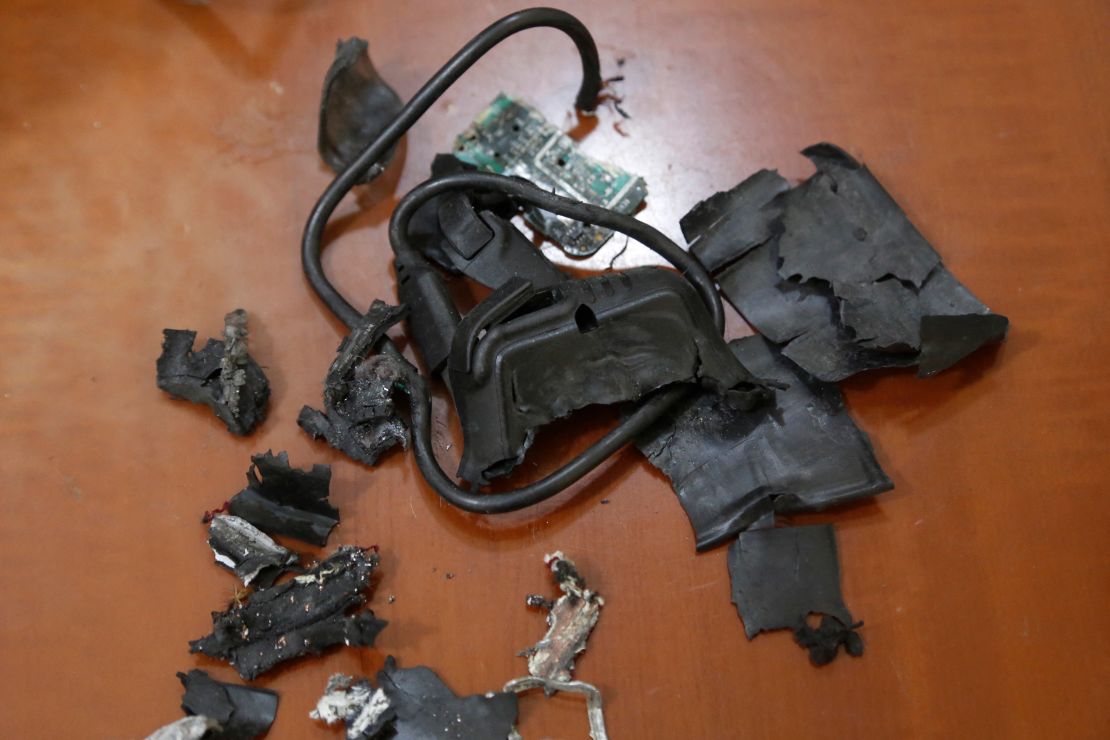
A photo taken in southern Beirut shows the remains of an exploded pager on Tuesday. AFP/Getty Images
Israel initially refused to comment on Tuesday's pager explosions, but on Wednesday tacitly acknowledged its role in the attacks. Defense Minister Yoav Gallant praised the 'excellent achievements' of the IDF, together with the country's security agency, the Shin Bet, and its intelligence agency Mossad.
Gallant said a 'new era' of war was beginning, and on Thursday Israel targeted Beirut for a third time, flying jets and dropping flares over the city while Nasrallah made a speech in which he pledged Israel would face a 'reckoning.' Later, Israel launched one of its most intense bombardments against Hezbollah targets in Lebanon in nearly a year of crossâ”border strikes, saying it hit about 100 Hezbollah rocket launchers.
Friday's airstrike was the third Israeli airstrike on Beirut since hostilities began last year, after Hamas' October 7 attack on Israel. In January, an Israeli airstrike killed Saleh Al-Arouri, deputy head of Hamas' military wing, who had been living in Beirut. In July, a second Israeli strike on Beirut killed Hezbollah's most senior military official, Fu'ad Shukr.
Several other Iran-backed militant groups, including the powerful Kataib Hezbollah and Harakat al-Nujaba in Iraq have vowed revenge for Israel's attack on southern Beirut. The groups have carried out several attacks against US forces in Iraq and Israel since Israel's war with Hamas started.
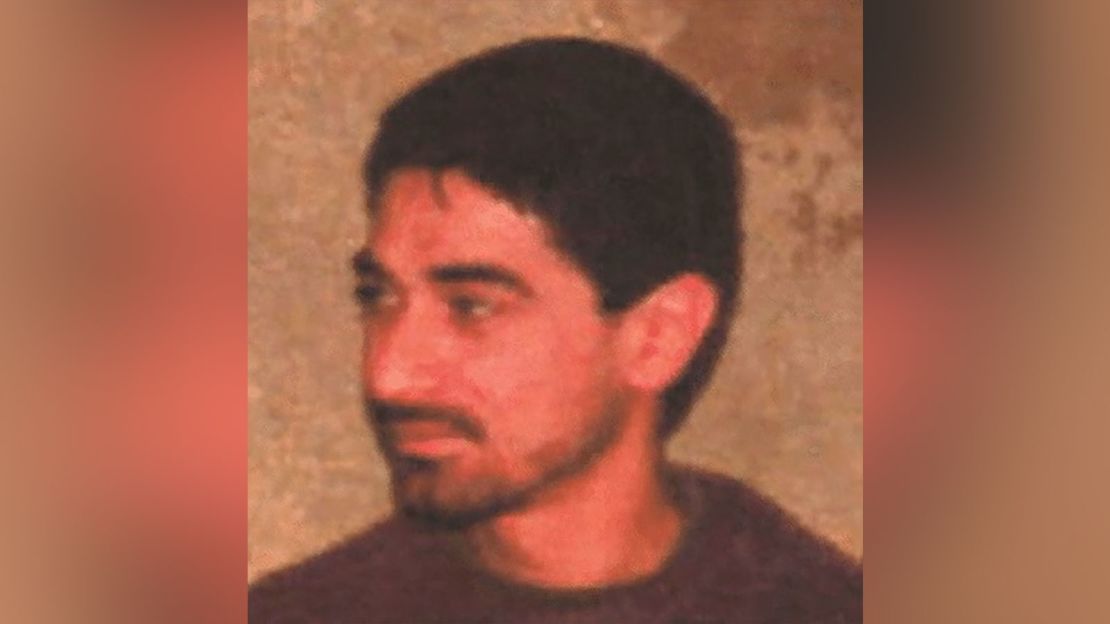
Ibrahim Aqil, pictured here on a wanted poster, had a $7 million bounty on his head from the United States. US State Department via REUTERS
Before the surprise attacks on Lebanon, Israel's security cabinet on Monday voted to add a new objective to its ongoing conflict with Hamas and Hezbollah: ensuring the safe return of residents from communities along its northern border with Lebanon to their homes.
After nearly a year of cross-border exchanges between Hezbollah and Israel, tens of thousands of people have been displaced from their homes both in southern Lebanon and northern Israel. While the return of residents of northern Israel has long been understood to be a political necessity for Prime Minister Benjamin Netanyahu's government, this is the first time it has been made an official war goal.
While ambulances and fire trucks rushed to the scene in southern Beirut, CNN's team on the ground saw one car fleeing with suitcases strapped onto it, another sign of the fear and panic sweeping Lebanese civilians after days of explosions and now airstrikes.
This dedication was highlighted during the International Conference on Technological Advancement in Embedded and Mobile Systems, held from September 19-20, 2024.
The event brought together researchers from various universities across East Africa and Germany, aiming to promote mobile technology as a critical tool for progress.
UTAB’s Vice-Chancellor, Father Dr. Gilbert Munana, emphasized the significance of the conference as an opportunity for Rwanda to exchange ideas and ensure inclusivity in the digital age.
He explained that technological advancements, particularly in mobile systems, are increasingly central to modern life and education, making it important for everyone to understand their capabilities.
Dr. Munana highlighted how almost every sector now involves some form of computing, and noted that the foundation of this shift lies in understanding the intelligence behind both stationary and mobile technology.
He further pointed out that the conference aligns with UTAB’s objective of launching advanced computer science programs, and the knowledge gained will contribute to the improvement of these courses.
Looking ahead, UTAB intends to offer courses that are not limited to academic settings but also aim to benefit the general public.
Dr. Munana stressed the importance of helping citizens realize that their phones can be used for more than just entertainment, such as for practical tasks like ordering groceries remotely, no matter their location, even in smaller towns like Byumba.
Engineer Pascal Gatabazi, Chief Technical Advisor at the Ministry of Education, underscored how technology has already become an integral part of everyday life, necessitating a shift in traditional practices.
He mentioned that farming methods, for example, should be modernized with technological tools, and highlighted how technology, such as cameras, has played a role in reducing traffic accidents by monitoring speed violations.
Gatabazi added that technology also enables people to perform tasks like withdrawing money and making payments remotely, stressing that Rwanda is advancing in this area and that it is essential for all sectors to keep pace with technological progress.
He emphasized that when people come together to share ideas and collaborate, growth becomes inevitable.
Professor Kisangiri Michael, representing the Centre of Excellence for ICT in East Africa (CENIT@EA), shared that the institution has provided over 148 young people with education in mobile technology. He pointed out that mobile technology has significantly impacted daily life in East Africa, with phones now replacing the need to carry physical cash.
Kisangiri stressed that further development in mobile technology is needed to continue driving regional progress and promoting knowledge-sharing in countries like Rwanda and Tanzania.
The conference attracted participants from universities across East Africa, including Rwanda, Burundi, Kenya, Tanzania, and Ghana, as well as institutions from Europe and Asia, fostering an environment of knowledge-sharing and collaboration to support technological growth.
Participants of the conference during a panel discussions.
The conference was a good opportunity for researchers to exchange ideas.
UTAB’s Vice-Chancellor, Father Dr. Gilbert Munana, emphasized the significance of the conference as an opportunity for Rwanda to exchange ideas and ensure inclusivity in the digital age.
Engineer Pascal Gatabazi, Chief Technical Advisor at the Ministry of Education, underscored how technology has already become an integral part of everyday life, necessitating a shift in traditional practices.
The official signing ceremony marked the beginning of this strategic initiative, which seeks to provide financial backing for SMEs in key sectors of the economy contributing to decent job creation and inclusive green growth.
Through this collaboration, the Embassy of Sweden in Kigali will cover 70% of the SME loan portfolio, ensuring that qualifying SMEs can access loans with flexible terms ranging from US$5,000 to US$350,000 for a period of 3 to 60 months. This 8-year coverage period will allow eligible businesses to scale their operations, contribute to economic development, and create employment opportunities.
Eligible sectors include Agriculture, Light manufacturing, Logistics, Renewable energy, Water and waste management, Export oriented SMEs, Tourism and Hospitality, Affordable Housing development and green building materials, Information and Communication Technology.
Commenting on the development; Dr. Diane Karusisi, the CEO of the Bank of Kigali, expressed excitement about this partnership and described it as a game-changer for SMEs in Rwanda.
'By providing a safety net that allows us to extend more flexible and accessible financing, we are enabling businesses to innovate, expand, and compete on a larger scale. At Bank of Kigali, we believe that empowering SMEs is crucial for driving inclusive growth, and this guarantee is a powerful step towards a more dynamic and resilient Rwandan economy,' she said.
Access to Finance Rwanda (AFR), as the strategic partner of the facility, will work closely with BK by providing technical assistance, supporting the optimal utilisation of the guarantee, and monitoring impact while capturing learnings. Their involvement will ensure that the facility achieves its objectives and that best practices are integrated throughout the implementation of the initiative.
Jean Bosco Iyacu, CEO of Access to Finance Rwanda, added that this partnership complements Bank of Kigali’s ongoing efforts to channel more capital into the SME sector.
'BK is a long-standing partner in AFR’s journey to drive innovation and support key sectors of the economy and rural areas. We are delighted to continue this relationship through this first SME-Centric Portfolio Guarantee Scheme. This initiative addresses the collateral constraints mainly faced by youth and women owned SMEs across Rwanda, and we anticipate it will play a crucial role in unlocking growth and creating dignified employment opportunities,' he noted.
Martina Fors Mohlin, Head of Development Cooperation at the Embassy of Sweden, noted, 'Our partnership with Bank of Kigali aligns with our mission to promote economic inclusive sustainable development in Rwanda. By providing the guarantee instrument, we strive to create a positive impact on job creation, gender equality and youth entrepreneurship.'
About Bank of Kigali Plc
Bank of Kigali, established in 1966, is Rwanda’s largest financial institution. As a leading commercial bank, it provides a wide range of services, including digital banking, to over 500,000 customers through an extensive branch network and digital platforms. BK is committed to fostering innovation and economic growth through targeted financial solutions for individuals, SMEs, and corporations.
Swedish development cooperation with Rwanda
The Swedish development cooperation with Rwanda is governed by a strategy for the period 2020 – 2024. The strategy focuses on human rights, democracy and gender equality; environment and climate; and more inclusive economic growth. In addition, support is provided for building up domestic research capacity in Rwanda.
With this strategy, Sweden will increase its commitment to contribute to an environmentally sustainable and including growth. The strategy also contributes to an inclusive economic development and growth, improved conditions for and increased access to productive employment and decent work, corporate social responsibility, and free and fair trade, including in rural areas.
About Access to Finance Rwanda (AFR)
AFR is a Rwandan not for Profit Company , established in 2010 to promote financial inclusion and financial sector development in Rwanda. AFR supports the removal of systemic barriers that hinder access and usage of financial services by low-income people, particularly the unserved segments including young people, women, MSMEs, Persons with Disabilities (PwDs), refugees and the informal sector.
The official signing ceremony marked the beginning of this strategic initiative, which seeks to provide financial backing for SMEs in key sectors of the economy contributing to decent job creation and inclusive green growth.
Dr. Diane Karusisi, the CEO of the Bank of Kigali, expressed excitement about this partnership and described it as a game-changer for SMEs in Rwanda.
Jean Bosco Iyacu, CEO of Access to Finance Rwanda said that this partnership complements Bank of Kigali’s ongoing efforts to channel more capital into the SME sector.
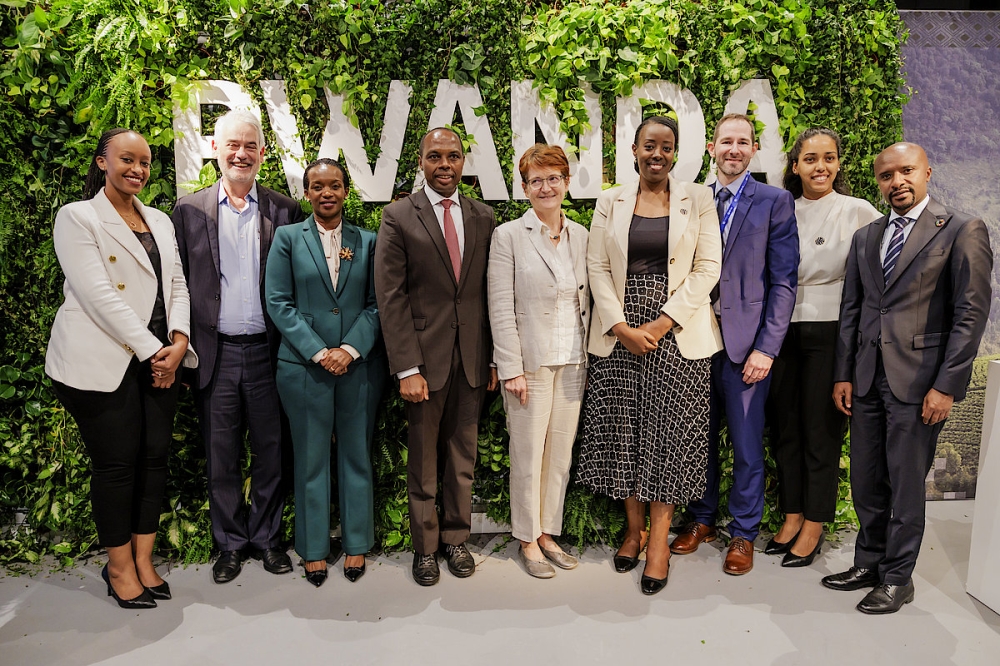
Martina Fors Mohlin, Head of Development Cooperation at the Embassy of Sweden.
The 29th United Nations Climate Change Conference (COP29), due in Baku, Azerbaijan on November 11-22, aims to facilitate 'high-level' negotiations around carbon trading, and its global potential.
According to the Azerbaijani government, carbon trading 'is the second major expected deliverable of COP29.'
'Current turnover in the carbon markets is about 2.2 to 2.5 billion dollars. If operationalized, as desired, this figure can be increased multiple times, providing additional contributions to global climate finance,' Azerbaijan Foreign Ministry said.
Â
Rwanda's carbon market framework was launched in 2023, at the 28th UN Climate Summit (COP28) in UAE, Dubai.
Â
At a climate conference held in Bonn, Germany in June, national delegations reconvened formal negotiations on carbon markets and Article 6 of the Paris Agreement for the first time since the failed talks at COP28, which was held in Dubai in late 2023.
'Tangible progress has been made during the Bonn session,' the Ministry added.
The challenges
Countries at the 28th UN Climate Change Conference failed to adopt key texts laid out under the Paris Agreement, though an agreement on non-market mechanisms was passed in December 2023. This has been seen as a major setback to international carbon trading.
Parties did not reach a consensus on either Article 6.2 or Article 6.4, for a variety of technical reasons, with many countries clashing on carbon removals and issues of transparency and climate ambition over the final text.
Many in the voluntary carbon market were disappointed that the lack of a deal would delay market-based and private-sector involvement.
However, those on the opposing side insisted that there were not enough safeguards and regulations in the texts to ensure a functioning and transparent market.
In Rwanda, the carbon trading framework was launched at COP28, but little to no activities have been witnessed.
However, the nascent market is increasingly attracting investments, thanks in large part to the recently announced regulations.
'We have an opportunity to expedite the operationalization of a crediting mechanism that will set a high bar on environmental integrity, and safeguards, among others,' said Joel Shyaka, who is a manager at CO2 Africa project.
This project is currently undergoing pilot phases between private landowners, despite the bottleneck of no existing policy that governs the sector due to how new these projects are on the continent and in Rwanda.
Reacting to the audit process, he said, 'So that auditing consists of seeing the tree species, the amount of carbon from a specific tree, let's say, per year, the soil quality, etc, then there is an exact amount of carbon that could be put in that specific forest.'
According to Shyaka, the current market is faced with major challenges including a lack of expertise in the field.
'We are stepping in to ensure that local communities are trained about conservation and the incentives that could come with it, and going with a people-centric approach is an advantage for us as a country.'
'In our case, we give a considerable percentage of the income to the landowners before we take out our costs as a way to improve the price of the credit in the first place and to give them an income so they can continue to conserve, and maintain and develop their land, and their community, but also to continue socio-economically develop.'
'It is more like pulling together all the bits and pieces. The piece that's missing is really having a common set of standards that were applied in the country. Other countries have such mechanisms and reporting requirements. We don't want to be in the gray market where we're selling these things abroad and not properly measuring the benefits or verifying it in the country.,' Shyaka reiterated.
At COP29, Shyaka highlighted that industry players and government institutions will deliberate how to ensure an equitable share of the market and fair returns to the communities that are using their resources.
He insisted on the need to convene the public and private sectors to be able to join efforts and build on the nascent knowledge and resources available.
What are the requirements?
Investors have been encouraged to operate within national policies, laws, and strategies as part of the requirements.
Also required is the need to indicate how the project shall contribute to the Nationally Determined Contributions (NDCs), which are emission reductions at the national level, as well as ownership of the property involved in the project, community development agreements or agreements with property owners and other relevant entities.
Rwanda has also prohibited double counting to ensure transparency and fairness in the carbon sector.
Juliet Kabera, Director General of Rwanda Environment Management Authority (REMA) said that the government is committed to sustainability, enhancing previous initiatives and creating new opportunities for innovation in carbon market mechanisms.
'By aligning with Article 6 of the Paris Agreement, we will strengthen our capacity to meet our NDCs and foster global cooperation in tackling climate change,' she added.
Vladimir Kara-Murza, a Russian dissident freed in the biggest prisoner swap since the cold war, has appealed to Keir Starmer during a meeting in Downing Street to not let hundreds of political prisoners in Russia and Belarus quietly 'die off'.
Kara-Murza, who was released last month two years into a 25-year sentence after speaking out against the war in Ukraine, said he had told the prime minister on Friday that organising further such swaps was a matter of 'life and death'.
The 43-year-old Russian politician, who has British citizenship after moving to England as a child, was one of 16 westerners and Russians, including five German nationals, exchanged last month for 10 Russian nationals, including two minors.
The deal marked the first time in 40 years that Russian political prisoners had been released by the Kremlin as part of a swap.
The White House said that Alexei Navalny, who died in a Russian prison camp last year, had been due to be part of the exchange.
Kara-Murza, a father of three, who survived two poisoning attempts in 2015 and 2017, said he had made the case for further swaps to Starmer and in all his recent meetings with senior politicians, including the US president, Joe Biden, and the German chancellor, Olaf Scholz.
The deal under which he had been released had been an 'unequal' arrangement, he said, involving murderers, spies and hackers being swapped for people who had committed no crimes, but there was no alternative, Kara-Murza insisted.
'There can be nothing more valuable, more important for democracy, than human life,' he said. 'I know what it's like just to wake up every morning in a cell two by three metres, four walls, a small window covered by bars, just essentially walking in a small circle all day, staring at walls. You have no one to speak to, nothing to do, no one to go to and this is how the rest of your life is going to continue ⦠This is not just a question of unjust imprisonment, although that in itself would be unacceptable ⦠it's a question, very literally, of life or death.'
Among the cases referenced by Kara-Murza were Alexei Gorinov, 63, an elected official of Moscow's Krasnoselsky district council, who was the first person in Russia to be arrested for his opposition to the war in Ukraine, and Maria Ponomarenko, 46, a journalist from Siberia imprisoned for accusing the Russian air force of bombing a theatre in the Ukrainian city of Mariupol, who is on hunger strike.
'We need to be advocating, to be getting them out,' Kara-Murza said, adding that the argument that such deals encouraged Kremlin to take hostages was 'fallacious' as Putin was going to lock up his opponents anyway.
Kara-Murza, who had been held in a high security prison in Siberia, said he had also talked to Starmer about the need for a strategic plan for Russia after Vladimir Putin.
Authoritarian regimes appeared stable from the outside but change could happen in an instant, he said, and it was vital not to repeat the mistakes of the 1990s after the collapse of the Soviet Union.
There would need to be a reckoning with those who committed crimes during Putin's 25 years in power and a plan to reintegrate Russia into the rules-based order, he said.
'One of the things that has occupied my mind for a long time, but especially these past few weeks that I've been out of prison, is that we have no right to miss the next opportunity for change in Russia,' he said.
Donald Trump's sweeping threats if he wins the presidency again to name a special prosecutor to 'go after' Joe Biden and take legal action against other foes would subvert the rule of law in America and take the country towards authoritarianism, former justice department officials and scholars have warned.
Trump's escalating legal threats have targeted 'corrupt election officials' lawyers, donors and others he falsely deems out to steal November's presidential election, and have popped up variously on his Truth Social platform, at campaign events and at an elite police group he addressed this month in North Carolina.
Trump's menacing pledges to essentially weaponize the justice department against opponents would mark a sharp break with the Department of Justice's mission statement, which cites as core values 'independence and impartiality'.
'Donald Trump is making many public threats to use the legal system to punish his enemies, which seems to be anyone who opposes him,' said the former deputy attorney general Donald Ayer, who served in the George HW Bush administration. 'This conduct is utterly without precedent in campaign history, threatens all of our freedoms, and violates our basic rule of law.'
'Trump's escalating threats to pervert the criminal justice system need to be taken seriously,' said the former justice department inspector general Michael Bromwich. 'We have never had a presidential candidate state as one of his central goals mobilizing the levers of justice to punish enemies and reward friends. No one has ever been brazen enough to campaign on an agenda of retribution and retaliation.'
Critics note that Trump and top allies at the conservative Heritage Foundation, which produced a far-right blueprint for a new Trump administration dubbed Project 2025, have signaled plans to overhaul the justice department to give the president and loyalists more power in decisions about who to investigate and prosecute.
Not coincidentally, Trump's sweeping attacks and threats come as he faces multiple federal charges from special counsel Jack Smith of conspiring to overturn his loss in 2020 to Biden and improperly retaining hundreds of classified documents after he left office. While a Florida judge in a widely criticized move dismissed the documents case, Smith in August appealed that decision.
Trump this year was convicted on 34 counts of business fraud in New York for altering his company books to hide $130,000 in hush-money payments to the adult film star Stormy Daniels who had alleged an affair with Trump before he took office in 2016.
During his debate on 10 September with Kamala Harris, Trump derided all these charges and others as 'fake cases'. Previously, Trump has painted his conviction in New York and the federal charges as one sprawling political conspiracy stemming from the 'weaponization' of the justice department and has vowed Biden is 'going to pay a big price' for the various prosecutions Trump faces.
Former prosecutors and some ex-Republican members of Congress warn Trump's barrage of legal threats pose serious dangers of politicizing the justice department for his agenda of retribution.
'Trump will use the power of the federal government, and especially DoJ, to intimidate and possibly prosecute all sorts of political opponents he deems hostile to him,' said former Republican representative Charlie Dent of Pennsylvania. 'That's one of the many reasons he's unfit to be president.'
Likewise, ex-federal prosecutor Paul Rosenzweig warned: 'Trump is threatening to prosecute those who stole the election from him in his warped reality,' adding that 'his threats to undermine the rule of law have escalated.
'Trump is no conservative, he's a radical. There's a reason why we have a long tradition of trying to isolate the attorney general from political influence.'
Ominously, Trump's threats of prosecuting foes now seems to dovetail with his new conspiratorial charges of election fraud this year, in a clear echo of his false claims that he lost in 2020 due to rampant voting fraud.
On Truth Social on 7 September, Trump starkly warned: 'WHEN I WIN, those people that CHEATED will be prosecuted to the fullest extent of the Law, which will include long term prison sentences so that this Depravity of Justice does not happen again.'
To drive home his dark threat, Trump added: 'Please beware that this legal exposure extends to Lawyers, Political Operatives, Donors, Illegal Voters, & Corrupt Election Officials. Those involved in unscrupulous behaviour will be sought out, caught, and prosecuted at levels, unfortunately, never seen before in our Country.'
Repeating debunked claims that Democrats played a role in sizable fraud in 2020, Trump vowed that he, legal scholars and attorneys were 'watching the Sanctity of the 2024 Presidential Election very closely'.
In a similar vein, Trump urged the national board of the Fraternal Order of Police that endorsed him this month to help 'watch for the voter fraud, because we win without voter fraud ⦠We win so easily.'
Trump added that he thought police could help him 'just by watching, because, believe it or not, they're afraid of that badge'.
Such targeted threats raising the phoney spectre of election fraud to rob Trump of victory this year, are prompting some ex-prosecutors to worry that Trump may be able to intimidate non-partisan election workers.
'We often worry that the threat of criminal prosecution will chill appropriate conduct,' the Columbia law professor and ex-prosecutor Daniel Richman said. 'So I do fear that those who are charged with independent roles in elections will lean over backwards to accommodate Trump, at the cost of their actual neutrality.'
If Trump wins, Richman cautioned that he may not face serious congressional checks.
'Historically, Congress has played an important, although variable role, in preventing presidents from abusing their authority over prosecutions. But the Republican party right now can't be counted on to do that.'
In a related sign of Trump's disregard for legal norms, Trump has repeatedly extolled many of the convicted participants in the violent attack on the Capitol on January 6 as 'patriots' and 'hostages' and promised that he would seriously consider pardons for a number of them.
At a Wisconsin rally this month Trump pledged if he wins this fall to 'rapidly review the cases of every political prisoner unjustly imprisoned by the Harris regime'. Although four of his supporters died of various causes on January 6 and a police officer died within days, Trump last month falsely claimed at a news conference that no one died due to the insurrection.
Without mentioning Trump, the attorney general, Merrick Garland, on 12 September in a fiery speech to US attorneys nationally and justice department staff denounced any moves that would turn the department into a 'political weapon', and the 'escalation of attacks' against its career staff.
'Our norms are a promise that we will not allow this nation to become a country where law enforcement is treated as an apparatus of politics,' Garland added.
Taken together, Trump's nonstop threats to use the Department of Justice to go after his political foes and others he imagines are out to steal the election are at sharp variance with democratic principles, say legal experts.
'The essence of a justice system in a democracy is that it is responsive to the rule of law,' the former federal judge and Dickinson College president John Jones told the Guardian. 'Trump's fulminations are anything but. At bottom he means it to have a chilling effect on supporters of a rival.'
Trump's verbal assaults are 'unprecedented in the annals of American democracy and have hallmarks of authoritarianism'.
The discussions were held on Friday, September 20, 2024 as confirmed by Rwanda’s Presidency.
President Kagame also held discussions with Singapore’s Prime Minister and Minister for Finance, Lawrence Wong.
According to the Presidency’s message shared on X account, the leaders 'renewed their commitment to a strong bilateral partnership and exchanged views on shared values of good governance and leadership aimed at transforming the lives of citizens.'
The two leaders also welcomed the signing of a renegotiated Double Taxation Avoidance Agreement, which will help boost investment opportunities between the two countries.
Besides, President Kagame attended a luncheon hosted by Senior Minister Lee Hsien Loong at Istana, the office of the president of Singapore.
The two leaders discussed global affairs and the impact of technology on development, as well as the productive economic partnership between their countries and its tangible benefits.
Lee Hsien Loong, who served as Singapore’s Prime Minister from 2004 to 2024, first visited Rwanda In 2022, marking his first trip to both Rwanda and Africa.
Rwanda and Singapore enjoy robust bilateral relations, particularly in areas such as investment, trade, education, rule of law, technology, and air transport services.
Both nations are members of FOSS, an organization established in 1992 by Singapore, which comprises small nations working together to address global challenges and promote development.
The bilateral relationship was further strengthened on September 29, 2023, when Rwanda’s Ministry of Foreign Affairs and International Cooperation (MINAFFET) and Singapore Cooperation Enterprise (SCE) signed a Memorandum of Understanding (MoU) to renew and deepen cooperation.
Signed by Jean de Dieu Uwihanganye, Rwanda’s High Commissioner to Singapore, and Wy Mun Kong, CEO of SCE, the five-year MoU focuses on key sectors such as ICT and cybersecurity, sustainability and climate change, urban planning, infrastructure development, and capacity building.
High-level visits continue to bolster ties between the two nations. President Kagame, who is on his fourth visit to Singapore, also attended the 11th Annual Asia Summit on September 19, where he participated in a fireside chat moderated by Richard Ditizio, CEO of the Milken Institute.
The discussion centered on Rwanda’s socio-economic transformation journey.
Singapore is one of the wealthiest countries globally, with a 2023 GDP of $501 billion, up from $0.70 billion in 1960. Its per capita GDP in 2023 stood at $84,600, reflecting its remarkable economic growth.
Tharman Shanmugaratnam welcomed President Kagame in Singapore.
President Paul Kagame has met with his counterpart of Singapore, Tharman Shanmugaratnam of Singapore.
President Kagame and his delegation attended a luncheon hosted by Former Prime Minister Lee Hsien Loong at Istana.
President Kagame and Senior Minister Lee Hsien Loong at Istana discussed global affairs and the impact of technology on development, as well as the productive economic partnership between their countries and its tangible benefits.
President Kagame and Senior Minister Lee Hsien Loong during discussions at the luncheon.
President Kagame also held discussions with Singapore’s Prime Minister and Minister for Finance, Lawrence Wong.
The agreemet is expected to boost investment opportunities between the two countries.
Rwanda and Singapore signed a renegotiated Double Taxation Avoidance Agreement.
The money was recovered on Thursday, September 19, from a 24-year suspect, who was working for the victim.
The suspect, who was handed over to Rwanda Investigation Bureau (RIB), allegedly stole US$17,200 from his boss, on Wednesday, September 18, at about 9p.m.
“The victim reported the alleged theft that night in Kigali and the search for his employee, who was the prime suspect, commenced,” Superintendent of Police (SP) Jean Bosco Mwiseneza, the Police spokesperson for the Northern region, said.
“On Thursday, at about 9a.m, Police received information from a resident in Musanze town, about the prime suspect. He was arrested at a forex bureau, where he was exchanging the money. At the time, he had already wired Frw12, 680,000 to his bank account and had Frw1 million cash,” he added.
SP Mwiseneza thanked the resident, who provided information that led to the arrest of the prime suspect and recovery of the money.
Article 166 of law determining offences and penalties in general states that; any person convicted of theft is liable to imprisonment for a term of not less than one (1) year and not more than two (2) years and a fine of not less than Frw1 million and not more than Frw2 million, community service in a period of six (6) months or only one of these penalties.
The money was recovered on Thursday, September 19, from a 24-year suspect, who was working for the victim.