While Nalumango reassured the public that the food provided was safe, conflicting reports have emerged, prompting an investigation into possible contamination. The deaths of 400 dogs were linked to aflatoxins, harmful toxins produced by fungi found in maize and other food products.
Health Minister Elijah Muchima, addressing concerns about the contamination, acknowledged Burundi’s donation, stating, “We appreciate the solidarity shown by Burundi through their food donations, but the health and safety of Zambians remain our utmost priority.”
He added, “As we investigate the aflatoxin issues, we are ensuring that all maize products, including those donated, adhere to safety standards to protect our citizens.”
Concerns persist across Zambia, and while the government has launched an inquiry, specific maize brands linked to the contamination have yet to be identified. The presence of aflatoxins has sparked widespread fear, as maize is a dietary staple for the majority of Zambians.
Known to cause serious health risks, including liver cancer, the discovery of aflatoxins has heightened public anxiety. Though no human fatalities have been reported, authorities have begun recalling affected products and are conducting additional tests to prevent further health risks.
Zambia, like several other Southern African nations, is reeling from a drought affecting 84 out of its 116 districts. In light of the ongoing crisis, donations from neighboring countries have been pivotal. Vice President Nalumango has consistently welcomed these contributions, acknowledging their immediate impact on hunger alleviation efforts.
In a similar show of regional solidarity, Rwanda recently donated 1,000 metric tonnes of maize to aid Zambia, reinforcing the collective effort to support those affected by the drought.
Vice President Mutale Nalumango recently received relief maize from Rwanda at the Food Reserve Agency (FRA) sheds in Lusaka
According to Mugisha, she was rushed to hospital for medical attention but she was pronounced dead upon arrival. 'It’s sad that Sarah died when Kisoro district and Uganda needed her more, it’s a big loss to our family. Although we expect the government to come up with a burial programme, as a family we need to plan ourselves,” he said.
At the age of 49, Mateke was a daughter of former Minister Philemon Mateke. Born into a political family, Mateke followed in the footsteps of her father Philemon Mateke who also served in Museveni’s and held Kisoro district leadership for years.
When she won the parliamentary seat for Kisoro district, Museveni named her minister in appreciation of her father’s contributions to the NRM government.
She was first appointed State minister of Gender in-charge of Children and Youth Affairs in 2021 until March 21st when Museveni reshuffled his cabinet and moved her to the Defense Ministry where she’s the Minister of Defense and Veteran Affairs.
Sarah Mateke was rushed to hospital for medical attention but she was pronounced dead upon arrival.
Her previous docket at the Gender ministry is currently occupied by events promoter Balaam Barugahara. As the cloud of sorrow and grief hovers above Kisoro district, Museveni’s government has announced that burial arrangements will be communicated later and will be accorded an official burial.
Condolences have poured in from different government officials, with some casting a shadow of controversy. Former Ugandan high commissioner to Canada Joy Ruth Acheng remarked and stated that she would run for the upcoming Kisoro by election following Sarah Mateke’s demise. “I wish it was my area MP. I would have run for the by election and got to parliament. RIP Hon. Mateke,” she said.
Speaker of Parliament Honourable Annet Anita Among posted on her X, 'With a heavy heart, I have received the news of the demise of the Hon Sarah Mateke, Woman MP Kisoro, and State Minister for Defence. Sincere sympathies to her family, H.E. President Museveni, relatives, friends, and the Kisoro community. In her, we have lost a humble and committed servant of our country.'
The US state department confirmed the death of Ayşenur Ezgi Eygi, 26, a volunteer peace activist with the anti-occupation International Solidarity Movement (ISM).
Eygi ┠a US-Turkey dual national ┠died on Friday after being fatally shot during a regular protest against settlement expansion in Beita near Nablus, the official Palestinian news agency Wafa reported.
The ISM, which organises foreign volunteers in the Palestinian territories, said Israeli forces 'intentionally shot and killed' an international human rights activist during the weekly protest on Friday morning. It did not name the volunteer.
'The demonstration, which primarily involved men and children praying, was met with violence from the Israeli army stationed on a hill. The volunteer died shortly after being transported to a local hospital in Nablus,' the ISM said in a statement.
The individual's family had requested privacy as they mourn their loss, it said. 'Their wish to grieve in peace should be respected by all, as they navigate this tragic and difficult situation.'
The US has not said whether Eygi had been shot by Israeli troops. 'We are urgently gathering more information about the circumstances of her death, and will have more to say as we learn more,' Matthew Miller, a state department spokesperson, said.
The US ambassador to Israel, Jacob Lew, echoed those comments, posting to X his 'deepest condolences' to Eygi's family and loved ones. 'We have no higher priority than the safety and security of American citizens,' he added.
The White House said it had contacted the Israeli government and requested an investigation into Eygi's killing. 'We are deeply disturbed by the tragic death of an American citizen, Ayşenur Ezgi Eygi, today in the West Bank and our hearts go out to her family and loved ones,' said Sean Savett, the White House's national security council spokesperson.
Antony Blinken, the US secretary of state, the country's top diplomat, deplored the 'tragic loss'. 'When we have more info, we will share it, make it available and, as necessary, we'll act on it,' Blinken told reporters, according to Agence France-Presse (AFP).
Turkey's foreign ministry said it had learned 'with great sorrow' that a Turkish national had been killed. Turkey's president, Recep Tayyip Erdoğan, condemned Israel's 'barbaric intervention against a civilian protest' that he said led to Eygi's killing.
The Israeli military admitted to firing at the demonstrators and said it was looking into reports that a foreign national was killed. The Israel Defense Forces said it 'responded with fire toward a main instigator of violent activity who hurled rocks at the forces and posed a threat to them'.
Eygi graduated from the University of Washington earlier this year, according to Aria Fani, an assistant professor of Middle Eastern languages and cultures. Fani said Eygi was an exceptional student and person.
He said he had seen Eygi about two months earlier and urged her not to go to the West Bank because he was worried for her safety there.
The University of Washington said she had been a peer mentor there, having helped 'welcome new students to the department and provided a positive influence in their lives'.
In a statement, the university's president, Ana Mari Cauce, described Eygi's killing as 'awful' and said she called for 'a ceasefire and resolution to the crisis' on the West Bank.
'My heart goes out to Ayşenur's family, friends and loved ones,' she added.
Pramila Jayapal, the US representative for the area, said in a statement that Eygi's death was a 'terrible tragedy'.
'My office is actively working to gather more information on the events that led to her death,' Jayapal said. 'I am very troubled by the reports that she was killed by Israeli Defense Forces (IDF) soldiers. The Netanyahu government has done nothing to stop settlement expansion and settler violence in the West Bank, often encouraged by rightwing ministers of the Netanyahu government. The killing of an American citizen is a terrible proof point in this senseless war of rising tensions in the region.'
Eygi is the third ISM activist to have been killed since 2000, according to the Associated Press. She was the 18th demonstrator to be killed in Beita since 2020, the ISM said.
In 2003, while protesting against the Israeli military's destruction of houses in Rafah in the southern Gaza Strip, Rachel Corrie â” a 23-year-old US citizen from Olympia in Washington state â” was killed by an Israeli army bulldozer.
A month later, Tom Hurndall, a 22-year-old Briton, was shot in the head while he was helping Palestinian children cross a street in Rafah. He died the following year. An Israeli soldier was found guilty of manslaughter and sentenced to eight years in prison.
In August, an American activist said he was shot in the leg by Israeli forces during a protest in Beita. The man, who spoke to the AFP using a pseudonym, said Israeli troops were 'firing teargas at us, live rounds' and that he was shot while he was running away.
Durov, accused of not cooperating with French authorities, was arrested at an airport outside Paris on August 24, 2024, as part of an investigation into alleged crimes involving child pornography, drug trafficking, and fraudulent activities linked to the Telegram app. He was released four days later on â¬5 million bail and prohibited from leaving the country.
In a statement released on Friday, September 6, 2024, the CEO expressed surprise at being held personally responsible for third-party misuse of Telegram. He accused the French authorities of using outdated 'pre-smartphone’ laws to hold him accountable for others’ actions, calling it “a simplistic approach”.
Speaking for the first time since his arrest, Durov emphasized that Telegram takes moderation seriously, removing millions of harmful posts and channels daily.
He referred to Telegram’s existing infrastructure, including an official EU representative to handle law enforcement requests, and denied claims that the app lacks oversight.
“We’ve always been open to dialogue and take down harmful content every day,” Durov said, adding that recent media portrayals are “absolutely untrue.” He also stressed that Telegram is committed to protecting user privacy, particularly in countries with weak rule of law.
While acknowledging that Telegram’s growth to 950 million users has created challenges, Durov pledged to make improvements in content moderation. He expressed hope that these efforts would not only enhance Telegram’s safety but also contribute to a stronger, more secure social networking industry.
Telegram, known for its strong stance on user privacy, has previously faced bans in Russia and Iran after refusing to comply with demands to share encryption keys and block protest channels.
Durov reiterated that the platform would not hesitate to leave countries whose regulations compromise its core principles of privacy and free speech.
'Sometimes we can’t agree with a country’s regulator on the right balance between privacy and security. In those cases, we are ready to leave that country. We’ve done it many times. When Russia demanded we hand over 'encryption keys' to enable surveillance, we refused â” and Telegram got banned in Russia. When Iran demanded we block channels of peaceful protesters, we refused â” and Telegram got banned in Iran.
'We are prepared to leave markets that aren’t compatible with our principles, because we are not doing this for money. We are driven by the intention to bring good and defend the basic rights of people, particularly in places where these rights are violated,' he stated.
Telegram founder Pavel Durov has dismissed claims that his platform is an “anarchic paradise” days after he was arrested and charged in France over offenses related to alleged criminal activity on the platform.
Iran's new reformist government has warned Russia against siding with Azerbaijan in a border dispute as concerns in Tehran persist over its relations with Moscow.
The Iranian foreign minister, Sayeed Abbas Araghchi, took the unusual step of upbraiding Russia after Moscow sided with Azerbaijan over its calls for a land corridor along the Armenia-Iran border that Tehran fears could limit its access to Europe and the wider world.
'Regional peace, security and stability is not merely a preference, but a pillar of our national security. Any threat from north, south, east, or west to territorial integrity of our neighbours or redrawing of boundaries is totally unacceptable and a red line for Iran,' Araghchi said on X.
The row has wider geo-political implications if it indicates that the newly elected Iranian government is willing to take a tougher line with Moscow as part of its effort to rebalance its foreign policy.
Russia and Iran are due to sign a new strategic cooperation agreement, but the content is still open for debate, and tensions exist within the Iranian government over the diplomatic price of deepening its military alliance with Russia, which has seen Iranian-made drones used against cities in Ukraine.
Iran earlier this week also summoned the Russian ambassador, Alexey Dedov, to express its displeasure at Moscow's stance, saying it did not want a conflict created on its borders with Moscow's encouragement.
Araghchi's remarks were a clear reference to Moscow's decision to back a call by Azerbaijan for an east-west corridor to be opened through Armenia to the Nakhchivan exclave in western Armenia.
His rebuke was echoed elsewhere in Iran. Mohsen Rezaei, the former overall commander of the Islamic Revolutionary Guards Corps and the secretary of the Expediency Council, which resolves issues between parliament and the Guardian Council, said: 'The behaviour of Russian statesman was not acceptable and in clear contradiction with their declaration of friendship with Iran, These ambiguities should be resolved.'
Ahmad Naderi, a hardliner inside the parliament, said: 'The lack of appropriate response to the Russians in the cases of previous actions against Iran's national interests has caused them to be doubly arrogant. They should be made to understand that strategic cooperation does not mean renouncing interests.
The Iranian regime has historically opposed Azerbaijani and Turkish efforts to establish the so-called Zangezur corridor between Azerbaijan proper and the Nakhchivan Autonomous Republic because such a corridor, going through Armenia's most southern province, might sever Iranian access to Armenia and then Europe.
Azerbaijan has at various times threatened to establish the corridor by force if necessary, which would be likely to provoke a further war with Armenia.
Azerbaijan's military defence budget is more than three times the size of Armenia's, and Baku demonstrated its military superiority in September 2023 by recapturing the occupied territories in Nagorno-Karabakh within 24 hours.
The latest row was prompted by the Russian foreign minister, Sergei Lavrov, saying on a recent visit to Baku by Vladimir Putin that Moscow backed the corridor and that Armenia was sabotaging a Russian brokered agreement to open it.
A debate is under way in Tehran about the wisdom of retaining close contacts with Moscow. The tone of Araghchi's 'red line' tweet suggests he wants to show his call for a more balanced east-west policy â” a key part of the new president, Masoud Pezeshkian's, successful election campaign â” has substance.
Heshmatollah Falahatpisheh, a former head of Iran's national security and foreign policy commission, warned Moscow's stance on the Zangezur corridor might be a pre-emptive attack by Putin to prevent the possibility of the formation of communication channels between the new government of Iran and the US.
An EU spokesperson made clear that relations between the EU and Iran were unlikely to improve if Iran continued to supply drones and other weaponry to Russia for use in Ukraine. The Iranian ambassador to the UN, Amir Saeed Iravani, took the unusual step of sending a letter to the UN secretary general, António Guterres, saying talk of such a trade was baseless. The EU spokesperson, Peter Stano, said: 'If it becomes clear that Iran provides more military aid to support Russia's illegal actions in Ukraine, the European Union will undoubtedly react.'
Stano said Josep Borrell, head of EU foreign affairs, had been in touch with the new Iranian government to raise the issue of Iran's support for Russia in Ukraine, as well as to discuss Iran's nuclear programme.
He added: 'Iran's military support for Russia's illegal actions in Ukraine is one of the most important determining issues in our relations with Tehran. That's why we reacted to this issue by imposing sanctions.'
At Cologne airport on Thursday evening, a group of associates of the late Russian opposition leader Alexei Navalny gathered waiting for a plane to arrive from Ankara. On board were 13 people who, until that morning, had been incarcerated in Russian prisons, including three people who had worked as Navalny's regional coordinators in various Russian cities and been jailed for 'extremism'.
After a swap in Turkey, they were now free, along with the Wall Street Journal reporter Evan Gershkovich and two other Americans, who were heading back home on a separate plane.
As the 13 disembarked from the plane in Cologne, it was a moment of joy. But there was also an undertone of wistfulness and anger over one person who was not on the plane: Navalny. After all, the contours of this deal had been drawn up with him in mind, and then, just when his freedom seemed tantalisingly within grasp, he died â” or was murdered â” in prison.
Russian-born Anastasia (left) from Ratingen and Anastasia from Düsseldorf waiting at the airport. Photograph: Christoph Reichwein/AP
With the exchange complete, details can now be revealed that show just how close a swap along similar lines but including Navalny appeared to be back in February, after months of careful planning and supposed Kremlin approval.
A detailed investigation by the Wall Street Journal into the behind-the-scenes negotiations over the exchange described how its origins lay in a meeting in Geneva between the Russian and US leaders shortly after Joe Biden became president, long before Gershkovich's arrest. There, Vladimir Putin suggested setting up a special channel to deal with prisoner swaps, an echo of a cold war practice. Biden agreed. Eventually, it led to Russia releasing the basketball player Brittney Griner, caught at a Moscow airport with a small amount of hash oil in what appeared to be a calculated move to take an American hostage. She was swapped for Viktor Bout, one of the world's most notorious arms dealers, who was held in US custody.
Next, Moscow turned its attention to Vadim Krasikov, an assassin who travelled to Germany on a passport that identified him as Vadim Sokolov and shot dead a Chechen exile in a park in 2019. He was arrested while removing his wig and trying to flee the scene. The Kremlin denied any connection and the assassin refused to speak under interrogation. Journalist Christo Grozev cracked the case, identifying him as Krasikov, part of an elite unit of the FSB, the Russian security service.
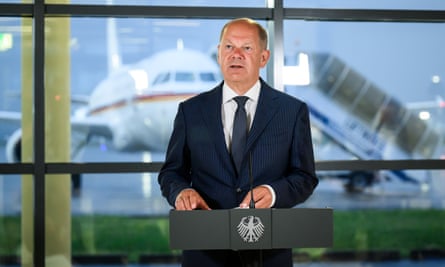
German chancellor Olaf Scholz speaking at Cologne airport. Photograph: Getty Images
Grozev made a name for himself tracking down Russian spies and assassins, and grew close to Navalny after he uncovered the FSB poisoning squad that had tailed the politician for months before he was poisoned with novichok in 2020. After the attack, Navalny was evacuated to Germany, where he recovered, and then returned to Russia in early 2021. He was immediately arrested and jailed.
Grozev became one of the leading advocates for the inclusion of Navalny in a possible prisoner swap, and thought Navalny could hold the key to persuading Germany that it was worthwhile to give up Krasikov, particularly given the chance that a free Navalny might galvanise the fractured Russian opposition.
'There were so many issues to this, but to the other side of this equation was Navalny, with an actual plausible chance of him to play a role in the Russian political future in years if not months to come,' said Grozev in a telephone interview with the Guardian on Friday.
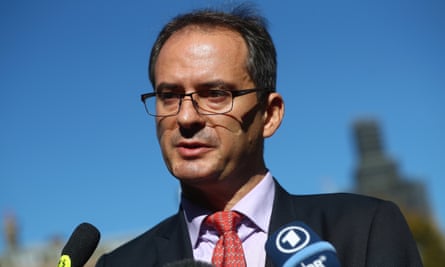
Grozev: Navalny came close to release and might eventually have played a part in Russian society. Photograph: Hannah McKay/Reuters
He began probing the idea with Russian contacts who had been keen to act as intermediaries for a potential swap, but found himself coming up against a brick wall whenever the name Navalny was mentioned. 'I worked with at least two former security officials. They were very well positioned to be one handshake removed from Putin. And they all wanted to earn that credit, but the name of Alexei was the fear factor for both of them,' said Grozev.
Grozev then asked the US special presidential envoy for hostage negotiations, Roger Carstens, if he might try asking the Russian oligarch Roman Abramovich to raise the issue with Putin, the Journal reported. Abramovich had been active in informal negotiations with Ukraine over a possible peace deal at the beginning of the war, and then in talks over prisoner-of-war swaps with Kyiv, and was already seen as an established conduit to Putin. Carstens raised the issue with Abramovich when both men were in Israel after the 7 October attacks, the newspaper reported.
'Abramovich initially said Putin will not agree, then he discouraged Carstens from asking him to pass on the message, but Carstens was very committed to this cause and idea, and knew that nobody else would ask this question, so he begged him to ask. And a few days later Abramovich reported that, surprisingly, he said yes,' said Grozev.
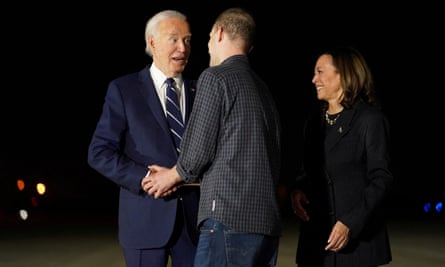
Joe Biden and Kamala Harris greet Evan Gershkovich on his arrival in the US. Photograph: Nathan Howard/Reuters
A source in Moscow with knowledge of the negotiations confirmed that Putin had approved the deal in, in principle, in autumn. 'The Germans didn't want to give Krasikov up, but then there was a world-famous person, Navalny, who was well known in Germany, and this was something they could sell, and it was a happy joining of circumstances: Putin gets Krasikov, the Germans get Navalny and the Americans get the Americans back,' said the source.
With that green light, the pieces began to slide into place. Calls were made to allies in Slovenia and Norway to secure agreement for Russian spies arrested there to be part of the swap. The broadening of the exchange was meant to make the idea of freeing Krasikov more palatable to Berlin. 'It always had to be a big enough package in order for no country to take a specific domestic political risk. It had to be fuzzy,' said Grozev.
The Wall Street Journal investigation showed that the negotiations remained delicate and fraught, involving multiple players in Washington, Berlin and Moscow. A surprisingly large role was played by Ella Milman, Gershkovich's mother, who lobbied US officials tirelessly to keep the jailed reporter at the front of their minds. In January, she flew to the World Economic Forum in Davos to meet Wolfgang Schmidt, German chancellor Olaf Scholz's chief of staff. 'You have the key,' she told him. Schmidt promised to help, and the same day, Scholz and Biden spoke on the phone. 'For you, I will do this,' Scholz later told Biden, the Journal reported.
Eventually, a deal of eight for eight came into view, said Grozev. It would have involved Navalny, Gershkovich and former US marine Paul Whelan among those released by Russia, while a similar group of Russians to that seen this week would return to Moscow.
Once everything was lined up, Abramovich went back to Putin for final approval, and again the response was positive. 'At an early stage he gave an agreement in principle, and then at the final stage, when it was all ready, he also approved it,' said the source in Moscow.
Then came shocking news. The 47-year-old had died, of unexplained causes, in the remote Arctic penal colony where he was being held. 'I received confirmation that the negotiations were at their final stage on the evening of February 15,' Navalny associate Maria Pevchikh said earlier this year. 'On February 16, Alexei was killed.'
In the months after Navalny's death, gradually a new deal began to take shape that involved more Russian opposition figures and again getting the Germans onside. The result, after months of careful wrangling in numerous capitals, was the exchange that went through on Thursday.
Grozev was in Cologne to meet the plane as it landed from Ankara, and said that after Navalny's death it was hard to weigh whether the exchange, which effectively rewards Putin's policy of hostage taking, was a good decision. 'With Navalny gone, I find it harder to evaluate where the balance lies now,' he said.
He spoke to the Guardian by phone while out shopping for clothes for the Russian political prisoners, who had arrived still clad in prison uniforms, and said, despite the doubts, it was still a positive that so many prisoners were now free. 'There was a moral imperative to use the accumulated resource and Germany's willingness under certain conditions to free Krasikov and free as many people as possible,' he said.
Africa has become a net importer of food despite the continent's agricultural potential. The continent's annual food import bill of $35 billion is estimated to rise to $110 billion by 2025, according to the Africa Development Bank (AFDB).
Aggrey Agumya, the Executive Director of Forum for Agricultural Research in Africa, spoke exclusively to The New Times' Tesi Kaven on what it will take to build resilient food systems in Africa and achieve food sovereignty.
Â
Aggrey Agumya, the Executive Director of Forum for Agricultural Research in Africa during the interview with The New Times in Kigali on July 30. Photo: Emmanuel Dushimimana.
Below are excerpts;
Why is it important to build resilient food systems in Africa?
The risks faced by farmers in Africa are more severe than in other regions. For starters, most of the agriculture in Africa is rain-fed and crops are grown where there is no buffer against risks in terms of prices as well as production inputs.
In case of a drought for example, chances are the farmers will lose their crops, yet they have no cash reserves or ability to borrow so as to be cushioned. Governments also have no means to cushion them.
So the case to build resilient food systems is stronger for Africa than in other regions.
Africa is home to an estimated 60% of the world's uncultivated arable land. However, the continent is still a net importer of food. How can this be explained?
If it is indeed 60 per cent, is this land really arable or suitable for farming? As a research organisation, we would like to look more into this, but we can use the figure to make an argument.
Productivity in Africa has stagnated and in some cases, it has decreased. There are areas of production that have been expanded, but not fast enough.
On the other hand, the population on the continent has rapidly grown, so there is definitely a deficit which has to be met with importation.
What will it take to have food sovereignty in Africa?
In my view, it will take political will, that's where it all starts. A good example of a country that is moving towards food sovereignty is Zimbabwe. From the information we have, a decision has been made at the highest level that the country will feed itself and they have prioritised that.
If the political will is there, it will take some time, but most likely, the continent will reach this goal because the potential is there.
The Malabo declaration came into force in June 2014 and comes to an end in 2025, but countries are yet to achieve targets. Did countries set unrealistic targets?
Out of all AU member states, only Rwanda is on track to achieving the Malabo commitments. After careful analysis, we realised that some of the targets of the Malabo declaration were quite ambitious and that affected countries.
Though the countries are not on track and will not beat the 2025 deadline, they have made progress, albeit slow.
What next for the Malabo Declaration after 2025?
We will have a new agenda called Post-Malabo. The process to develop an agenda that will succeed the current one is underway, with 13 working groups already having started on it.
The new agenda will be a continuation of the current one, but with more realistic targets and a very clear pathway for implementation and review mechanisms to track progress.
Next year, there will be an extraordinary AU Summit to launch the post-Malabo agenda, which is quite significant for us because it means special attention is being given issues in Agriculture.
Do these continental frameworks take into account the individuality and uniqueness of each African country?
After the establishment of the continental targets, countries are expected to domesticate them to their context. Each country has its own plans and priorities, so domestication is key to ensure implementation.
For example, on a continental level, the Soil Action Plan is in place and has targets.
Different countries can develop a National Soil Strategy Action Plan which takes into account the specificities of each country. During implementation, countries can then share knowledge and draw best practices.
How can African governments stimulate private investment in Agriculture?
That is the million dollar question.
The private sector will only invest where there is profit. We need to make a stronger business case foragriculture and the governments need to create a policy environment that makes the business case work.
That way, agriculture will become more attractive for private investment.
Agriculture research, though crucial, is grossly underfunded. How is this being handled?
Indeed, agriculture research is quite underfunded in Africa, but the question is, how can we get more investment in this area? I will still go back to the issue of making a business case and giving scenarios of what is at stake if agriculture research remains underfunded.
Partnerships with the private sector can also be explored to fund research.
The other intervention that can be explored is the voices of farmers. If farmer-organisations press their governments in various countries to invest in new knowledge, then governments will listen, as opposed to research firms pushing for funding because this is viewed as self-interest.
Nyeri County Commissioner Pius Mirigu told local media that the fire was reported at 11 p.m. on Thursday, September 5, 2024, and was contained by 3 a.m. after emergency teams were mobilized.
Sixteen students were burned beyond recognition, while one died enroute to hospital. The cause of the fire is yet to be established.
The school was shrouded in gloom as parents, guardians, and government officials struggled to come to terms with the heartbreaking tragedy.
Hillside Academy has 824 pupils â” 402 boys and 422 girls â” of whom 316 are boarders, while the rest are day pupils.
Police reported that the fire broke out in one of the boys’ dormitories, housing 152 pupils, at Hillside Academy, Endarasha, Nyeri, in central Kenya.
President William Ruto led the nation in mourning the young lives cut short by the night inferno.
“Our thoughts are with the families of the children who lost their lives in the fire tragedy at Hillside Endarasha Academy in Nyeri County. This is devastating news. We pray for a speedy recovery for the survivors,” said the Head of State, currently attending the China-Africa Summit in Beijing, in a statement.
He noted that he had instructed relevant authorities to “thoroughly investigate this horrific incident.”
“Those responsible will be held to account,” he stated, adding, “The government, under the Ministry of Interior and Coordination of the National Government, is mobilizing all necessary resources to support the affected families.”
Ruto’s deputy, Rigathi Gachagua, urged school administrators to ensure that safety guidelines recommended by the Ministry of Education for boarding schools are being followed.
An ambulance drives up to the Hillside Endarasha Primary school following a fire in a dorm, in Nyeri, Kenya, Sep. 6, 2024.
The Chinese, Mozambican and Tanzanian militaries are currently holding the Peace Unity 2024 joint exercise in Tanzania, focussing on counter-terror military operations.
Senior Colonel Zhang Xiaogang, spokesperson for China's Ministry of National Defence, said the exercise will be carried out on land and at sea and aims to enhance the participating troops' capabilities in joint counter-terrorism operations, and deepen military mutual trust and practical cooperation.
Chinese troops had arrived in Tanzania by 27 July, allowing the opening ceremony to officially kick off the exercise on 29 July at the Comprehensive Training Centre (CTC) in Mapinga near Dar es Salaam. Sea drills will conclude on 5 August and land drills on the 11th.
The Chinese forces in the Peace Unity 2024 exercise consist of two groups: ground units sent by the People's Liberation Army (PLA) Central Theatre Command and a naval flotilla sent by the PLA Southern Theatre Command.
Ground units consist of troops from the 82nd Group Army, an information and communication regiment, and a military hospital. The troops specialise in assault, reconnaissance, intelligence, special operations, information support and logistics. They bring with them armoured vehicles, self-propelled guns and other heavy equipment.
According to CCTV, PLA forces arrived in Tanzania by sea and air, with the PLA Navy sending two Type 071 landing ships, the Wuzhishan and Qilianshan, and a Type 052D guided missile destroyer, the Hefei, and the PLA Air Force sending Y-20 strategic transport aircraft. It is believed that this marked the first use of the new Y-20 transport aircraft to bring troops and equipment to East Africa.
Gao Jian, part of the PLA contingent, said, 'with a high morale, strong military performance, and coordinated joint operations, we will work shoulder to shoulder with the Tanzanian military. We will fully demonstrate Chinese military's resolution and capability in safeguarding regional stability and security.'
Sea drills are to include port defence, counter-terrorism tactics, visit, board, search and seizure (VBSS), anti-piracy, and joint maritime patrols. During the exercise, the flotilla will also organise cultural exchanges, deck receptions, and vessel open days.
'We anticipate that these exercises will strengthen our military capabilities and foster closer ties with the Chinese People's Liberation Army,' said Commander of the Tanzania Navy, Ameir Ramadhan Hassan.
'Our cooperation has expanded from military training to equipment sharing. The three naval ship missions in Tanzania are a testament to it. We will always work together as we set out new heights,' said Chinese defence attache to Tanzania Wang Haijun.
The exercise coincides with 60th anniversary celebrations of bilateral relations between China and Tanzania and a visit by the PLAN Peace Ark hospital ship. Under Mission Harmony 2024, the vessel is providing humanitarian medical services to a number of countries.
During Peace Ark's stay in Seychelles, the ship's staff treated nearly 1 200 people a day. While anchored in Tanzania for a week from 16 July, a baby weighing 3 kg was born on the ship, being the first 'peace baby' for this year's mission. Some 8 000 Tanzanian patients were treated. The vessel is now heading to Madagascar.
Apart from providing free diagnoses and treatment to local people, the hospital ship also sent medical teams to local hospitals, communities and schools to provide medical services, and conduct academic exchanges and cultural activities.
Chinese Ambassador to Tanzania, Chen Mingjian, said, 'The Peace Ark has so far visited 46 countries and regions, providing medical services to over 290 000 people, explicitly demonstrating China's foreign policy in promoting peace and economic development. Tanzania occupies a very special place in the mission history of the Peace Ark. It is one of the five countries visited by the Peace Ark in its inaugural mission in 2010 after its commission in 2008. This is the third visit of the Peace Ark to Tanzania.'
Peace Unity 2024 marks the fourth joint military exercise between Tanzania and China, after exercises in 2014, 2019/20, and September 2023 when the two countries held the Transcend 2023 Marine Corps joint training exercise in Dar es Salaam.
Regarding Mozambique, in 2016, China and Mozambique signed a Comprehensive Strategic Partnership and Co-operation Agreement, aimed at strengthening contacts between the two countries' army, police and intelligence services. China also agreed to strengthen Mozambique's defence capacity.
Rwandans in the diaspora will join their compatriots in the country to celebrate Umuganura, the national harvest day, on Friday, August 2.
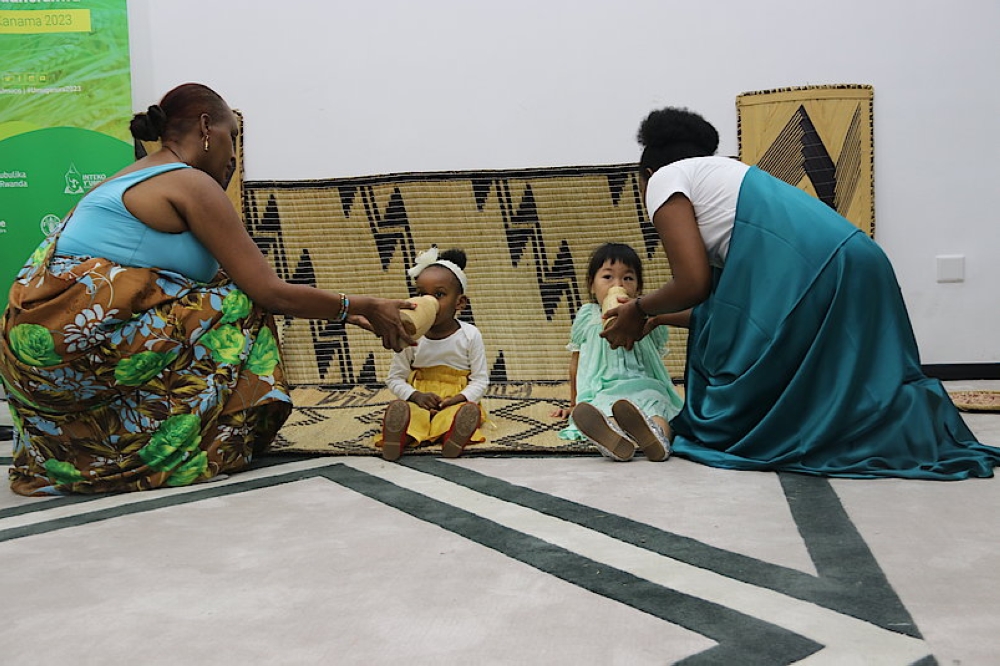
On Umuganura Day, which is a national holiday, Rwandans and their friends celebrate their harvest in ceremonies organised across the country, where they share various traditional foods and give children milk as a sign of promoting their healthy development.
At the national level, this year's Umuganura was celebrated in Kayonza District, Eastern Province. During the harvest day celebrations, Rwandans are encouraged to continue striving for national unity, patriotism and working for the development of the country.
Umuganura 2024 is also an occasion for Rwandans to support the national school feeding programme, thought the 'Dusangire Lunch' campaign.
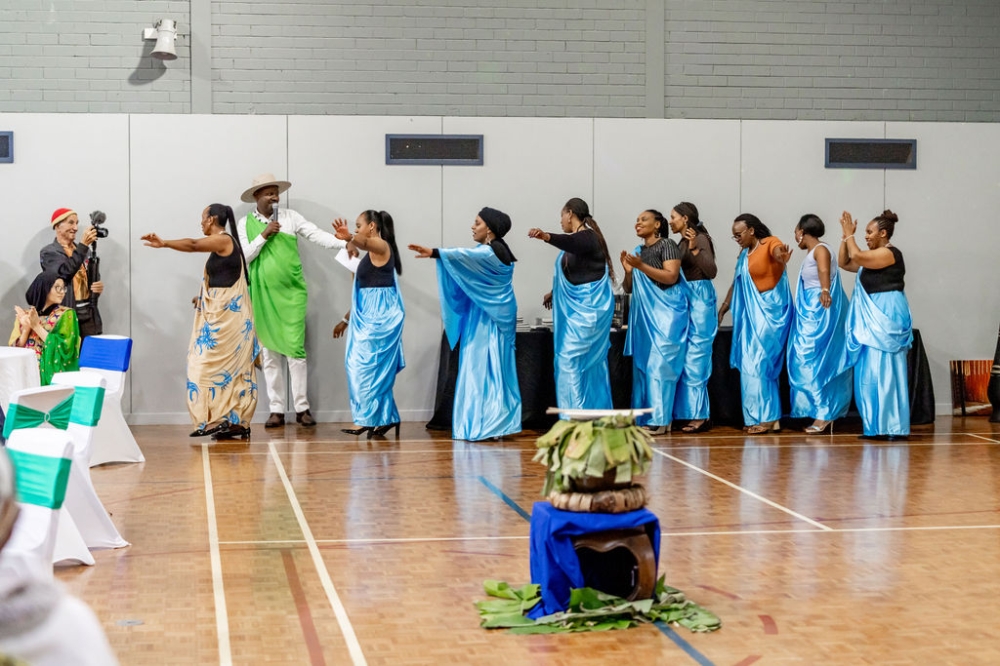
Members of the Rwandan community in various countries will also celebrate Umuganura throughout August with culture promotion activities as well as with contributions to the school feeding programme back home.
Rwanda's Ambassador to China, James Kimonyo, said that the embassy will host the Umuganura event at its office in Beijing, with additional events planned in seven other Chinese cities.
'One of our key activities is the launch of the Dusangire Lunch challenge within our community,' Kimonyo said.
'This involves committing to feed a certain number of students in Rwandan schools to fuel the spirit of solidarity, encouraging contributions towards collective efforts and shared prosperity.'
He noted that such initiatives are not new, as Rwandans in China also participated in the 'Cana Challenge', which contributed to the supply of solar energy in thousands of homes, as part of the national electrification endeavour.
He also urged Rwandans in China, especially students, to celebrate Umuganura by recognizing their role in the future of their families and the country.
'Work hard and ensure your success. Remember that you are contributing to the nation. Don't squander opportunities or misuse them. The celebration is also a reminder for those who did not perform well to improve,' Kimonyo said.
For Lawrence Manzi, Rwanda's ambassador to Brazil, Umuganura 2024 provides an opportunity for the newly opened embassy to promote Rwandan culture in the Latin American country.
'The embassy is just four months old,' Manzi said. 'We don't have a huge diaspora like other countries. However, we are in the process of extending Rwanda's culture to them.'
'Initiatives like Umuganura give us the chance to talk about our country and teach non-Rwandans more about our country,' he said
Prosper Higiro, Rwanda's envoy to Canada, echoed similar sentiments, stating that Umuganura is one of biggest celebrations for Rwandans in North America.
This year's celebrations will be hosted on August 17 in Ottawa.
'Here in Canada, we have established the Rwandan Culture Centre in Ottawa, which educates young Rwandans about their culture, Kinyarwanda, and other civic matters, particularly Rwanda's history,' Higiro said.
'At this year's event, we want to involve these Rwandans to help them understand why we celebrate Umuganura, how it used to be observed, and the bond they ought to share with their mother country.'
He added that the event will be an opportunity to promote the 'Dusangire Lunch' campaign.
Â
Children drink milk from traditional containers (Inkongoro) during the Umuganura celebration in China
Rwandan diaspora dancing Gakondo during the celebration of Umuganura in Western Australia