It was the kind of lower-order Âdemolition job once associated with West Indies, but on a heady third day at Edgbaston the tourists were the ones on the receiving end. Roared on by a capacity crowd after lunch, Mark Wood unleashed a truly Âelectric burst of fast-twitch reverse swing that secured a 3-0 series clean sweep for England.
Not even Ben Stokes promoting himself to opener and crashing the fastest half-century by an Englishman â” 24 balls, beating Ian Botham's long-held record by four â” could knock Wood off the top of the podium after this 10-wicket win. Stokes was murderous, no question, a target of 82 vaporised in about 40 minutes. But Wood, luckless in Nottingham last week despite bowling like the speed of light, was the catalyst here.
Even with a sense of inevitability about the end result after Jamie Smith's stylish 95 led England's turnaround on the second day, there was still a job to be done. And after West Indies hustled to 151 for five by lunch â” a lead of 57 runs â” it looked like that job would involve a good deal of patience. Kavem Hodge was well set on 52, while England knew plenty about the battling qualities of Joshua Da Silva at the other end.
Enter Wood, who was thrown a 41-over old ball by Stokes after the break and set off on a white-knuckle ride. He claimed five wickets in 21 deliveries and each one was met with a collective gasp. Attention may be on the Olympics, where all manner of remarkable feats are being delivered, but this was something to rival all that from a bowler who has a strong claim to be the fastest in England's history.
To say the luck finally turned for Wood here would be to sell short the qualities that led to his fifth five‑wicket haul in Test cricket. Resistance was utterly futile out in the middle, Wood getting the ball to swing in late at speeds above 90mph and sending stumps cartwheeling like the gymnasts in Paris. West Indies may have a diplodocus's tail but a good number of lower orders would have struggled to cope here.
It began with Da Silva being pinned lbw by a full ball â” the wicketkeeper's feet stuck in concrete by the pace and late movement â” and ended with Shamar Joseph fencing meekly to slip. In between there were a pair of clonking clean-bowleds to wipe out Alzarri Joseph and Jayden Seales, while Hodge, one of the bright sparks for West Indies after that memorable century at Trent Bridge, was simply nicked off with a beauty.
After Wood walked off to a Âstanding ovation, the ball raised to all corners as he did so, all that was left was for the openers to negotiate the target. The only catch was that one of them, Zak Crawley, was in hospital having a scan. A fractured little finger was the problem here, Crawley dropping a sharp catch off the bowling of Stokes during a more hard-fought morning session in which Mikyle Louis briefly crackled with 57.
Not for the first time, Stokes stepped up and in the time it took to queue for a pint, the target was monstered. Striking an unbeaten 57 from 28 balls, with Ben Duckett chipping in 25 more, the England captain sent the spectators into raptures â” even if by doing so he also cut short their entertainment. Still, they got to witness a bit of history, Stokes belting Shamar Joseph over deep midwicket for the first of his two sixes and surpassing the 28-ball half-century that Botham struck against India in 1981.
Lord Beefy will probably raise a glass of red to this, although for Stokes, satisfaction was to be found elsewhere. A series that started with an emotional farewell for Jimmy Anderson ended with a handful of newcomers having announced themselves. Among them was Gus Atkinson, who took his tally for the series to 22 wickets when before lunch Surrey's slippery quick pinned Jason Holder lbw for 12, hinted at the reverse that was to follow and ensured Crawley's painful drop was at least not costly in terms of runs.
Smith was another, with scores of 70 at Lord's and 95 here underlining his talents with the bat. Less Âdiscussed was the solid Âwicketkeeping that returned 14 catches and was Âgenerally sound throughout. And while Shoaib Bashir was among the support cast in Birmingham after last week's five‑wicket haul at Trent Bridge, the off-spinner still got things moving on the third morning by trapping Alick Athanaze lbw on the sweep.
There is a case to say that with the series already secured, England should have blooded Dillon Pennington or Matt Potts here. But while Chris Woakes was pretty sore by the end, sending down only a couple of overs on the final day, his role as a home banker was highlighted by four Âwickets in the match and another precious half-century with the bat. As well as being nearly seven years younger, these all-round qualities are what undermine any comparisons with Anderson's enforced retirement.
England have made progress since the 4-1 defeat in India, albeit home conditions and the strength of opposition must be taken into account. That said, for all the obvious concerns about West Indies, a number of green shoots were visible amid the rubble of a one-sided contest: green shoots like the emergence of the stylish Hodge or a pace attack that has the potential to be world beating if afforded time, resources and fixtures.
The question is whether this is actually possible as the red weed of franchise cricket continues its unchecked spread, or whether the global game's priorities require urgent recalibration. With all three grounds packed out for this series â” Test cricket also accounting for the bulk of the broadcast money in this country â” and the Hundred getting off to another low-key start, English cricket's surrender to the current direction of travel is pretty hard to fathom.
Turkey's parliament on Saturday approved a motion to deploy its armed forces to Somalia, Â including to the country's territorial waters.
The two-year operation aims to support Mogadishu's counterterrorism operations and comes months after the two countries signed a defence and economic cooperation deal.
Al Qaeda-linked Al Shabaab has been waging an insurgency against the Somali government since 2006 in a bid to establish to establish a fundamentalist Islamic state.
Turkey has been providing training, assistance, and advisory support to Somalia for more than 10 years, working to restructure its defence and security forces.
But Turkish officials say economic challenges have prevented Somali armed forces from being fully effective.
Earlier this month, Ankara said it will send an exploration vessel off the coast of Somalia later this year to search for oil and gas as part of a hydrocarbon cooperation deal between two countries.
Ordinarily, the history of Rwandan football is one of a modest and locally contained affair with a few foreign players who graced the stage in the 1980s throughout the 1990s.
Traditionally, most of these foreign players were from Burundi, the Democratic Republic of Congo (DRC) and sometimes Uganda.
Notable names include Jean-Marie Ntagwabira (RIP), who played for local clubs during the 1980s going on to become a famous coach, and Hassan Gasana, a prominent striker who played for APR FC and was known for his goal-scoring ability during the late 1990s. Both players were originally from Burundi.
Others are Shabani Nonda, Bokota Kamana Labama (both from DRC) and Uganda’s Ibrahim Mugisha, a highly-regarded goalkeeper who played for APR FC and Rayon Sports during the 1990s and early 2000s.
In modern history, Rwanda, as a country, has blossomed into a beacon of sporting excellence, establishing standard infrastructure as a way of boosting the sports fraternity, especially football.
As thus, Rwandan football clubs, keen on elevating their game and making a mark on the regional stage have started scouting beyond regional borders.
There is an influx of foreign players across the African continent, particularly from the football-rich nations of West Africa.
With countries like Nigeria, Ghana, Ivory Coast and Cameroon, West Africa is a region celebrated for its prodigious footballing talent.
Known for producing world-class players, this region has now become the prime target for Rwandan clubs looking to infuse new energy and skill into their squads.
The latest to join is Agyenim Boateng Mensah, a Ghanaian youngster who last week signed for Huye-based Mukura Victory Sports club on a two-year deal.
As he came to Rwanda, Agyenim was the second top scorer in the Ghana Premier League of the season after netting 14 goals in 19 games.
Before that, others like Michael Sarpong and Olokwei Commodore have also featured in the Rwanda Premier League but Prosper Donkor stands out as the initiator of the exodus of Ghanaian players to Rwanda when he signed for Rayon Sports FC on August 5, 2018.
Today, APR FC has Salomon Banga from Cameroon and Victor Mbaoma, a Nigerian centre-forward who has also played for the Nigeria national football team. Police FC has 22-year-old Odili Chukwuma who was recently signed from Bugesera FC. The list is endless.
The arrival of West African players has brought a breath of fresh air to the league. This is because with their dazzling footwork, tactical acumen, and unwavering determination, they quickly become the heartbeats of their teams.
Festus Adejere is a young Nigerian talent who plays for Second Division Side La Jeunesse FC. He says that he is proud to leverage the insights he gets from his managers and teammates to enhance his professional journey.
'Training sessions here turn into learning experiences, with fellow teammates picking up new techniques, strategies, and a deeper understanding of the game,' he says.
Festus Adejere (L) , a young Nigerian player who plays for Second Division side La Jeunesse FC, poses with fans after a game in which he scored the winning goal.
According to him, the fusion of local enthusiasm and foreign expertise blended with a unique footballing culture makes the game more entertaining and highly competitive.
Adejere, who was his team’s top scorer last season with 14 goals, says that the integration of these foreign players into Rwandan teams has also fostered a sense of unity and camaraderie.
'As you develop further, the impact goes beyond just winning matches. You try to become a mentor or role model for younger Rwandan players, inspiring them to dream bigger and work harder,' he explains.
Adejere (carrying a young fan) says that the integration of foreign players into Rwandan teams has fostered a sense of unity and camaraderie.
This shared love for football has bridged cultural gaps, promoted mutual respect and understanding. Most West African players have embraced Rwandan culture, while locals appreciate the diverse backgrounds and stories their new heroes come with.
Today, the Rwanda Premier League stands as a testament to the power of collaboration and diversity in sports. This has not only raised the standard of football in Rwanda but has also brought a sense of excitement and global connectivity to the league.
As the league continues to grow, striving to be a melting pot of talent, where young Rwandan prospects come together to create football magic, the contribution of West African talent cannot be underestimated.
The status of Rwandan football is a story of ambition, collaboration, and the unifying spirit of the game. It is Sport reimagined, where every match is a celebration of talent and culture.
The beautiful game continues to transcend borders, bringing joy and inspiration to all who witness it.
Second Division side La Jeunesse FC has some players from West Africa
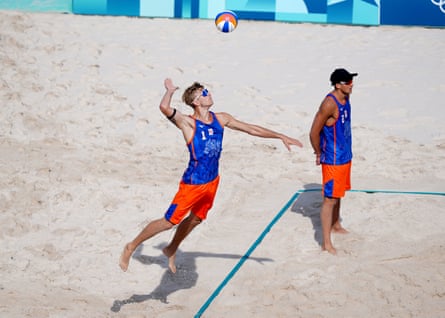
convicted child rapist competing for the Netherlands at the Paris 2024 Olympics was met with boos â” and some applause â” as he walked out for his first beach volleyball match on Sunday.
Steven van de Velde, who was convicted for raping a 12-year-old girl in 2016, lost his first game with partner Matthew Immers. The beach volleyball player has been at the centre of a storm in Paris after victims' groups said his inclusion sent a dangerous message to rapists and would cause 'collateral damage' to victims of sexual abuse.
Boos were audible when Van de Velde was introduced to the crowds at the Eiffel Tower Stadium in central Paris, but were replaced with cheers when his Dutch teammate Immers took to the field of play before the pair's match against Italy.
There had been a mixture of boos and cheers as the players had entered the arena together, but when Van de Velde was introduced on his own, the jeers were more pronounced. While there was some muted applause for the player, there were no cheers. Van de Velde raised his arm as he walked on to the sandy court, which is directly next to the Eiffel Tower.
The Italians Alex Ranghieri and Adrian Ignacio Carambula Raurich took the first set 22-20, the Dutch won the second 21-19, and the deciding third set was 15-13 to the Italians.
Van de Velde, who is now 29, was sentenced to four years in prison in 2016 after pleading guilty to raping the British girl. He had flown to England to meet her in 2014 with full knowledge of her age, having met her on Facebook. Van de Velde served 12 months in a British prison, before being transferred to his home country where he was released after a further month.
The boos that greeted the player are unusual at the Games, and were incongruous in this most spectacular of venues where crowds had earlier performed several Mexican waves and cheered as dancers entertained them between matches.
Two Dutch fans said they had bought tickets for the event a year and a half ago before the scandal blew up. Anna from Utrecht, who did not want to give his surname, said: 'I think he has had his penalty, so now he can start with a clean sheet.'
His friend Jesper, who also did not want to give his second name, said the case had sparked a lot of debate among Dutch people. 'The crime he committed is, of course, a sensitive one,' he said. 'That's why people are also a little bit struggling, because we having conversations like, are we cheering him on, or not? It's different â” if it was any other Dutch person, we wouldn't even have that discussion.' He added that he also thought Van de Velde had served his time and should be allowed to play: 'You respond from emotion, which is completely correct. But we also have a legal system.'
The participation of Steven van de Velde (left) has caused controversy. Photograph: David Davies/PA
Earlier this week the International Olympic Committee faced calls for an investigation into how the player had been allowed to compete at Paris 2024. In an email seen by the Guardian, a senior official with the Dutch Olympic Committee has insisted that Van de Velde was not a paedophile, in response to a concerned British man who lives in the Netherlands.
The man had called the inclusion of Van de Velde in the team 'a stain on the Dutch national side'. In a reply the Dutch Olympic committee spokesperson wrote: 'Steven is NOT a peadophile [sic]; you really don't think that de Dutch NOC would send someone to Paris who IS a real risk? No, he isn't a risk.'
Van de Velde is understood have requested not to stay in the Olympic Village, and has been allowed to absent himself from post-match mixed zone interviews.
The IOC has said that inclusion in competition is a matter for individual nation's Olympic committees. Asked if the IOC was 'comfortable and happy' with Van de Velde's involvement, its spokesman Mark Adams said: 'I think to characterise it as 'comfortable and happy' would not be correct.' He added: 'I think a crime occurred some time ago, 10 years ago. A great deal of rehabilitation has taken place, and there's very strong safeguarding in place also, and I believe ⦠the athlete in question is not even staying in the village.'
In a statement the Dutch Olympic Committee said it had put in place 'concrete measures' to ensure a safe sporting environment for all Olympics participants in light of Van de Velde's participation.
It said Van de Velde had engaged with all requirements and had met stringent risk assessment thresholds, and stated that there is no risk of him reoffending. The committee said: 'Van de Velde has consistently remained transparent about the case which he refers to as the most significant misstep of his life. He deeply regrets the consequences of his actions for those involved. He has been open about the personal transformation he has undergone as a result.'
It said it 'regretted' the 'unforeseen renewed attention, on social media in particular, for those struggling with trauma from sexual offences and transgressive behaviour'.
White House administrator Pete Buttigieg says it is 'a bad look' for Republicans to call Kamala Harris a diversity hire in their attempts to slow down the momentum that has greeted her ascent to the top of the Democratic ticket for November's presidential race.
On Saturday's episode of the New York Times podcast The Interview, the Democratic transportation secretary said 'you can tell' that is the case because of how even Republican US House speaker Mike Johnson has tried to distance himself from that line of attack against Harris.
'You got somebody like Mike Johnson, who is a very, very conservative figure ⦠telling his own caucus, like, 'Hey, cool it,'' Buttigieg remarked to podcast host Lulu Garcia-Navarro. 'He's basically saying that they are embarrassing the party, and I think acknowledging that they are diminishing the party's chances by indulging in that kind of rhetoric.'
Buttigieg added: 'And the fact that they can't think of what else to do, besides go right to race and gender, isn't just revealing about some of the ugliest undercurrents in today's Republican party â” it's also profoundly unimaginative because it means that they can't speak to how any of this is going to make people's lives better.'
Harris, a former California attorney general and US senator who is of Indian and Jamaican heritage, became the first woman to be elected vice-president when Joe Biden won the Oval Office in 2020. She is now poised to become the first woman of color to lead a major-party presidential ticket after Biden halted his re-election campaign on 21 July and endorsed her, setting the stage for Harris to reportedly raise $200m for her political warchest in a matter of days.
Supporters of the Republican nominee Donald Trump â” who lost the presidency to Biden â” have met those accomplishments by disparaging Harris as a hire resulting from diversity, equity and inclusion initiatives. While grappling with a criminal conviction for election-related fraud in a case involving an adult film actor who alleged an extramarital sexual encounter with him as well as other prosecutions pending against him, Trump has insulted Harris as 'crazy', 'nuts', 'dumb as a rock' and â” at a rally on Friday â” 'a bum'.
That approach prompted some Republican leaders to try to warn party members against aiming overt racism and sexism at Harris. Those included Johnson, who said at a Tuesday news briefing: 'This election will be about policies and not personalities.'
The Louisiana congressman added: 'This is not personal with regard to Kamala Harris, and her ethnicity or her gender having nothing to do with this whatsoever.'
Opinion polls show Harris is running a tight race with Trump after Biden had fallen several points behind, with support in vital swing states plummeting.
Buttigieg â” the ex-mayor of South Bend, Indiana, who unsuccessfully sought the Democratic presidential nomination in 2020 â” is considered to be among a field of contenders to be Harris's running mate. And in fact, a National Public Radio/PBS News/Marist poll showed him tied as the most popular Democratic vice-presidential candidate for the fall election.
He declined to tell Garcia-Navarro whether he believed he would make a good vice-president.
'I don't think it's appropriate for me to talk like that knowing that the person who needs to make that decision is ⦠her ┠not me,' Buttigieg said. 'I don't think it's appropriate for me to wander down that path with you right now.'
The legendary Kenyan opposition leader made the remarks after signing the AUC Chair application documents on Saturday, July 27, 2024.
'I signed off my AUC Chair application documents. We are focused on bringing the seat home for Kenya and serving the African people,' Odinga stated.
Raila Odinga (center) signs the AUC Chair application documents on Saturday, July 27, 2024.
Thereafter, Foreign Affairs Principal Secretary, Korir Sing’oei confirmed that all was set for the submission of Odinga’s application documents.
'All-Set-Go!' Sing’oei captioned social media photos showing bundles of the documents set to be submitted to the AU Secretariat for consideration.
August 6, 2024, is the deadline for submission of candidatures for the coveted continental job.
Odinga, who previously served as African Union High Representative for Infrastructure Development, is seeking to succeed Chad’s Moussa Faki in elections slated for February 2025.
He is among four renowned African leaders who have declared interest in the job. Others are former Seychelles Vice President Vincent Meriton, Djibouti’s Minister of Foreign Affairs Mahmoud Youssouf, and ex-Somali Foreign Minister Fawzia Yusuf.
Huge Boost
Odinga received a huge boost in his bid earlier this year when the African Union Executive Council unanimously resolved that candidates for the position of the next chairperson of the AU Commission would be nominated by the Eastern African regional states.
Several African Heads of State, including President Paul Kagame and Uganda’s Yoweri Museveni have since expressed their support for Odinga to clinch the top job.
Others are Samia Suluhu of Tanzania, Salva Kiir Mayardit of South Sudan, and Ghana’s Nana Akufo-Addo.
Malawi President Lazarus Chakwera and his Zambian counterpart Hakainde Hichilema have also pledged to support Odinga’s bid.
The chairperson of the AU Commission is the Chief Executive Officer of the African Union. The position is crucial in driving the Union’s agenda and representing the continent on the global arena.
Candidates for the position are nominated by member states of the African Union. A high-level panel of eminent Africans is responsible for assessing and shortlisting the nominated candidates based on their qualifications, experience, and leadership abilities.
The final election is conducted by the Assembly of the African Union, which comprises representatives from all member states. The election is held by secret ballot, and a two-thirds majority of eligible member states is required to elect the Chairperson.
The successful candidate serves a four-year term, renewable once.
Former Kenyan Prime Minister Raila Odinga is optimistic that he will emerge victorious in the race for the chairperson of the African Union Commission (AUC).
Under the theme “Building Resilient and Sustainable Food Systems,” the exposition serves as a platform for stakeholders to exchange knowledge, explore business opportunities, and foster partnerships that can contribute to the growth and development of Rwanda’s agriculture sector.
According to Dr Olivier Kamana, the Permanent Secretary at the Ministry of Agriculture, the show aims to showcase the latest advancements and technologies in the agricultural sector.
'It offers an unequalled opportunity to leverage the showcasing of agricultural technologies and innovations, access to financial and entrepreneurship opportunities to fast track agriculture sector transformation,' he said in a statement.
The Agrishow has become a flagship event in the agricultural sector, attracting farmers, agribusinesses, policymakers, researchers, and international exhibitors.
Agriculture is the backbone of Rwanda’s economy.
This year’s show promises to be bigger and better as it has already started attracting engaging discourse.
Elie Mugisha, a modern farming and communication enthusiast says that sustainable farming and conservation agriculture are some of the issues he is expecting to acquire more knowledge about.
'You will meet expertise in fish farming who are making it a big business nowadays. Do not plan to miss this one,' he said ahead of the event.
The Agriculture show 2024 is expected to unveil the latest advancements and technologies in the agricultural sector.
The organizers have already received an overwhelming response from exhibitors, with various participants registering for the event so far.
They expect a diverse group of participants from within the region and beyond highlighting the international interest and recognition of Rwanda’s agricultural potential.
Visitors will expect a wide array of exhibits, including agricultural machinery, livestock, seeds, fertilizers, agro-processing technologies, and innovative solutions for sustainable farming practices.
The show will also feature live demonstrations, expert presentations, panel discussions, and networking opportunities, making it a comprehensive and interactive experience for all attendees.
Farmers, entrepreneurs, researchers, students, and anyone interested in the agricultural sector are encouraged to seize this opportunity to learn, connect, and explore the future of agriculture in Rwanda.
According to Dr Olivier Kamana, the Permanent Secretary at the Ministry of Agriculture, the show aims to showcase the latest advancements and technologies in the agricultural sector.
The two leaders met on the side lines of the ongoing Olympics in Paris, France, on Saturday.
In a brief statement, President Kagame said they discussed their shared commitment to fruitful bilateral cooperation, including strengthening partnerships in trade, sports, technology, and environmental protection.
The UK and Rwanda have been developing a strong commercial relationship in recent years, with growing interest in expanding trade volume.
The UK is a leading investor in Rwanda, particularly in the tea sector. More than 150 British companies are registered in Rwanda.
Additionally, the UK government is actively involved in supporting Rwanda’s business environment through initiatives like the Rwanda Investment Climate Reform Program.
First Meeting
Saturday’s meeting was the first since Starmer’s Labour Party was voted into government earlier this month, ending the 14-year dominance of the Conservative Party.
Starmer’s ascent to the high office was, however, marked by controversy following his decision to scrap the UK-Rwanda migration deal introduced by the Conservative Party.
The UK-Rwanda Migration and Economic Development Partnership was signed in April 2022. The deal aimed to deter unauthorized immigration, especially people arriving by small boats, by referring the asylum seekers to Rwanda.
The migration scheme was set to kick off in July after a two-year delay occasioned by court battles and opposition from a section of Members of Parliament.
Starmer argued that the policy was neither a deterrent nor value for money. He has pledged to tackle the issue ‘upstream’ by getting rid of people-smuggling gangs behind the movements.
In response to the termination of the deal, Rwanda reaffirmed that it was committed to addressing the global migration crisis despite the setback.
'We remain committed to finding solutions to the global migration crisis, including providing safety, dignity and opportunity to refugees and migrants who come to our country,” the Government said.
The two leaders met on the side lines of the ongoing Olympics in Paris, France, on Saturday.
President Paul Kagame and UK Prime Minister Keir Starmer during the meeting on Saturday, July 27, 2024.
A winter's day, 2015, New York. Investigator Victor Burgos turned over the conversation he was about to have in his mind. In the next minutes, he was either going to recruit an ally in the fight against anti-doping or have a hostile, frustrating encounter that would send him back to the drawing board. Chances were it would be the latter. The omertà of dopers matches the mafia. No one talks. Few inform on their peers.
He was meeting a distance runner who was blissfully unaware of what was coming. The man was superb by normal standards, his marathon Âpersonal best well within what might be regarded as world class. In Kenyan terms, though, he was a mid-ranker and never going to be an Olympic superstar. He also had tested positive for 19-Ânortestosterone, a hardcore steroid.
The man appeared. Burgos approached him with a United States Anti-Doping Agency (Usada) business card in hand and a copy of the letter containing all the details of the positive test. Burgos introduced himself and was required to read the athlete his rights, especially regarding the opportunity to check the positive finding by having his B sample tested. (Laboratories always split an athlete's urine sample, test half â” the A sample â” and leave half â” the B sample â” so that it can be used to corroborate the first test with the athlete and advisers present. It almost always produces the same result.) Burgos chose his words carefully. 'This is not the end of the world,' Burgos recalls telling the athlete. 'This doesn't define who you are. If you made a mistake, we can talk about that.'
The way Burgos tells it, he was offering an opportunity to lessen the gravity of his punishment, an opportunity to provide 'substantial assistance' to Usada to help catch other dopers. It is a provision of anti-doping rules open to all but rarely used, because most athletes remain in denial, insisting they have done nothing wrong and that their positive test is mistake. 'He was shocked, and he was dishonest at the beginning,' said Burgos. 'He said: 'I don't know how the substance entered my body, this is a lie.'' 'Why don't we take a walk,' suggested Burgos. 'Let's grab a coffee.'
As they walked, they talked. It was deliberately far removed from the classic good cop-bad cop interrogation scene, sat behind a table in a darkened room. Burgos is chief investigator at Usada and he sees the results of all positive tests in the United States. Something in this one caught his attention. The substance, for one: 19-nortestosterone is a red flag for intentional doping.
Then the athlete's competitive record was intriguing, plying his trade on the US road race circuit, a subgenre of the sport but lucrative, especially for a young African, because you might win $10,000 (£7,750) prize money at a marathon or $5,000 at a 10k race. The races take place in mid-sized American cities, less exalted locations than London, New York and Chicago, and prize money isn't the $55,000 on offer for winning a major marathon. But clock up a few of these wins in a year and it's a decent living. The athlete was unlucky. In many of these lower-level road races, there is no anti-doping. His misfortune was Usada turned up at his event.
Burgos had weighed all this up. An established Olympian with a reputation to lose is less likely to talk; this guy, more so. The final piece of the jigsaw was his address in New York. Burgos lives in the city. So it was not a huge call to go to his apartment.
'Ninety-nine per cent of the time when athletes tests positive an organisation will email them,' said Burgos. 'We send a list of options in a very legalised notice letter and that's the end of it.' That email comes with a blizzard of acronyms and legalese. 'Usada collected a sample, your A sample shows an adverse analytical finding [AAF], which is a potential anti-doping rule violation [ADRV] â¦'
Burgos spoke with Usada's general counsel and asked him to hold off sending the email notification. 'I want to notify him personally,' he told him. 'I'll go to his apartment, tell him face to face.'
After the initial confrontation, the athlete accepted the offer of coffee. 'We walked around Manhattan and I was trying to soften the blow,' said Burgos. 'I don't want him to walk away distraught. People handle bad news in their own way, and I don't want to be the bearer of news that leads to somebody harming themselves. All I know about him is what I've pulled up online.' They went to Starbucks. 'OK. Let's talk it through,' said Burgos. 'Let's talk about where you were before you arrived in the US to compete in this event.'
Burgos knew that he had come from a camp in Kenya and that this athlete trained with a well-known group. (The camp has a strong anti-doping policy and several measures in place to enforce it. Many athletes train there without using performance-enhancing drugs.) Burgos quantified the athlete's responses. 'How much of an investment am I going to make in allowing him to be dishonest? He's not going to spill his guts to me. I just met him. He needs to understand who I am, am I trying to trick him?'
The young Kenyan was preparing for a new training camp with a group in the US where athletes make use of long mountain trails and altitude, which benefits their oxygen-carrying red blood cell production. Many runners go there and do not take performance-enhancing drugs. But some take advantage of the extensive networks of drug dealers operating there with the favoured performance enhancers, EPO â” the drug that increases oxygen carrying red blood cells â” and steroids.
What was on offer was a deal. Go undercover and provide the authorities with information about other dopers he was in contact with and he could keep running. It was more than a week before they met again. By then a formal cooperation deal was on the table and the federal Drug Enforcement Agency was now involved. The performance-enhancing drugs commonly used by distance athletes who dope potentially break US federal law, so the athlete became a DEA undercover informant.
It's the stuff of Hollywood, Donnie Brasco with an anti-doping context, though that shouldn't trivialise the seriousness. A working model became apparent to investigators from the athlete's experience. Young Kenyan athletes were encouraged to the USA, entered in the B-list road races where no anti-doping was expected. They were provided with the means to dope and with their natural talent and pharmaceutical enhancement, they often won. Whether the athletes received all the prize money and how much was deducted for 'expenses' was unclear.
'There's a certain level of desperation in athletes who allow themselves to be sucked into this doping scheme because of the level of poverty, the lack of education and promises to travel outside Kenya,' said Burgos. 'These are the systemic reasons why this happens. The ones we are trying to hold accountable are those who are facilitating this, recruiting these young athletes, promising them the world and doping them, some unwittingly, some not. That's the real layer we want to uncover.'
The athlete was in effect placed back into the training group, with no initial sanction, as that would have attracted suspicion, and he was allowed to compete. (His performances at the races at which he had doped previously would be annulled later when his reduced sanction was applied.) There was one condition: no doping.
'We were actively testing him during that period, so he was not allowed to dope and he was to tell us right away if he did,' said Burgos. 'We had notified the World Anti-Doping Agency [Wada] and the international federation for track and field, and they all signed off.'
But now the drug testers had an inside man. 'It was absolutely not something we could [enter into lightly],' said Burgos. 'I stayed plugged in and we communicated with him regularly to make sure he was mentally OK. And this particular training group was not the only one. There was another training group we spent a lot of time on.'
The benefit for testers is that training time is when doping is rife. 'Intentional dopers who test positive in competition have generally erred or something has gone horribly wrong, like they took too great a dose, too close to competition,' said Burgos. 'Doping occurs during training. It allows you to train harder and to recover from that training and from injury.'
Many drugs have a specific and short window in which a test can detect them. This kind of intelligence means that the anti-doping authorities can target their testing precisely and catch cheats out. However, it isn't just about testing. Anti-doping agencies don't have to have a positive test to ask for a ban. Testimony from whistleblowers, evidence from email chains, possession â” offences known as non-analytical violations â” can also be used to ban an athlete.
The decimation of Kenyan distance running
In May 2015, an athlete living in Albuquerque found himself pulled over in his car by DEA agents. He hadn't known he was under surveillance, but the agents had a good idea of what would they were looking for because of their inside line. With few good options, he consented to their request to search his premises.
What they found was vials of AICAR, a muscle-building, fat-burning drug favoured by cyclists and long-distance athletes. Though a distance runner himself, his best days were behind him. He was supplying elite athletes training in Albuquerque. He would receive a four-year ban and left the US. An associate, also identified and tested by intelligence several years later, received an eight-year ban.
In this period around when the intelligence operations were running, Kenyan distance running was decimated. The image of the Kenyan runner effortlessly striding past European and American counterparts on the back of their clean-living lifestyle and 10-mile runs to school in the high-Âaltitude Rift Valley in one of the most enduring in sport. But it was shattered by Âtarget testing.
The most high-profile Kenyans to face sanctions during that period included Wilson Kipsang, the former marathon world record-holder and 2014 London Marathon winner. He did not fail any drugs tests but received a four-year ban for four 'whereabouts failures' between April 2018 and May 2019, meaning he wasn't at the address he specified to drug testers at the appointed hour he had requested.
That is a condition all elite athletes have to fulfil so that they are available for testing. More than two missed appointments in a 12-month period results in a ban. Kipsang insisted that he had never used prohibited substances or methods and that drug testers had made procedural errors, wrongly rejecting his reasons for missing tests. However, the hearing found against him, concluding he had falsified evidence.
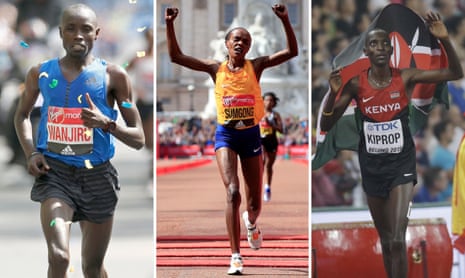
The Kenyan runners Daniel Wanjiru, Jemima Sumgong and Asbel Kiprop have all faced sanctions for drugs offences. Composite: Action Images/Reuters; PA Images; AP Photo
Jemima Sumgong, the 2016 Olympic marathon champion and London Marathon winner the same year, was banned for eight years in January 2019 after World Athletics, the sport's governing body, ruled there was 'compelling evidence' she had fabricated her medical records and lied about her whereabouts after a positive test for EPO in 2017. Sumgong contested the findings and claimed emergency medical treatment was likely responsible for the positive test.
Daniel Wanjiru, the 2017 London Marathon winner, was banned in October 2020 until December 2023 after the blood passport, which athletes have to provide, showed 'abnormalities' which the Athletics Integrity Unit (AIU) concluded were 'highly likely ⦠caused by the use of prohibited methods'. He had been tested 16 times between April 2017 and 2019 and his 14th test had shown elevated levels of haemoglobin concentration. He denied ever using performance-enhancing methods or drugs and his management company expressed their 'disappointment' with the decision.
Asbel Kiprop, 2008 Olympic 1500m champion and triple world champion, was banned for four years in April 2019 after testing positive for EPO, a red blood boosting product. He has consistently protested his innocence.
There are currently 91 Kenyan track and field athletes listed as banned by the AIU, an agency which worked with the Usada intelligence gathering programme. That makes them top nation on the doping list, ahead of India on 90 and Russia on 78. Burgos's informant did eventually receive a sanction and have their races before the dope test annulled from the record but long after the original test, during which time he was an undercover runner.
For some it seems extreme but Burgos insisted: 'Testing is not enough. Just look at the hard numbers. Globally we collect 250,000-300,000 samples annually and less than 0.5% come back positive. That's just not acceptable. This is the level of action you require. You need to get creative. But it comes with a level of risk and many organisations are risk averse. It is just very scary for them to sign off on something like that. Fortunately we have a chief executive in Travis Tygart who is like-minded. Only through the power of investigations are you going to peel back layers of organised doping schemes. That's what we employed in this case.'
It was 1968 at Mexico City that the Kenyans first made their mark on the Olympics, Kip Keino the most-remembered of their three gold medals in an era when their athletes were clean, fuelled only by the Rift Valley mountain air. Their subsequent domination of running and the small fortunes to be made from it means that today's picture seems an awkward juxtaposition with that age of innocence.
For legal reasons and to protect the identity of those involved in undercover operations the Observer has agreed not to name individuals
Public allegations of sexual harassment are rare in China. Swift responses to punish the accused are rarer still. So a recent case at one of China's top universities, in which a student posted a video online accusing her supervisor of sexually harassing her, leading to his sacking, has created shockwaves.
On 21 July, a woman who identified herself as Wang Di posted an hour-long video on Weibo, in which she accused her PhD supervisor at Renmin University in Beijing, Wang Guiyuan, of physically and verbally abusing her for more than two years. The professor, a former Chinese Communist party representative at the university, threatened to block her graduation prospects, Wang Di said.
Her video included an audio recording of one encounter in which a man is asking to kiss a woman, who repeatedly refuses. 'I am reporting my professor, Wang Guiyuan ⦠for sexually harassing and forcibly molesting me, and requesting to have a sexual relationship with me,' Wang Di said. The audio could not be independently verified.
By the following evening, the student's video had received more than 2m likes and prompted an outpouring of supportive comments. A related hashtag soon surpassed 110m views. Within a day, the university said that after an investigation, the allegations were proven to be true, although the university's statement referred to 'moral misconduct', not sexual harassment. Wang Guiyuan was fired from the university and expelled from the CCP. Local police said they were investigating the claims. Wang Guiyuan did not respond to a request for comment.
But the speed at which the Renmin case was dealt with masks the facts that allegations of sexual harassment and abuse are often dismissed or downplayed if made privately, and that women face enormous risks in speaking out, Chinese feminists and legal experts say.
A supporter of Zhou Xiaoxuan outside Haidian district people's court in Beijing on 2 December 2020. Photograph: Noel Celis/AFP/Getty Images
The Renmin case demonstrates the consequences of a university lacking a proper internal procedure for handling complaints, said Feng Yuan, who founded a helpline for victims of domestic violence. 'It is assumed that the victim must reveal his or her identity and speak out in this way.'
On Weibo, Zhou Xiaoxuan, a screenwriter who goes by the pen name Xianzi, wrote: 'Universities systematically cover up teachers' behaviour and systematically ignore the situation of students. Only a very small number of students who can't stand it, risking slut-shaming and cyberbullying, seek help from public opinion.'
In 2018, Zhou discovered her own uneasy fame after she publicly accused a famous television presenter, Zhu Jun, of forcibly kissing and groping her during an internship. Her lawsuit against him ultimately failed because of insufficient evidence. Sexual harassment cases in China often require 'smoking gun' evidence such as audio or video recordings of the alleged abuse.
Other women have come forward on social media with their own accounts of campus harassment. 'Thank you sister for speaking out. I too was sexually assaulted by my post-doctoral professor 3 years ago and still have no outcome after calling the police and reporting it,' one user wrote on Weibo.
On 24 July, Shaanxi normal university said that it had suspended a professor accused of 'violating teacher ethics' in 2017, adding that it had 'zero tolerance' for misconduct.
The statement didn't provide details about the nature of the allegation: sending explicit photographs to female students.
Feminists have pointed out that Chinese institutions â” schools, courts, the police â” tend to avoid naming sexual abuse directly, preferring instead to treat the matter as a misunderstanding or moral failing between two people. Such a strategy is a way of dealing with gender-based violence 'in a way that does not touch the essence of the problem', Feng said.
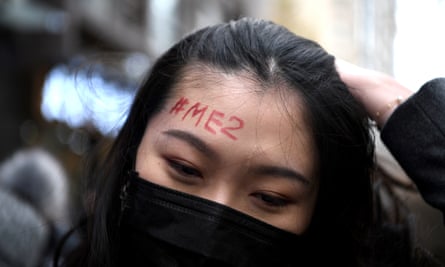
Organised feminist activity has largely been squashed in China, with activists facing severe punishments. In June, Sophia Huang Xueqin, a journalist who reported on China's nascent #MeToo movement, was jailed for five years for inciting state subversion.
Feminism in China has been forced to become 'very decentralised and individualised', said Li Maizi, a veteran activist who is now based in the US. That means that women who speak out against abuse by people in positions of authority shoulder all the risks themselves.
One of those risks is being sued â” by the alleged harasser. In May, a court in Beijing heard a defamation case filed by Li Songwei, a celebrity counsellor, against a woman who accused him on social media of engaging in an inappropriate sexual relationship with her when she was his client.
And Xianzi, the screenwriter, was sued by Zhu for defamation after she made her MeToo accusation against him (he dropped his lawsuit due to poor health last year).
Research by Darius Longarino, Wei Changhao and Yixin Ren of the Paul Tsai China Center at Yale Law School suggests that only 8% of civil lawsuits relating to sexual harassment are cases in which an alleged victim is suing an alleged perpetrator. The majority of lawsuits are lodged by the accused, often for defamation.
But despite the risks, some women will continue to speak out publicly, Li predicts, 'because where there's repression there's resistance'.