Arsenal have joined Paris Saint-Germain and Atletico Madrid in the race to sign Manchester City forward Julian Alvarez but may need to make further sales to fund his arrival, with City demanding £80m in a deal with add-ons. (Mirror)
Manchester United and Chelsea have both been scouting 16-year-old Real Madrid defender Joan Martinez, but Los Blancos are calm as they don't believe the teenager wants to leave. (Diario AS)
RB Leipzig are preparing for the departure of star midfielder Dani Olmo, though there are still details to be negotiated with the German club wanting â¬60m from Barcelona for his signature. (Marca)
Ostracised Chelsea midfielder Conor Gallagher has held positive talks with Atletico as his â¬40m move to Spain gathers pace. (Fabrizio Romano)
Chelsea want to sell Gallagher / Jonathan Moscrop/GettyImages
Man Utd have scheduled a medical for incoming right-back Noussair Mazraoui and the Red Devils could even have the Morocco international available for the Community Shield next week. (Santi Aouna)
Mazraoui's arrival could see Aaron Wan-Bissaka leave Old Trafford. The former Crystal Palace defender has been linked with West Ham United but is now also being targeted by Serie A champions Inter. (Football Insider)
Bournemouth are adamant they will not sell striker Dominic Solanke for less than his £65m release clause as Tottenham Hotspur mull over a deal. (Mirror)
Liverpool are ready to duke it out with Newcastle United in the bidding for Palace defender Marc Guehi and also want to add left-back Julio Soler to their ranks as a long-term replacement for Andy Robertson. (Sun)
Atletico are ready to rival Real Madrid for Spain international Aymeric Laporte, who is keen to terminate his contract with Saudi Pro League side Al Nassr and return to Europe. (El Chriniguito)
Rioters will 'pay the price' for the wave of violent clashes that has spread across the UK, ministers warned on Saturday, after a day in which police battled rival groups of demonstrators in the worst outbreak of civil disorder in Britain for more than a decade.
Dozens of arrests were made after the scenes of disorder, with police warning that further violence is likely in the coming days.
Multiple towns and cities saw clashes between anti-immigration demonstrators and counter-protesters, with police officers attacked and injured, and many more arrests promised.
The home secretary, Yvette Cooper, said the police would have the government's full support to take the strongest possible action. 'Criminal violence and disorder have no place on Britain's streets,' she said.
'Anyone who gets involved in criminal disorder and violent thuggery on our streets will have to pay the price and they should expect there to be arrests, prosecutions, penalties and the full force of the law including imprisonment and travel bans. There are consequences for breaking the law.'
The widespread clashes pose the first big challenge to Keir Starmer's new government, which is facing demands to introduce emergency powers to stop further violence and to recall parliament.
On Saturday bricks were hurled at police officers in Stoke-on-Trent, fireworks were thrown amid tense exchanges between an anti-Islamic group and an anti-racism rally in Belfast, and windows of a hotel which has been used to house migrants were smashed in Hull, where three police officers were injured and four people arrested. Later video footage on social media showed shops on fire. Several officers were also injured during 'serious disorder' in Liverpool city centre, where bricks, bottles and a flare were thrown and two officers needed hospital treatment and six arrests were made. Greater Manchester police said a dispersal notice had been authorised for the city centre. Scuffles broke out as opposing groups faced each other in Nottingham's Old Market Square with bottles and other items thrown from both sides.
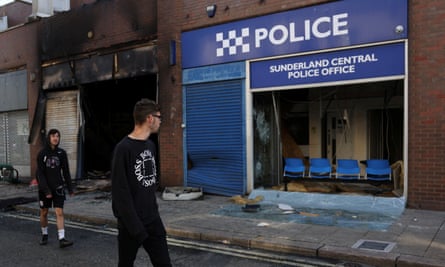
People walk past Sunderland Central Police Office after a night of violent anti-immigrant demonstrations, in Sunderland on 3 August. Photograph: Hollie Adams/Reuters
About 150 people carrying St George's Cross flags, shouting 'you're not English any more' and 'paedo Muslims off our street', were greatly outnumbered in Leeds by hundreds of counter-protesters shouting 'Nazi scum off our streets'. Skirmishes broke out between demonstrators and punks ┠in town for a festival ┠in Blackpool, with bottles and chairs thrown.
In Bristol, police kept protesters and counter protesters apart before a group headed to a hotel used to house asylum seekers.
The need for urgent political intervention was stressed by the government's independent adviser on political violence and disruption, Lord Walney, who told the Observer that new emergency powers may be needed. 'The system isn't set up to deal with this rolling rabble-rousing being fuelled by far-right actors,' he said.
'I think home office ministers may want to look urgently at a new emergency framework ┠perhaps temporary in nature ┠that enables police to use the full powers of arrest to prevent people gathering where there is clear intent to fuel violent disorder.'
Keir Starmer held a meeting of senior ministers on Saturday in which he said police had been given full support to tackle extremists who were attempting 'to sow hate by intimidating communities'. He made clear that the right to freedom of expression and the violent scenes over recent days were 'two very different things'.
Last week's riots followed the killing of three young girls at a Taylor Swift-themed dance class in Southport on Monday. Axel Rudakubana, 17, from Lancashire, is accused of the attack, but false claims were spread online that the suspect was an asylum seeker who had arrived in the UK by boat. In the wake of these messages, far-right protesters â” guided by social media â” gathered in cities across the country.
A key factor in this spread of online disinformation involved Elon Musk's decision to allow rightwing activists such as Tommy Robinson back onto his social media platform X, said Joe Mulhall, director of research at Hope not Hate, the anti-fascism organisation. 'The initial disinformation and anger was being perpetrated by individuals on Twitter, for example, that have been previously deplatformed,' he said. 'And now they've been replatformed.'
Robinson was permanently banned from the platform (then called Twitter) in March 2018, then reinstated in November last year, after Musk bought it. 'We hadn't seen any significant numbers at any demonstrations since 2018,' Mulhall added.
An example of the danger posed by the misuse of social media was revealed in Stoke-on-Trent, where police were forced to deny there had been a stabbing, countering claims made on social media. 'There is growing speculation that a stabbing has taken place as a result of the disorder today. We can confirm this information is false and no stabbings have been reported to police or emergency responders, despite videos fuelling speculation on social media,' police said.
The danger of such intervention was stressed by Ben-Julian 'BJ' Harrington, the National Police Chiefs Council lead for public order, who condemned social media disinformation as a cause of last week's disorder.
He said: 'We had reports today that two people had been stabbed by Muslims in Stoke ┠it's just not true. There's people out there, not even in this country, circulating and stoking up hatred, division and concerns in communities that they don't care about, don't know and don't understand.'
Harrington, who was also the NPCC's gold commander in charge of national strategy for Saturday's disorder, said that 'yobs and thugs and criminals' were responsible. 'This isn't about protests,' he said. 'This is about violent disorder. This is about people who are descending into communities and causing damage ┠throwing bricks and bottles and things at cops who work within those communities.'
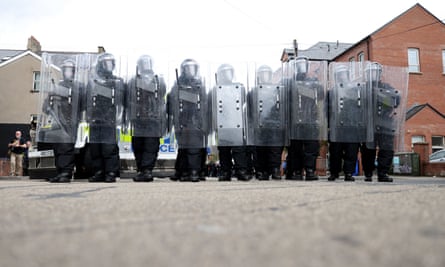
Riot police form a line on the Lower Ormeau road after protesters make their way through the area following a protest outside Belfast City Hall. Photograph: Peter Morrison/PA
Forces across England brought officers back from leave to deploy an extra 130 police support units ┠about 2,000 officers, he revealed. 'Of course there is a limited number of officers, and every one that is taken from a community is not out there solving burglaries.'
Echoing concerns about the dangers of social media, shadow home secretary James Cleverly called for tech companies to be hauled into Downing Street to ensure they were acting to stop the spread of disinformation on their platforms. However, he was criticised for issuing a statement in which he said Starmer taking the knee had sent 'completely the wrong message' to protesters, adding that there was 'never a justification for disorder like this'.
There was also further condemnation of Nigel Farage's role in inciting the violence with his comments about the Southport killings, in which he questioned 'whether the truth is being withheld from us' after the attack on Monday. Robert Jenrick, one of the favourites in the Tory leadership race, said that the Reform leader's comments did not 'make the situation better'.
Last week's clashes spread four days ago, when more than 100 protesters were arrested on Whitehall, where bottles and cans were thrown at police, while violence also broke out in Hartlepool and in Manchester.
On Thursday, Starmer announced a new 'national' response to the disorder linking police forces across the country through shared intelligence and the expanded use of facial recognition.
Then, on Friday, about 500 people, including some parents with their children, gathered in Sunderland city centre, responding to far-right social media posts to turn up and demonstrate. The gathering quickly descended into violence, with masked boys and men throwing missiles, including bricks, stones, beer barrels and scaffolding poles, at riot police.
Ten people were arrested and four policemen taken to hospital, one seriously injured. A police station was ransacked and a Citizens Advice Bureau set alight. By Saturday morning, the acrid smell of fire still hung in the air. Shoppers stopped to express their shock at what had happened, with hundreds of residents of all ages gathering on the city's streets with brushes, litter pickers, buckets, bin bags and dust pans.
The Sunderland Central Labour MP, Lewis Atkinson, said a link could be drawn between the disorder and the ashes of the English Defence League (EDL), which was founded by Robinson, whose real name is Stephen Yaxley-Lennon. The EDL has disbanded but its supporters remain active, and Atkinson said evidence suggested a neo-Nazi offshoot of the group was involved in Friday's violence.
A priest at Sunderland Minster said yobs tried to smash a gravestone to use as missiles during the disorder that gripped the city. 'It's an act of sacrilege to disturb someone's gravestone,' said Rev Jacqui Tyson. 'It's also remarkably lacking in common sense â” have you tried to pick up a gravestone?'
Donald Trump says he would be willing to debate Kamala Harris on the friendly environs of Fox News in September â” but the vice-president has not signed on to what would be a switch-up.
Trump had previously agreed to appear on ABC News and debate Joe Biden a second time this year before the president ended his re-election campaign.
In a statement on his Truth Social platform, Trump said the debate would be held on 4 September in Pennsylvania. The former president said that there was a conflict of interest at play after filing a defamation lawsuit against ABC and network host George Stephanopoulos over the anchor's assertion that Trump had been 'found liable for rape' in the E Jean Carroll case.
Trump earlier this year was ordered to pay $83m for defamatory statements he had made about the magazine columnist after an earlier case found him liable for defamation and sexual abuse.
'The Debate was previously scheduled against ⦠Biden on ABC, but has been terminated in that Biden will no longer be a participant, and I am in litigation against ABC Network and George Slopadopoulos, thereby creating a conflict of interest,' Trump wrote.
The former Republican president added that the site of the debate on Fox News â” which is generally welcoming to the GOP â” had not been determined. But he said the moderators would be Fox News' Bret Baier and Martha MacCallum, and the rules would be similar to his 27 June debate with Biden â” except that this time there would be a studio audience.
But on Saturday, in a statement that invoked Trump's previous challenge to debate Biden at any time or place, Harris's campaign made clear she did not agree to the terms of the proposed Fox News debate. And she particularly rejected using that debate to replace the ABC one.
'Donald Trump is running scared and trying to back out of the debate he already agreed to and running straight to Fox News to bail him out,' Harris campaign spokesperson Michael Tyler said in a statement shared on X by NBC News political correspondent Yamiche Alcindor.
'He needs to stop playing games and show up to the debate he already committed to on [10 September]. The vice-president will be there one way or the other to take the opportunity to speak to a prime-time national audience. We're happy to discuss further debates after the one both campaigns have already agreed to.
'Mr Anytime, anywhere, any place should have no problem with that unless he's too scared to show up on the 10th.'
In a post on X, Harris herself added: 'It's interesting how any time, any place' becomes 'one specific time, one specific safe space.''
The vice-president said in July that she was 'ready' to debate Trump and accused him of stepping back from the previous agreement involving ABC.
In a post on Saturday, Trump alleged that Harris was 'afraid' to 'do a REAL debate' against him. He added: 'I'll see [Harris] on September 4th or I won't see her at all.'
Democratic party alarm at Biden's June debate performance on CNN set in motion his dramatic withdrawal from the race, with polls indicating he was likely headed for a blowout electoral defeat.
Trump and Harris are now polling neck-and-neck.
The political dance over presidential debates is now set to escalate. Earlier this year, Biden and Trump agreed to sidestep the typical arrangement of three debates, typically held in the fall and organized by the bipartisan Commission on Presidential Debates.
Democrats said reducing the number to two and moving them up to June and September reflected changes in the 'structure of our elections and the interests of voters'.
Biden said he had won two debates with Trump in 2020 and challenged him to two this year. 'I hear you're free on Wednesdays,' Biden said, referring to a weekly off-day during the New York criminal trial that saw Trump convicted of falsifying business records in connections with hush-money payments to the adult film actor Stormy Daniels.
But that decision ultimately backfired for Biden.
The latest twist in the 2024 debate drama comes after Trump said he would not face Harris because she was not the party's official candidate. On Friday, Harris secured enough Biden delegates to officially become her party's nominee.
At a rally in Atlanta on Tuesday, Harris said she welcomed a debate against Trump, who days earlier had called her a 'bum'.
'As the saying goes, you got something to say, say it to my face,' Harris said.
U.S. warships and fighter jets are headed to the Middle East and nearby areas to bolster American defenses in support of Israel, as both countries brace for a possible military strike by Iran.
U.S. Defense Secretary Lloyd Austin late Friday signed orders to move the additional assets and capabilities to the Middle East and parts of Europe, following pledges by Tehran and its proxies to take revenge for the killings this past week of a top Hezbollah commander in Lebanon and the Hamas terror group's political leader on Iranian soil.
The U.S. moves include sending the USS Abraham Lincoln aircraft carrier strike group to the Middle East, along with naval cruisers and destroyers capable of shooting down ballistic missiles.
In addition, the U.S. is sending an additional fighter squadron to the region and is taking steps to allow for the deployment of land-based missile defense capabilities.
The Pentagon did not say when the various ships and planes will be in place, but in a statement Friday it described the moves as necessary to 'mitigate the possibility of regional escalation by Iran or Iran's partners and proxies.'
The statement also said the movement of more military capabilities to the region aims 'to improve U.S. force protection, to increase support for the defense of Israel, and to ensure the United States is prepared to respond to various contingencies.'
The new orders came just hours after Austin pledged additional support to Israel during a call with Israeli Defense Minister Yoav Gallant.
'The secretary reiterated ironclad support for Israel's security and informed the minister of additional measures to include ongoing and future defensive force posture changes that the department will take to support the defense of Israel,' Pentagon spokesperson Sabrina Singh said during a briefing.
The Pentagon's support for Israel since the October 7 Hamas terror attack 'should leave Iran, Lebanese Hezbollah and other Iranian-backed terrorist groups with no doubt about U.S. resolve,' she said.
Tensions in the region have escalated significantly in the past week, following an Israeli strike in Lebanon that killed Fouad Shukur, Hezbollah's top military commander, and the subsequent assassination of Hamas political leader Ismail Haniyeh, who was in Tehran to celebrate the inauguration of Iran's new president.
Israel has not publicly claimed responsibility for Haniyeh's death, but Iran's supreme leader, Ayatollah Ali Khamenei, put the onus on Israel and called for retribution.
'The criminal, terrorist Zionist regime martyred our dear guest in our territory and has caused our grief, but it has also prepared the ground for a severe punishment,' Khamenei posted on the X social media platform.
'It is our duty to take revenge,' he added in a separate post.
Iranian officials said Thursday they planned to meet with representatives from Iran's key proxies â” including Hamas, Hezbollah, Yemen's Houthis and militias in Iraq and Syria â” to plan their next steps.
'How Iran and the resistance front will respond is currently being reviewed,' said Major General Mohammad Bagheri, Iran's armed forces chief, speaking on Iranian state TV.
'This will certainly happen, and the Zionist regime [Israel] will undoubtedly regret it,' he added.
But U.S. officials, seeking to prevent the tensions from exploding into a regional war, have repeatedly signaled that Washington would not leave Israel undefended.
During a call Thursday between U.S. President Joe Biden and Israeli Prime Minister Benjamin Netanyahu, Biden 'discussed efforts to support Israel's defense against threats, including against ballistic missiles and drones, to include new defensive U.S. military deployments,' according to the U.S. readout.
U.S. defense officials Friday likewise emphasized Israel would not stand alone in the face of Iranian aggression.
'We will stand with Israel in their self-defense,' said Singh.
'These are defensive capabilities,' Singh added. 'All of our capabilities that we have there in the region are defensive and to send a message of deterrence.'
Besides the additional ships and warplanes headed to the Middle East, the Pentagon has a U.S. Marine Corps amphibious ready group with some 4,000 troops in the region.
The USS Theodore Roosevelt carrier strike group is also in the Middle East but is expected to leave once the USS Abraham Lincoln aircraft carrier strike group arrives.
This would not be the first time the U.S. has enhanced its defensive capabilities to help shield Israel from an Iranian attack.
This past April, the U.S. moved naval destroyers and other military assets into the region while coordinating with Britain, Jordan, Saudi Arabia and other allies in the Middle East to thwart a massive drone and missile barrage by Iran.
At the time, one U.S. official called the effort an 'incredible military achievement.'
Whether the U.S. will be able to rely on a similar coalition to deter a second Iranian attack on Israel, however, is unclear.
Whether Iran and its proxies would attempt another aerial attack on Israel, after an estimated 99% of the missiles and drones that they launched in April failed to hit a target, is also unclear.
'Iran is currently in the process of making a difficult decision on how to respond to the targeting killing of Hamas leader Ismail Haniyeh in Tehran,' said Robert Murrett, a retired U.S. vice admiral and deputy director of the Institute for Security Policy and Law at Syracuse University.
'Iran will likely carefully calibrate its response to the Israelis,' Murrett told VOA via email. 'They [the Iranians] are fully aware of the regional implications of any direct or indirect attack on Israel with or without surrogates.'
In the meantime, the Pentagon insisted Friday that a further escalation between Iran and Israel 'is not inevitable.'
'We do believe there is an off-ramp here, and that is that [Gaza] cease-fire deal,' between Israel and Hamas, Singh said.
Some information from Reuters was used in this report.
Nigeria is a complex democracy with a history of political instability and economic challenges, though founded on the principles of human rights and fundamental freedoms. Among these enshrined rights is the freedom of peaceful assembly and association, as guaranteed by Section 40 of the 1999 Constitution. This constitutional provision empowers citizens to come together freely, express their views, and advocate for their interests without fear of reprisal. It is a cornerstone of democratic governance, fostering a society where diverse voices can be heard and where citizens can actively participate in shaping their nation's destiny.Â
However, the line between peaceful protest and violent riot is often blurred in Nigeria. While the constitution protects the right to protest, it does not grant citizens carte blanche to infringe upon the rights of others or to engage in destructive behaviour. This delicate balance is frequently undermined by the actions of some protesters who, under the guise of legitimate grievances, resort to violence, vandalism, and looting.
The history of protests in Nigeria is replete with instances where initially peaceful demonstrations have degenerated into chaotic scenes of destruction. The EndSARS protests of 2020, while initially a legitimate expression of youth discontent with police brutality, tragically escalated into widespread violence and looting. Similar patterns have been observed in previous protests, such as the fuel subsidy removal protests of 2012.
This recurring trend of protest-turned-riot has far-reaching consequences. It creates a climate of fear and uncertainty, deterring both domestic and foreign investment. No rational investor would be willing to risk their capital in a country where there is a high likelihood of their assets being destroyed during periods of civil unrest. The economic implications of this are devastating, as it hampers job creation, hinders development, and exacerbates poverty.
Also, local businesses, both small and medium-sized enterprises (SMEs) and large corporations bear the brunt of the violence associated with these protests. The destruction of property, looting, and disruption of business operations lead to significant financial losses and job cuts. The 2020 EndSARS protests, for instance, resulted in an estimated economic loss of over N700 billion, according to the Lagos Chamber of Commerce and Industry (LCCI). This figure represents a substantial setback for the Nigerian economy and highlights the devastating impact of violent protests on businesses and livelihoods.
Moreover, the actions of these destructive elements undermine the credibility of genuine protesters and their cause. By resorting to violence and lawlessness, they alienate the public and provide ammunition to those who seek to suppress dissent. This is a grave disservice to the democratic process and sets back the struggle for justice and accountability.
It is essential to recognise that the rights of protesters do not supersede the rights of others. While citizens have the right to express their grievances peacefully, they must do so in a manner that respects the law and the rights of their fellow citizens. This includes the constitutional rights of others to free movement and the right to own movable and immovable properties. Property destruction, looting, and violence are not legitimate forms of protest and must be condemned unequivocally.
To address this issue, there is a need for a comprehensive approach that involves both the government and civil society. The government must uphold its constitutional obligation to protect the rights of citizens, including the right to peaceful assembly. At the same time, it must also take decisive action to prevent and respond to violence. Security agencies must be trained to handle protests professionally and with restraint, while also being empowered to enforce the law and protect lives and property.
Civil society organisations also have a crucial role to play in promoting peaceful protest and civic education. They can work with communities to build trust between citizens and the government and to educate people about their rights and responsibilities. Also, the National Orientation Agency (NOA) has a vital role in sensitising citizens on the importance of peaceful protest.
Through public awareness campaigns, workshops, and community engagement programs, NOA can effectively communicate the message that protests should be conducted peacefully and without resorting to violence or destruction. By emphasising the negative consequences of violent protests, NOA can contribute to a shift in public perception and encourage citizens to express their grievances through lawful and constructive channels.
Ultimately, the success of any democracy depends on the ability of its citizens to engage in peaceful and constructive dialogue. When protests devolve into riots, it is the nation as a whole that suffers. It is imperative that Nigerians embrace a culture of peaceful protest and reject violence as a means of achieving their goals. Only then can we hope to build a just and prosperous society for all.
The country’s Minister of Forest Economy, Rosalie Matondo and WCS officials launched this initiative which aims to address the significant financing gap for the conservation of tropical forests, especially those still untouched by degradation.
'This project marks a significant step towards innovative financial mechanisms that allow our country to capitalize on our conservation efforts,' said Matondo during the launch in Brazzaville. Nouabalé-Ndoki National Park, covering over 0.4 million hectares, has absorbed over 11 million tons of CO2 over the past decade, showcasing the immense climate contribution of these forests.
WCS, the visionary behind HIFOR, developed the initiative to create a sustainable financial model for conserving tropical forests that offer vital climate, biodiversity, and socio-economic benefits. Each HIFOR unit represents one hectare of well-preserved forest, allowing investors to support the protection of these critical ecosystems while creating a long-term stream of funding.
The HIFOR initiative was endorsed on August 28 by the Republic of Congo’s Forest Carbon Task Force, led by Prime Minister Anatole Collinet Makosso. The task force recognized the importance of the high-integrity forests, which remove an estimated 1.8 billion tons of CO2 annually. Without these forests, global temperatures could already be 0.5°C higher.
Despite their importance, the world’s high-integrity forests are in decline, with 12% lost between 2000 and 2020. These forests are increasingly vulnerable to fragmentation and degradation, a reality that underscores the urgency of new conservation efforts.
Richard Malonga, WCS Congo Country Director, emphasized the importance of protecting these forests: 'With threats to high integrity forests constantly evolving and increasing, our efforts must be relentless. Congo is fortunate to have many of these forests, and we are proud to partner with the government to pilot this innovative mechanism for their long-term protection.'
Unlike traditional forest financing tools, HIFOR focuses on preserving ecological integrity rather than compensating for deforestation emissions. HIFOR units are non-compensatory, tradable assets that provide a way for governments and communities to protect their forests while developing low-carbon, sustainable economies.
WCS plans to pilot HIFOR in collaboration with local governments and communities to ensure transparency and long-term success. 'Early HIFOR projects will be individually audited to maintain quality and transparency,' noted Malonga.
For over 30 years, WCS has been a crucial partner in the conservation of global wildlife and ecosystems, contributing to the management of national parks and the protection of biodiversity on the planet.
As the world grapples with climate change and biodiversity loss, initiatives like HIFOR offer a beacon of hope, providing both ecological and financial solutions to safeguard the planet’s most vital ecosystems.
While Nalumango reassured the public that the food provided was safe, conflicting reports have emerged, prompting an investigation into possible contamination. The deaths of 400 dogs were linked to aflatoxins, harmful toxins produced by fungi found in maize and other food products.
Health Minister Elijah Muchima, addressing concerns about the contamination, acknowledged Burundi’s donation, stating, “We appreciate the solidarity shown by Burundi through their food donations, but the health and safety of Zambians remain our utmost priority.”
He added, “As we investigate the aflatoxin issues, we are ensuring that all maize products, including those donated, adhere to safety standards to protect our citizens.”
Concerns persist across Zambia, and while the government has launched an inquiry, specific maize brands linked to the contamination have yet to be identified. The presence of aflatoxins has sparked widespread fear, as maize is a dietary staple for the majority of Zambians.
Known to cause serious health risks, including liver cancer, the discovery of aflatoxins has heightened public anxiety. Though no human fatalities have been reported, authorities have begun recalling affected products and are conducting additional tests to prevent further health risks.
Zambia, like several other Southern African nations, is reeling from a drought affecting 84 out of its 116 districts. In light of the ongoing crisis, donations from neighboring countries have been pivotal. Vice President Nalumango has consistently welcomed these contributions, acknowledging their immediate impact on hunger alleviation efforts.
In a similar show of regional solidarity, Rwanda recently donated 1,000 metric tonnes of maize to aid Zambia, reinforcing the collective effort to support those affected by the drought.
Vice President Mutale Nalumango recently received relief maize from Rwanda at the Food Reserve Agency (FRA) sheds in Lusaka
According to Mugisha, she was rushed to hospital for medical attention but she was pronounced dead upon arrival. 'It’s sad that Sarah died when Kisoro district and Uganda needed her more, it’s a big loss to our family. Although we expect the government to come up with a burial programme, as a family we need to plan ourselves,” he said.
At the age of 49, Mateke was a daughter of former Minister Philemon Mateke. Born into a political family, Mateke followed in the footsteps of her father Philemon Mateke who also served in Museveni’s and held Kisoro district leadership for years.
When she won the parliamentary seat for Kisoro district, Museveni named her minister in appreciation of her father’s contributions to the NRM government.
She was first appointed State minister of Gender in-charge of Children and Youth Affairs in 2021 until March 21st when Museveni reshuffled his cabinet and moved her to the Defense Ministry where she’s the Minister of Defense and Veteran Affairs.
Sarah Mateke was rushed to hospital for medical attention but she was pronounced dead upon arrival.
Her previous docket at the Gender ministry is currently occupied by events promoter Balaam Barugahara. As the cloud of sorrow and grief hovers above Kisoro district, Museveni’s government has announced that burial arrangements will be communicated later and will be accorded an official burial.
Condolences have poured in from different government officials, with some casting a shadow of controversy. Former Ugandan high commissioner to Canada Joy Ruth Acheng remarked and stated that she would run for the upcoming Kisoro by election following Sarah Mateke’s demise. “I wish it was my area MP. I would have run for the by election and got to parliament. RIP Hon. Mateke,” she said.
Speaker of Parliament Honourable Annet Anita Among posted on her X, 'With a heavy heart, I have received the news of the demise of the Hon Sarah Mateke, Woman MP Kisoro, and State Minister for Defence. Sincere sympathies to her family, H.E. President Museveni, relatives, friends, and the Kisoro community. In her, we have lost a humble and committed servant of our country.'
The US state department confirmed the death of Ayşenur Ezgi Eygi, 26, a volunteer peace activist with the anti-occupation International Solidarity Movement (ISM).
Eygi ┠a US-Turkey dual national ┠died on Friday after being fatally shot during a regular protest against settlement expansion in Beita near Nablus, the official Palestinian news agency Wafa reported.
The ISM, which organises foreign volunteers in the Palestinian territories, said Israeli forces 'intentionally shot and killed' an international human rights activist during the weekly protest on Friday morning. It did not name the volunteer.
'The demonstration, which primarily involved men and children praying, was met with violence from the Israeli army stationed on a hill. The volunteer died shortly after being transported to a local hospital in Nablus,' the ISM said in a statement.
The individual's family had requested privacy as they mourn their loss, it said. 'Their wish to grieve in peace should be respected by all, as they navigate this tragic and difficult situation.'
The US has not said whether Eygi had been shot by Israeli troops. 'We are urgently gathering more information about the circumstances of her death, and will have more to say as we learn more,' Matthew Miller, a state department spokesperson, said.
The US ambassador to Israel, Jacob Lew, echoed those comments, posting to X his 'deepest condolences' to Eygi's family and loved ones. 'We have no higher priority than the safety and security of American citizens,' he added.
The White House said it had contacted the Israeli government and requested an investigation into Eygi's killing. 'We are deeply disturbed by the tragic death of an American citizen, Ayşenur Ezgi Eygi, today in the West Bank and our hearts go out to her family and loved ones,' said Sean Savett, the White House's national security council spokesperson.
Antony Blinken, the US secretary of state, the country's top diplomat, deplored the 'tragic loss'. 'When we have more info, we will share it, make it available and, as necessary, we'll act on it,' Blinken told reporters, according to Agence France-Presse (AFP).
Turkey's foreign ministry said it had learned 'with great sorrow' that a Turkish national had been killed. Turkey's president, Recep Tayyip Erdoğan, condemned Israel's 'barbaric intervention against a civilian protest' that he said led to Eygi's killing.
The Israeli military admitted to firing at the demonstrators and said it was looking into reports that a foreign national was killed. The Israel Defense Forces said it 'responded with fire toward a main instigator of violent activity who hurled rocks at the forces and posed a threat to them'.
Eygi graduated from the University of Washington earlier this year, according to Aria Fani, an assistant professor of Middle Eastern languages and cultures. Fani said Eygi was an exceptional student and person.
He said he had seen Eygi about two months earlier and urged her not to go to the West Bank because he was worried for her safety there.
The University of Washington said she had been a peer mentor there, having helped 'welcome new students to the department and provided a positive influence in their lives'.
In a statement, the university's president, Ana Mari Cauce, described Eygi's killing as 'awful' and said she called for 'a ceasefire and resolution to the crisis' on the West Bank.
'My heart goes out to Ayşenur's family, friends and loved ones,' she added.
Pramila Jayapal, the US representative for the area, said in a statement that Eygi's death was a 'terrible tragedy'.
'My office is actively working to gather more information on the events that led to her death,' Jayapal said. 'I am very troubled by the reports that she was killed by Israeli Defense Forces (IDF) soldiers. The Netanyahu government has done nothing to stop settlement expansion and settler violence in the West Bank, often encouraged by rightwing ministers of the Netanyahu government. The killing of an American citizen is a terrible proof point in this senseless war of rising tensions in the region.'
Eygi is the third ISM activist to have been killed since 2000, according to the Associated Press. She was the 18th demonstrator to be killed in Beita since 2020, the ISM said.
In 2003, while protesting against the Israeli military's destruction of houses in Rafah in the southern Gaza Strip, Rachel Corrie â” a 23-year-old US citizen from Olympia in Washington state â” was killed by an Israeli army bulldozer.
A month later, Tom Hurndall, a 22-year-old Briton, was shot in the head while he was helping Palestinian children cross a street in Rafah. He died the following year. An Israeli soldier was found guilty of manslaughter and sentenced to eight years in prison.
In August, an American activist said he was shot in the leg by Israeli forces during a protest in Beita. The man, who spoke to the AFP using a pseudonym, said Israeli troops were 'firing teargas at us, live rounds' and that he was shot while he was running away.
Durov, accused of not cooperating with French authorities, was arrested at an airport outside Paris on August 24, 2024, as part of an investigation into alleged crimes involving child pornography, drug trafficking, and fraudulent activities linked to the Telegram app. He was released four days later on â¬5 million bail and prohibited from leaving the country.
In a statement released on Friday, September 6, 2024, the CEO expressed surprise at being held personally responsible for third-party misuse of Telegram. He accused the French authorities of using outdated 'pre-smartphone’ laws to hold him accountable for others’ actions, calling it “a simplistic approach”.
Speaking for the first time since his arrest, Durov emphasized that Telegram takes moderation seriously, removing millions of harmful posts and channels daily.
He referred to Telegram’s existing infrastructure, including an official EU representative to handle law enforcement requests, and denied claims that the app lacks oversight.
“We’ve always been open to dialogue and take down harmful content every day,” Durov said, adding that recent media portrayals are “absolutely untrue.” He also stressed that Telegram is committed to protecting user privacy, particularly in countries with weak rule of law.
While acknowledging that Telegram’s growth to 950 million users has created challenges, Durov pledged to make improvements in content moderation. He expressed hope that these efforts would not only enhance Telegram’s safety but also contribute to a stronger, more secure social networking industry.
Telegram, known for its strong stance on user privacy, has previously faced bans in Russia and Iran after refusing to comply with demands to share encryption keys and block protest channels.
Durov reiterated that the platform would not hesitate to leave countries whose regulations compromise its core principles of privacy and free speech.
'Sometimes we can’t agree with a country’s regulator on the right balance between privacy and security. In those cases, we are ready to leave that country. We’ve done it many times. When Russia demanded we hand over 'encryption keys' to enable surveillance, we refused â” and Telegram got banned in Russia. When Iran demanded we block channels of peaceful protesters, we refused â” and Telegram got banned in Iran.
'We are prepared to leave markets that aren’t compatible with our principles, because we are not doing this for money. We are driven by the intention to bring good and defend the basic rights of people, particularly in places where these rights are violated,' he stated.
Telegram founder Pavel Durov has dismissed claims that his platform is an “anarchic paradise” days after he was arrested and charged in France over offenses related to alleged criminal activity on the platform.