Gachagua was impeached by the National Assembly in a historic vote on Tuesday, October 8, 2024. A total of 281 MPs voted in favour of the impeachment motion against him, while 44 legislators voted against it, and one abstained.
The 59-year-old is scheduled to appear before the Senate on Wednesday and Thursday this week to defend himself against a host of impeachment charges, which include corruption, insubordination, undermining the government, and practising ethnically divisive politics. The Senate will then vote on each of the charges and deliver its verdict.
Ahead of the “hour of reckoning” and amid a perceived general consensus among lawmakers allied with President William Ruto to remove him from office, Gachagua has turned to the Judiciary, hoping that the courts will save him from the wrath of MPs.
Speaking during a church service on Sunday, the Deputy President beseeched the Judiciary to assert the will of the people over the whims of politicians. He expressed confidence in the Kenyan Judiciary’s ability to deliver justice.
'I am a believer in the independence of the Judiciary. I am certain the courts will exercise judicial authority, protect and uphold the Constitution, and honour the will of the people. Our Judiciary is efficient. They (judicial officers) protect the Constitution and the rule of law and always ensure that the people’s will is respected. I have confidence that the rule of law will prevail and the people’s choice will be upheld,' he told the congregation.
Gachagua, who was elected on a joint ticket with President Ruto in the August 2022 General Election, insisted that it would be unfair to remove him from office barely halfway through his five-year term.
'We elected many leaders (in the 2022 General Election). Is it possible to remove others from office? The President (William Ruto) and I were elected on one ticket. We are asking that the people’s choice be respected,' he added.
Gachagua also appealed to his supporters to pray for him and for the country, urging them to remain calm regardless of the outcome of his impeachment in the Senate.
'Despite everything happening in the country, my plea is that we maintain peace and calm. God is on the throne. Let’s preach and maintain peace, irrespective of the outcome. Kenya is our country,' he stated.
Late last week, Gachagua filed a petition at the High Court in Kenya seeking to block the Senate from proceeding with his impeachment trial. He claims the impeachment motion is malicious and that MPs were coerced into passing it. The petition is among at least 20 cases filed by various individuals and groups in a bid to stop what seems inevitable.
During his appearance in the National Assembly last Tuesday, Gachagua, whose impeachment has been linked to an alleged fallout with President Ruto, dismissed the charges leveled against him as “outrageous and baseless propaganda” aimed at tarnishing his reputation and unfairly ousting him from office.
He spent significant time addressing allegations of corruption, denying claims that he had amassed Ksh5 billion worth of wealth within two years through corrupt means. He insisted that the listed property belonged to his late brother, who had named him as one of the administrators of his vast estate.
If the Senate upholds any of the charges against Gachagua, he will become the first Deputy President in Kenya’s history to be removed from office through impeachment.
Gachagua was impeached by the National Assembly in a historic vote on Tuesday, October 8, 2024.
Mosquito-borne diseases such as dengue and malaria will become a bigger part of the curriculum at medical schools across Europe in the face of the climate crisis.
Future doctors will also have more training on how to recognise and treat heatstroke, and be expected to take the climate impact of treatments such as inhalers for asthma into account, medical school leaders said, announcing the formation of the European Network on Climate & Health Education (Enche).
Led by the University of Glasgow, 25 medical schools from countries including the UK, Belgium and France will integrate lessons on climate into their education of more than 10,000 students.
Glasgow University's Dr Camille Huser,co-chair of the network, said: 'The doctors of the future will see a different array of presentations and diseases that they are not seeing now. They need to be aware of that so they can recognise them.'
Insects that spread diseases, such as mosquitoes, are expanding their range and being found in new areas, aided by changes in temperature and rainfall patterns. Chronic diseases such as cancer, heart and lung conditions, diabetes and mental illness can all be affected by factors such as extreme weather or air pollution.
The role of the climate in teaching at medical schools varies considerably, Huser said, and often consists of just a single module or lecture. The network envisages it being 'infused' throughout teaching in future.
'Climate change ⦠doesn't necessarily create a whole new range of diseases that we haven't seen before but it exacerbates the ones that do exist,' Huser said.
'Diabetes, for example, is not something that people link to climate change at all, but the symptoms and complications become more frequent and worse for people who live in a world where the climate has changed.'
Antimicrobial resistance, in which pathogens evolve so existing drugs no longer treat them effectively, is also being exacerbated by climate breakdown and Huser said this should be reflected in teaching.
Students will also be taught to advocate for things such as active travel ┠walking or cycling rather than driving ┠and 'green prescribing', where patients are encouraged to take up activities such as community gardening and tree planting. Both offer health benefits to individuals, as well as being positive for the environment.
Encouraging people to look after their health had 'huge benefits for them personally', Huser said, but would also 'reduce emissions if they require less input from the health system'.
She added that many people did not realise the healthcare sector was responsible for as much or more greenhouse gas emissions than the airline industry. 'When you fly somewhere, you feel very guilty, but when you go to the doctor, you don't feel guilty.'
Students will be shown how changes in managing a condition can have an impact. Inhalers used to treat asthma emit greenhouse gases, so keeping the condition controlled not only benefits the patient but reduces inhaler use. Some patients may be able to switch to dry powder inhalers, which release fewer greenhouse gases.
While there have been piecemeal initiatives at institutional levels, network leaders said this was the first joint attempt around the teaching of undergraduate medical students. The network will also attempt to influence bodies that set national curricula, such as the General Medical Council in the UK, so that the climate crisis becomes a mandatory part of all doctors' education.
Huser's co-chair, Prof Iain McInnes, also of Glasgow University, said the network's aim was 'building the conversation into medical curricula so that the doctors of the future are literate in this conversation, they don't feel it's a campaign item.
'This is as pivotal and critical to their thinking as it is to manage obesity, smoking and other environmental challenges. It is simply part of the DNA of being a doctor.'
The World Health Organization (WHO) is supporting the initiative, along with private pharmaceutical and healthcare businesses, including AstraZeneca, Bupa, GSK, Novartis, Novo Nordisk, Roche and Sanofi, as members of the Sustainable Markets Initiative Health Systems Task Force, a public-private collaboration working on the decarbonisation of healthcare.
Prof Cecilia Sorensen, director of the GCCHE, said: 'Climate change will impact all of us, everywhere but not equally and not in the same way. Regional networks are necessary to help health professionals prevent and respond to climate and health challenges which are unique to the communities where they practise.'
Donald Trump is invoking a vision of an extreme new White House term that would transform America and rock the world.
And Vice President Kamala Harris has only three weeks to avert it, as she struggles to restore momentum in a neck-and-neck race to Election Day.
The Republican nominee is escalating the most toxic anti-immigrant rhetoric in modern US history, warning outsiders with 'bad genes' have 'invaded' the country after falsely claiming that Haitian migrants here legally were eating pets in Ohio. At a rally in Arizona on Sunday, Trump baselessly suggested that if Harris were elected, 'the entire country will be turned into a migrant camp.' In Colorado two days earlier, he again vowed to 'begin the largest deportation operation in the history of the United States,' promising, 'We will close the border. We will stop the invasion of illegals into our country. We will defend our territory. We will not be conquered.'
And he escalated his threats against political opponents this weekend, saying on Fox News' 'Sunday Morning Futures' he could turn the military on 'the enemy from within.' The ex-president, who incited violence to try to stay in power after the 2020 election, also said at a rally Saturday that a heckler exercising the right to free speech should 'get the hell knocked out of' her.
In another preview of how he could use presidential power to serve his personal and political whims, Trump this weekend threatened to withhold federal disaster aid to Democratic-run California â” even as he falsely accuses Harris and President Joe Biden of doing the same to hurricane-hit Republican districts. Trump also said CBS should lose its license because he faults its editorial choices over a Harris interview on '60 Minutes' that he declined to sit for. Trump's allies, meanwhile, raised concerns about how a new administration might deal with big business by threatening to cancel Deloitte's federal contracts after an employee apparently leaked Sen. JD Vance's private messages critical of the former president.
And new details are emerging of the former president's genuflection to foreign tyrants like Vladimir Putin after the Kremlin confirmed Trump sent Covid-19 tests to a Russian authoritarian who is a sworn enemy of the United States during a pandemic he frequently downplayed.
History suggests that Trump doesn't always act on everything he says. But his past behavior suggests his threats should be taken seriously.
And a Supreme Court ruling granting presidents substantial immunity suggests few impediments to imperial executive power.
Trump's deepening extremism is increasing already massive pressure on Harris. And a phalanx of senior Democratic leaders ┠including former Presidents Bill Clinton and Barack Obama ┠are pleading with voters in swing states, especially the Black and Latino voters Harris needs, not to let Trump return.
The vice president sharpened her attacks on Trump on Sunday during a rally in North Carolina, criticizing him for failing to release his medical records (just after issuing her own medical report) and for refusing to meet her in a second debate and to be interviewed by '60 Minutes.'
'He's not being transparent with the voters. ⦠It makes you wonder, why does his staff want him to hide away? One must question, are they afraid that people will see that he is too weak and unstable?' she asked.
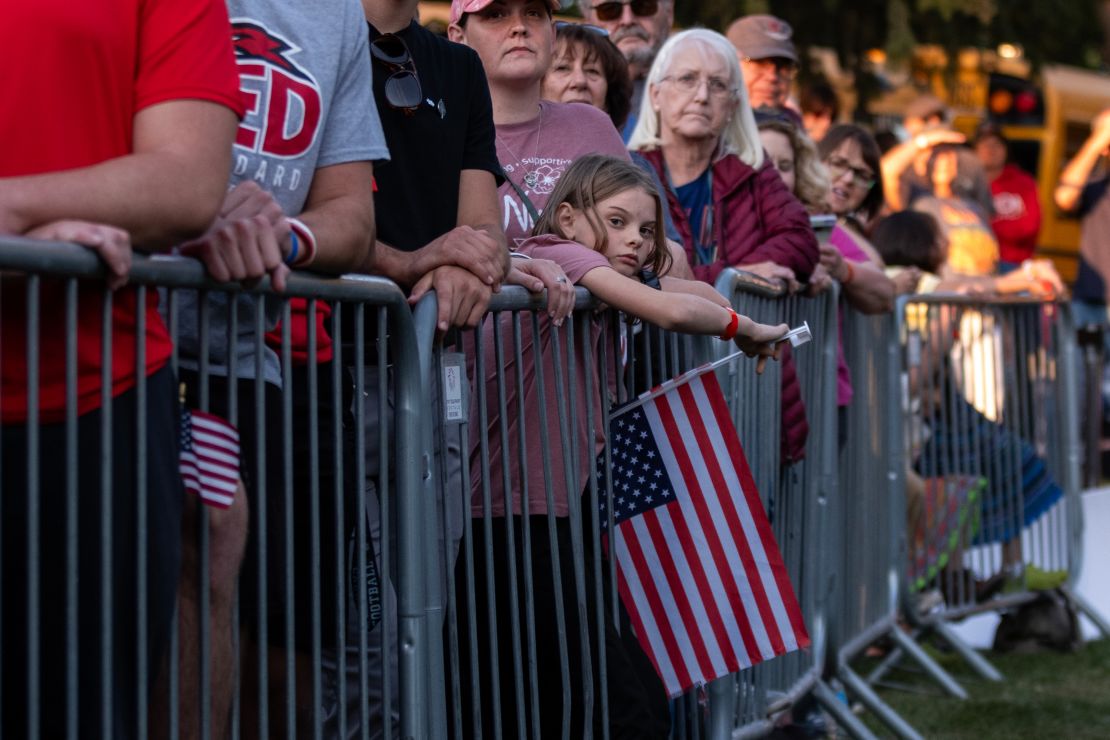
Supporters of Vice President Kamala Harris listen to her speak during a rally at Ripon College, in Wisconsin, on October 3. Jim Vondruska/Getty Images
Growing fears among Democrats
Dread is growing among Democrats that the euphoria over Harris' entry into the race in July, her successful convention in August and her debate performance the following month have not translated yet into a decisive lead over Trump.
There's no clear leader in the latest CNN average of national polls, which includes neck-and-neck surveys by CBS, ABC and NBC released Sunday. Even if Harris were leading in national surveys, there are fears that, like Hillary Clinton before her, she could win the popular vote but fall short in the Electoral College.
The tightly balanced race three weeks out shows that while he's an aberration from traditional presidential candidates, Trump is offering something millions of Americans want. Republicans argue that Harris-Biden policies caused a spike in inflation the White House tried for months to downplay. Trump cites the chaotic US withdrawal from Afghanistan to argue the current White House is seen as weak around the world. And after failing to tackle the policy or political ramifications of immigration earlier in Biden's term, Democrats offered Trump a huge opening on a critical issue.
The close contest also suggests that despite Trump's unapologetic extremism, Democrats have failed for the third election in a row to produce a candidate and a message that can give them any reassurance about the election result. While liberals and moderates might be horrified by the strongman leadership Trump proposes, he's winning on what voters consistently say is the top election issue: the economy. In the ABC News/Ipsos poll, for example, 59% say it's getting worse, even though the job market is robust, inflation is far from its highs and interest rates are easing.
With the nation in such a sour mood, Harris' incumbency as vice president is a liability. And her failure, in a recent interview with ABC's 'The View,' to come up with even one thing she would have done differently from Biden is a misstep Trump will exploit all the way to Election Day. Harris has spelled out policies to help people buy and rent homes, to ease the cost of health care and to revive a bipartisan border bill that Trump killed. But it's still often hard in her interviews to spot a powerful rationale for her campaign. Trump's vow to deport migrants, torch US trade competitors with tariffs and fix a world spinning out of control looks forceful by comparison, even if extreme.
Still, Democrats looking for reassurance might note that Trump tops out at 48% or below in most polls. This implies that his typical ceiling in national elections remains in place, while Harris may still have room to grow. In the NBC News poll, 10% of voters said they might change their minds. And what the network called a 'sliver' were still unclaimed. In states such as Pennsylvania, Michigan, Arizona and Georgia, even late shifts in support could be decisive.
The eventual makeup of the electorate will also be crucial. Will Harris' focus on abortion rights, for instance, stir higher-than-expected turnout from women voters that could confound pollsters' assumptions? Can she stem her opponent's advances among Black male and Hispanic voters? Or will Trump tap a new pool of support among Americans who agree with him on many issues but rarely vote?
What Harris needs to do
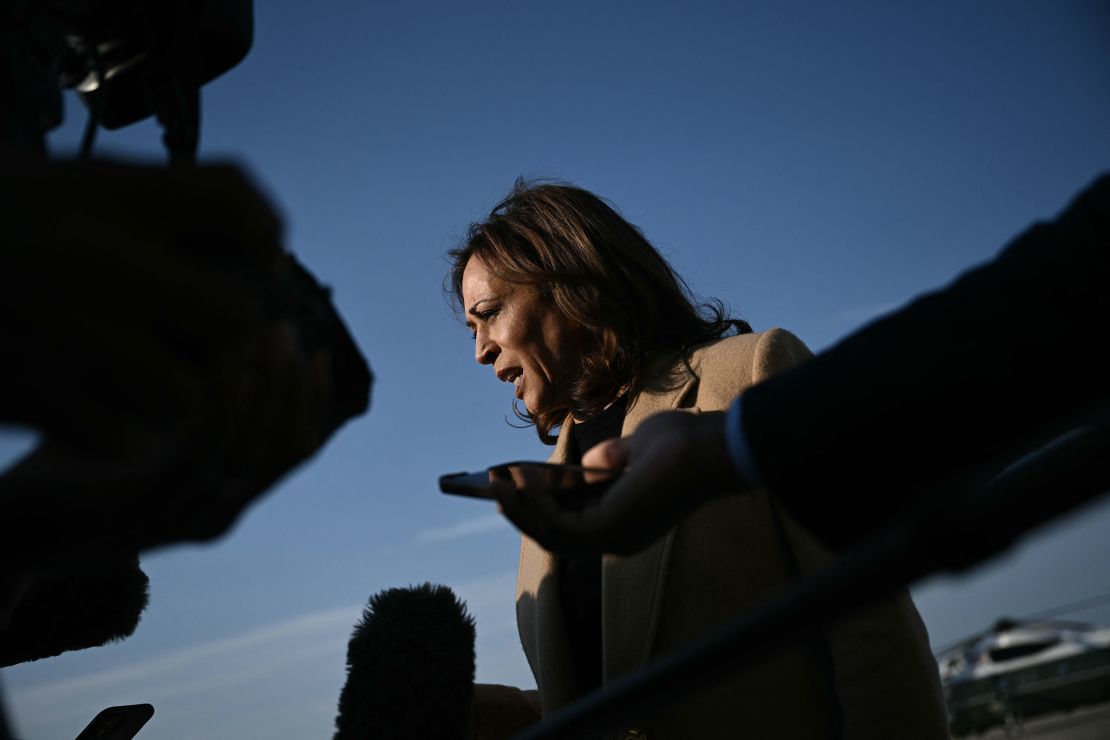
Vice President Kamala Harris speaks to the press before boarding Air Force Two at Joint Base Andrews in Maryland on October 12, 2024. Brendan Smialowski/Pool/AFP/Getty Images
Democratic strategist Doug Sosnik believes the election is a 50-50 race and that Harris plateaued in the last 10 days as Trump gained some ground. He told CNN Political Director David Chalian on the 'CNN Political Briefing' podcast that the presidency may depend on which candidate finally brands themself as a change agent.
Trump's campaign released a memo Sunday claiming that question had already been answered. 'She can't convince the voters that she is 'the change agent' in the race, that she will be better on the economy, inflation, immigration, crime, or improving people's financial situation,' the memo said. 'The bottom line is that voters say President Trump will do a better job.'
But Sosnik said the campaign is 'really going to boil down to Harris and whether she can stand up to the pressure and the scrutiny and whether she can create a permission structure for people who don't want to vote for Trump but are concerned about Harris.' He warned: 'They don't feel like she has given them enough reason to vote for her ⦠she is not doing that right now.'
Harris' task is complicated by the lack of opportunities to take on Trump directly. The former president, who has spent weeks lambasting her for avoiding the press, rarely strays from his comfort zone of conservative media and Fox News, where he enjoys adulation rather than cross-examination. He is dodging a second presidential debate against Harris and pulled out of a '60 Minutes' interview before critiquing the vice president's performance on the show. And whereas in 2016, when Trump's rallies were hard to escape on cable television, the performances now rarely get end-to-end coverage outside conservative media, meaning that many voters may not appreciate his extreme and increasingly disjointed antics.
Obama seemed baffled during a campaign appearance for Harris in Pennsylvania last week at his predecessor's enduring appeal among millions of voters. 'There is absolutely no evidence that this man thinks about anyone but himself,' Obama said. 'Donald Trump sees power as nothing more than a means to an end.'
But Trump â” despite his two impeachments, his criminal conviction, and his attempt to destroy democracy to stay in power â” is within reach of the presidency again with a more radical agenda than before.
Sen. Chris Murphy has been sounding the alarm in recent days with a string of increasingly frantic posts on X. Reacting to Trump's description of undocumented migrants last week as 'rapists' and the 'worst criminals in the world,' Murphy wrote that such rhetoric portends 'a dystopian country' with open-air prison camps and the rule of law suspended. 'We cannot let this happen. His vision of America is not America,' the Connecticut Democrat added.
His post underscored what Harris represents for those who fear the very real prospect of Trump's return.
IGIHE has learnt that Rees Kinyangi Lulu was taken into custody on October 2, 2024, in connection with misappropriated funds linked to Nobilis Hotel, a property owned by Sonarwa.
He was arrested along with the hotel’s accountant, Aisha Uwamahoro.
Their arrest was confirmed by the spokesperson of the Rwanda Investigation Bureau (RIB), Dr. Murangira B. Thierry, who stated, “It’s true. They are being investigated for embezzlement and the mismanagement of public assets.”
The case has been forwarded to the prosecution, although investigations are still ongoing.
The Chief Executive Officer (CEO) of Sonarwa General Insurance, Rees Kinyangi Lulu, has been arrested.
The in-kind donations were mobilized as per the directives of President His Highness Sheikh Mohamed bin Zayed Al Nahyan and the follow-up of His Highness Sheikh Mansour bin Zayed Al Nahyan, Vice President, Deputy Prime Minister, and Chairman of the Presidential Court, and under the supervision of H.H. Sheikh Theyab bin Mohamed bin Zayed Al Nahyan, Deputy Chairman of the Presidential Court for Development and Fallen Heroes’ Affairs and Chairman of the International Humanitarian and Philanthropic Council.
The aid collection was organized by the Emirates Red Crescent Authority, with the participation of more than 4400 volunteers from various nationalities who packed 10000 baskets of supplies.
Dr. Hamdan Musallam Al Mazrouei, Chairman, Board of Directors, the Emirates Red Crescent Authority, stressed the depth of the historical relations between the UAE and Lebanon, which, he said, has been evident today in the wide public participation in the activities to collect humanitarian relief aid for its people facing the crisis.
Al Mazrouei has also referred to the spirit of human solidarity that marks the diverse segments of the UAE society consisting of a wide variety of nationalities, cultures and ethnicities who rose to the occasion to extend a helping hand to the people of Lebanon in their difficult circumstance.
Around 24 donor and volunteer organizations participated in the activities of collecting relief aid at the cruise terminal in Abu Dhabi Ports. They are the Emirates Red Crescent Authority, the Zayed Charitable and Humanitarian Foundation, the Khalifa bin Zayed Al Nahyan Foundation and the Mohammed bin Rashid Al Maktoum Global Initiatives.
Others include the Mohammed bin Rashid Al Maktoum Charitable and Humanitarian Foundation, the Ahmed bin Zayed Charitable and Humanitarian Foundation, the Islamic Affairs and Charitable Activities Department, Dubai Humanitarian, Dubai Cares, Sharjah Charity Association, the International Humanitarian City, the Big Heart Foundation and the Emirates Foundation.
Other volunteer organization involved in collecting the relief are the UAE Volunteers Foundation, the Sharjah Centre for Voluntary Work, the Hamad bin Mohammed Al Sharqi Foundation for Humanitarian Work, the Fujairah Charity Association, the Watani Al Emarat Foundation, the International Charitable Works Organisation, the Emirates Charity Association, the Sharjah Charity House, the Dar Al Ber Society, the Dubai Charity Association, and the Day for Dubai.
‘UAE stands with Lebanon’ will run until October 21st.
After careful thought, I’ve realized what I admire most in all my favorite people is their grit. I love people with gritâ”actual gritâ”the drive to push harder for what they believe in. I crave that kind of optimization, a journey that transforms me into my favorite version of myself.
Waking up and going to work everyday, spending an hour at night watching reels, playing cute little games on my phone, reading cute little stories, and consuming cute little movies is fun. I won’t deny itâ”I love it. It makes life more bearable. But is it really? Now, I spend half of my life consuming information and earning money, and this feels like it could be my life forever.
But this isn’t who I thought I would be when I was a child, I wanted to be a hero, I wanted to live my life to the fullest, I was curious and enthusiastic about everything. The world was very much my oyster. It made sense thenâ”I was a child, untouched by society’s expectations. I was my original self, or as Robin Sharma says, I still had my genius.
'Your time is limited, so don’t waste it living someone else’s life.” â” Steve Jobs
For a long time, I’ve been coddling my potential. We all know we’re capable of greatness, yet we play it safe. We choose the less risky option. We spend time focusing on things that can get us a job in two months, and when we get the job, we get too busy being busy.
We forget who we wanted to be in the first place. But the money is good, we get a promotion, and the next thing we know, we’re comfortable. We lose our grit. We become a mediocre version of ourselves. And when people ask us to do better, we tell ourselves, 'I’m doing my best.'
I’ve never done my 'best.' I’ve always done what was easier, what I could manage at the moment, what felt possible from my perspective. I think it all started the last year of secondary school when I gave up on chemistry because it got hard. Then I gave up on finishing my book when my characters became too complicated. I gave up on a lot of things. You could say I’ve been a quitter.
My best could probably have built a spaceship by now, my best is such a great version of the person I am if I didn’t have doubt, laziness and greed. My best would save the world. Now imagine if we all did our best? Like our absolute best?
In my society, we often cringe at people who are trying too hard. Anytime someone calls themselves a history maker, an empire builder, or an entrepreneur, we roll our eyes. It’s as if the idea that someone might want to create something great is unfathomable.
But now I get it. The only person stopping me from becoming myself is me. So how do I go back? Where’s the step-by-step guide?
'Push yourself to do more and to experience more. Harness your energy to start expanding your dreams. Yes, expand your dreams. Don’t accept a life of mediocrity when you hold such infinite potential within the fortress of your mind. Dare to tap into your greatness.' â”Robin Sharma, The Monk Who Sold His Ferrari
Sounds simple enough, right?
But here’s the thing about gritâ”they never really teach us how to maintain it. We can get motivated in seconds, but keeping the grit for something you want is hard. And there’s no cheat code for it because it’s all in your head. You either have it or you don’t.
One day, you want something badly; the next month, not having it doesn’t seem so bad. And so we end up with failed ‘piped’ dreams and forgotten projects because the passion we once had fades.
Like Robin Sharma said, 'You’ll never take the world to a place higher than you’ve visited internally.' Since starting my periodic publications, I realize I sound like a motivator. So, I figured its time to start becoming the person I write about in these articles.
I believe it begins by building a deep intimacy with my own mortality. Spoiler alert: eventually, I will turn to dust and be forgotten. So, why make life about ego, the nice car, the big house, or the powerful demeanor? Who do I really want to be in this brief life of mine?
I want to be seen as a curious person, deeply interested in life, someone with genuine experiences and meaningful connections. I want to be skilled at my craft so I can focus less on being likable and more on loving the people in my life. At the end of the day, success is tied to matters of the heart.
It’s never just about mindsetâ”it’s also about heartset, healthset, and soulset. Wanting that big office in a successful company doesn’t come from a safe space. It often comes from a mind that’s insecure, self-loathing, and in need of something external to fill an internal void.
'Great lives, great art, great businessesâ”great anythingâ”don’t come from your mind; they come from your heart.' â”Robin Sharma
Revolutionizing your existence means showing up more as yourself every dayâ”waking up with grit and passion, existing boldly, and doing things that help you reconnect with your higher self.
Whether it’s waking up an hour earlier to do those assisted pushups, meditating, journaling, or declutteringâ”it will be done. It’s about committing to these actions because we need to cultivate resilience for our dreams. Mastery over our minds, hearts, health, and souls empowers us to achieve what our inner genius have always wanted.
There is more to who you are than even the people who raised you or the friends who know you best can see. Only you can truly sit down and discover what’s worth living forâ”something bigger than yourself.
For Mother Teresa, it was helping people; for Nelson Mandela, it was fighting for his people; for Malala Yousafzai, it was advocating for girls’ education; for Martin Luther King Jr., it was seeking justice and equality; for Rosa Parks, it was standing up for civil rights.
For Mahatma Gandhi, it was leading through nonviolence; for Wangari Maathai, it was protecting the environment; for Eleanor Roosevelt, it was advocating for human rights; for Albert Einstein, it was unlocking the mysteries of the universe; for Marie Curie, it was advancing scientific discovery; for Harriet Tubman, it was liberating the oppressed.
What will it be for you?
The author is a Digital Strategist, Creative Entrepreneur and Passionate Mental Health Advocate
Addressing the press in Kigali on Sunday, October 13, 2024, Dr. Brian Chirombo, the WHO Representative in Rwanda, saluted the health workers as the heroes of the outbreak, noting that specialist health workers were most affected at the onset.
'The health workers were actually affected while working hard to save lives. They have put their lives on the line, and some of them have succumbed. They are the heroes of this outbreak. Even after some of their colleagues died early on, many of these healthcare workers and experts continue to work tirelessly, risking their lives,' he stated.
'Of course, the government and ourselves are working to ensure that they are kept safe while working, but the risks are not zero. These healthcare workers continue to face danger every day to save lives,” he added.
Dr. Chirombo also commended the measures implemented by the Rwandan government to contain the outbreak. He criticized those imposing travel and trade restrictions on Rwanda, arguing that significant progress has been made to combat the Marburg virus.
'The measures taken by Rwanda and its partners are sufficient. The decision to halt travel is not helpful and only exacerbates the country’s economic situation. Such decisions negatively impact the economy and society. The available data shows progress, with more people recovering, which is proof that things are improving,” he stated in an apparent reference to a travel advisory issued by the United States government last week.
'When people recover, it shows that the infected are receiving proper care. It is a very dangerous outbreak. Rwanda is not the first country to face this, and it takes time and effort to fight it.'
Health Minister Dr. Sabin Nsanzimana also emphasized that the measures in place are yielding positive results, with more people recovering than dying from Marburg.
'There are positive indicators showing that the efforts being made are paying off. In the past three days, we tested and found no new cases of the disease. This is good news, but we cannot afford to be complacent. We have seen that the number of recoveries continues to rise, now standing at 18, while 14 have died,' Dr. Nsanzimana said, adding that the vaccination of frontline health workers and high-risk individuals will continue.
Since the outbreak was confirmed on September 27, 2024, Rwanda has reported 61 cases and 14 deaths from more than 3,600 tests conducted.
The virus, which causes hemorrhagic fever, is believed to originate in fruit bats and spreads through close contact with the bodily fluids of infected individuals. Symptoms include fever, chills, headache, muscle aches, rash, chest pain, sore throat, nausea, vomiting, diarrhoea, and unexplained bleeding.
To prevent infection, health experts recommend strict hygiene practices, such as frequent handwashing and avoiding contact with personal items or bodily fluids of individuals showing symptoms of Marburg virus disease.
Dr. Brian Chirombo, the WHO Representative in Rwanda, saluted the health workers as the heroes of the outbreak, noting that specialist health workers were most affected at the onset.
The vaccines were delivered on Saturday, October 13, 2024, by the Sabin Vaccine Institute, which sent an initial shipment of 700 Marburg vaccine doses on October 5, nine days after Rwanda declared its first-ever outbreak of Marburg virus.
The Ministry of Health rolled out vaccination efforts targeting frontline health workers on October 8.
The Sabin Vaccine Institute stated that the single-dose Marburg vaccine is being administered in accordance with clinical protocols reviewed and approved by Rwandan ethics and regulatory authorities.
The U.S.-based institution is currently conducting Phase 2 clinical trials for vaccines targeting both Marburg and Sudan ebolaviruses. As part of MARVAC, a WHO-coordinated consortium focused on developing vaccines for the Marburg virus, Sabin’s vaccine development is supported by BARDA, which has allocated $235 million to fund research and development for the filoviruses.
Rwanda has so far confirmed 61 cases of Marburg virus, 14 deaths, and 18 recoveries from more than 3,300 tests conducted.
The virus is believed to originate in fruit bats and spreads through close contact with the bodily fluids of infected individuals.
Initial symptoms of Marburg virus disease include high fever, severe headache, muscle and joint pain, and fatigue, followed by gastrointestinal symptoms such as nausea, vomiting, and diarrhoea.
To prevent infection, health experts recommend strict hygiene practices, such as frequent handwashing and avoiding contact with personal items or bodily fluids of individuals showing symptoms of Marburg virus disease.
The Ministry of Health rolled out vaccination efforts targeting frontline health workers on October 8, 2024.
The outbreak entered its third week on Saturday, October 12, 2024, following the confirmation of the first-ever cases in several health facilities in the country on Friday, September 27, 2024.
So far, the country has recorded 61 cases, 14 deaths, and 18 recoveries from more than 3,300 tests conducted.
The Ministry of Health has been at the forefront of the response, implementing measures to contain the spread of this deadly hemorrhagic fever and protect public health.
The Ministry attributes its success in keeping cases and fatalities low to the establishment of a National Response Workforce. This multisectoral team is tasked with executing strategic objectives to manage and control the outbreak, minimizing transmissions and fatalities while protecting the health and dignity of communities across Rwanda.
According to the Ministry of Health, the National Response Workforce is organized into clusters, including communication, diagnostics, surveillance, evacuation, procurement, case management, strategic information, psychology, resource mobilization, operations, a call center, mobile vaccination clinics, and treatment facilities.
Currently, the response team is engaged in decontaminating infected areas, providing treatment to patients in designated centers, and addressing public concerns through the Rwanda Biomedical Center (RBC) emergency number 114. Additionally, psychological experts on the team are tasked with offering counseling and psychosocial support to survivors and their families, aiding in rapid reintegration and combating stigma.
Currently, the response team is, among other activities, engaged in decontaminating infected areas.
During a visit to Rwanda on October 8, 2024, the Director General of the Africa CDC, Dr. Jean Kaseya, commended the country’s rapid and effective response to the Marburg outbreak. Dr. Kaseya lauded Rwanda’s efforts to contain the virus after touring the Marburg Command Post and meeting with Rwanda’s Health Minister, Dr. Sabin Nsanzimana.
'Impressed by Rwanda’s swift, proactive response. The Africa CDC stands firmly with Rwanda, committed to safeguarding lives and stopping the spread,' Dr. Kaseya stated.
Following his visit to Kigali, Dr. Kaseya also condemned the decision by the United States government to issue a travel advisory against Rwanda over the Marburg virus outbreak, terming it unfair.
The Centers for Disease Control and Prevention (CDC), a national public health agency of the United States, issued a Level 3 travel advisory on Monday, October 7, 2024, urging its citizens to reconsider nonessential travel to Rwanda due to the outbreak.
Dr. Kaseya criticized the advisory, insisting that decisions during the ongoing outbreak must be guided by scientific facts to avoid spreading panic.
'The decision taken by the U.S. government was not fair, and we believe this is not the treatment that Rwanda and Africa deserve,' he stated, reiterating that Rwanda had implemented satisfactory measures to contain the spread of the disease and that the risk of spreading the virus to another country was 'nearly zero.'
Some of the initial steps taken by the government at the onset of the outbreak included heightened contact tracing, suspending hospital visits, banning wakes and home vigils (locally known as Ikiriyo) for Marburg-related deaths, and limiting burials for Marburg deaths to a maximum of 50 people.
Additionally, all healthcare facilities were directed to implement a protocol for receiving and providing services to clients exhibiting symptoms of Marburg virus disease, with strict adherence to infection prevention and control (IPC) measures.
In recent days, the government has also rolled out other measures to reduce the risk of exporting cases to other countries, including mandatory symptom screening of all passengers departing from Kigali. Furthermore, the government has initiated the vaccination of public health workers and other high-risk groups.
The Ministry attributes its success in keeping cases and fatalities low to the establishment of a multi-sectoral National Response Workforce.