The General Staff of the Finnish Defence Forces has officially denied the information spread by the Russian media that drones were launched from Finnish territory to allegedly attack Murmansk Oblast in Russia.
Source: European Pravda citing Yle, Finland's national broadcaster
Details:Â Andrey Chibis, the governor of the Murmansk Oblast, reported on Tuesday that three drones had been used to attack the oblast.
Later, various Russian Telegram channels started spreading groundless claims that the Ukrainian drones had been launched from the territory of Finland. They were picked up by the Russian government-owned Rossiyskaya Gazeta (Russian newspaper) and the Kremlin-controlled NTV TV channel.
The General Staff of the Finnish Defence Forces told Yle that the accusations are not true.
'The territory of Finland has not been and will not be used for alleged actions against Russia,' the statement said.
The Finnish General Staff added that Finland and its allies are monitoring the situation and will not comment further.
'It should be noted that this is a case of possible Russian information interference, and the allegations made should be viewed critically,' the Finnish General Staff said.
Background: In July, after a strike on Russia's Olenya airfield in the Murmansk Oblast, less than 200 kilometres from the Finnish border, Finnish President Alexander Stubb called for getting used to the fact that war could come to his country.
An emotional Jordan Chiles opened up Wednesday about how the controversy surrounding her bronze medal in the women's artistic floor exercise at the 2024 Paris Games affected her, saying the process took away 'the person I am.'
US gymnast Chiles was stripped of her first individual Olympic medal after the Romanian gymnastics team challenged the decision to revise her final score in the floor exercise to the Court of Arbitration of Sport (CAS). CAS eventually upheld the challenge, meaning the US star's bronze went to Romania's Ana Bǎrbosu.
On Wednesday, Chiles said that the whole ordeal affected her deeply.
'The biggest thing that was taken from me was the recognition of who I was. Not just my sport, but the person I am,' she told Forbes' Power Women's Summit, appearing emotional at times. She was given a round of applause from the watching audience as she collected her thoughts.
'To me, everything that has gone on, it's not about the medal. It's about my skin color. It's about the fact there were things that have led up to this position of being an athlete. And I felt like everything has been stripped. I felt like when I was back in 2018 where I did lose the love of the sport, I lost it again. ⦠I feel like I was really left in the dark.'
CNN has reached out to the International Olympic Committee, the International Gymnastics Federation and CAS for comment on Chiles' comments.
Chiles said she had a coach who was emotionally and verbally abusive to her in 2018. She explained she 'didn't have the ability to use my voice or be heard,' adding that the situation at the Olympics brought back similar emotions.
Chiles has previously talked about her abusive coach but has never named her. Chiles spoke of the 'huge toll on [her] mental health' the coach's comments had as she considered quitting gymnastics.
'She called me fat. She said I looked like a donut. To the littlest things that people asking me, 'Oh, you're eating this today.' And it's like, 'Well, I'm not eating because you just triggered my brain.' And it was really, really hard on me,' Chiles told Taraji P. Henson and Tracie Jade on the 'Peace of Mind with Taraji' show in 2021.
'Because I was just like, 'This is ridiculous. Like, what have I put myself through?' But I was also enjoying it at the same time. So it was, like, half of my brain was telling me one thing, and half of my brain was telling me another.'
How the bronze was taken away
Chiles was awarded bronze in the women's floor exercise at the 2024 Games in August after her coaches challenged her initial score, which had placed her fifth. The win was historic â” marking the first time all three positions on the Olympic podium were held by Black women. In a remarkable display of sportsmanship, Chiles suggested she and silver medalist Simone Biles playfully bow to Brazil's Rebeca Andrade, who won gold. The move was captured in an iconic photo that instantly made sporting history.
Chiles was initially awarded a bronze medal in the women's floor exercise event at the 2024 Paris Olympic Games.
Gabriel Bouys/AFP/Getty Images
The Romanian Gymnastics Federation filed an official challenge with CAS to review the circumstances surrounding the decision to revise Chiles' score, suggesting that the challenge from the US team came four seconds after the one-minute deadline coaches are permitted.
CAS decided to uphold the challenge and it was later announced that the bronze would be awarded to Bǎrbosu of Romania.
Both the US Olympic & Paralympic Committee (USOPC) and USA Gymnastics (USAG) have said they will appeal the decision, while also claiming that CAS initially sent 'crucial communications' to the wrong email addresses, and as a result, the parties were not able to properly prepare for the hearing.
'No-one was listening to the fact that there are things that we have in place ⦠They wanted it all to be about the Olympics and this and that,' Chiles said Wednesday. 'It's a picture. But I make history and I will always continue to make history. It's something I rightfully did.
'I followed the rules. My coach followed the rules. We did everything that was totally, completely right. So having been left in the dark is something that I feel like they took that all away and were trying to put the name 'gymnastics' in front of it.'
USAG has also voiced concerns about Dr. Hamid G. Gharavi, who has represented Romania in previous arbitration cases, chairing the CAS panel. CAS says that none of the parties involved objected to Gharavi's appointment to the panel, but USAG claims that it was never informed of his ties to Romania.
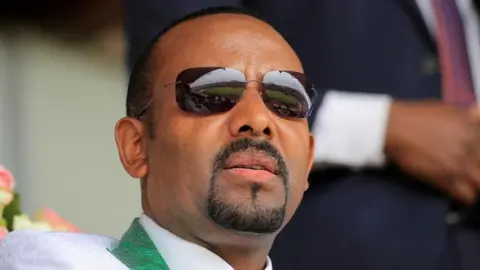
Ethiopia's Prime Minister has warned that anyone planning on invading his country should 'think 10 times' before doing so because, he said, any attack would be repelled.
Abiy Ahmed did not direct his comments at any particular nation, but they come at a time of rising tensions with neighbouring Somalia and Egypt.
Somalia has described a maritime pact that Mr Abiy's government signed with the self-declared republic of Somaliland in January as an act of 'aggression', and has responded by forging closer military ties with Egypt.
Somaliland broke away from Somalia more than 30 years ago, but Mogadishu regards it as part of its territory.
Egypt has been involved in a long-running dispute of its own with Ethiopia over Addis Ababa's decision to build a large dam on a tributary of the River Nile.
It is reportedly planning to send troops to Somalia following the signing of a military pact between the two governments last month.
In a televised address marking Ethiopia's Sovereignty Day, Mr Abiy said the east African nation had no intention of creating conflict.
However, he said that 'those who are afar and nearby' should know that 'we usually embarrass and repel those who dare try to invade us'.
'Anyone intending to invade Ethiopia should think not just once but 10 times because one great thing we Ethiopians know is [how] to defend ourselves,' Mr Abiy added.
Somalia has been angered by landlocked Ethiopia's decision to reach a deal with Somaliland to give it access to a port.
Somaliland has also said that it could lease a section of the coast to Ethiopia's navy, in exchange for Mr Abiy's government becoming the first to recognise it as an independent state.
Tensions in the region escalated last month after two Egyptian C-130 military planes arrived in Somalia's capital to mark the strengthening of ties.
Egypt reportedly plans to send up to 5,000 soldiers to join a new-look African Union (AU) force in Somalia at the end of the year, with another 5,000 to be deployed separately.
An AU force has been in Somalia since 2007 to help the government fight al-Shabab, a jihadist group waging a brutal insurgency in the country.
Ethiopian troops are part of the force, but Somalia has announced that they will have to withdraw next year.
For its part, Egypt has accused Ethiopia of threatening its supply of water from the River Nile following the construction of the Grand Ethiopian Renaissance Dam (Gerd) in the northern Ethiopia highlands, from where 85% of the Nile's waters flow.
The Gerd is Africa's biggest hydroelectric dam project, and Ethiopia sees it as vital to meeting its energy needs.
Juliana Kangeli Muganza previously worked as an analyst in the Strategy and Policy Council at the Office of the President.
She holds a Master’s degree in Public Policy from Oxford University and a Bachelor’s degree from Drexel University in the United States.
Her previous international experience includes working as the Programme Coordinator at the West Philadelphia Financial Services Institution from May 2013 to May 2014.
RDB was established by Law No. 46/2013 of June 16, 2013. It is tasked with accelerating economic development in Rwanda by supporting the growth of the private sector.
It also has the mandate to participate in the preparation and implementation of policies and strategies aimed at expediting all economic development activities and assisting both the government and the private sector in actively participating in them.
It is responsible for implementing policies and strategies to promote domestic and foreign investment in Rwanda to accelerate economic development.
Additionally, RDB is tasked with implementing policies and strategies to promote the export of value-added goods and services to regional and international markets, except for those under the responsibility of other entities.
RDB also promotes the tourism sector, participates in the design and implementation of policies and strategies related to tourism, and oversees the conservation of national parks and other key tourism sites.”
Juliana Kangeli Muganza as the new Deputy CEO of the Rwanda Development Board (RDB)
He noted that, contrary to the critics, the event drew participants from all walks of life, including individuals from the corporate sector, whom he said are often too busy to meet their “missing rib” through conventional dating.
Unlike conventional dating, which emphasizes longer, one-on-one interactions that allow people to build a deeper connection before deciding to pursue a relationship, speed dating involves meeting a large number of people in a short period to assess compatibility.
'There were so many young diplomats from international embassies in Rwanda, the corporate sector, and young entrepreneurs who don’t have time to go to bars and look for someone, or to ask their families to connect them to others. They want to meet in a more corporate environment, and that was the right place for them,' Bunyeshuri said.
He added, 'People who are saying otherwise were not there and probably hate the feeling that people are falling in love.'
Bunyeshuri acknowledged that criticism and the fear of being judged are some of the challenges facing emerging trends in modern dating, especially in conservative societies.
'Speed dating in Rwanda, a very conservative country, obviously faces negative talk and criticism from people. This is expected,' he added.
'With the era of social media, anyone can say anything for likes and views. Young people should stay focused,' he emphasized.
Bunyeshuri is planning another event, which he says will take place between September and October this year.
He mentioned that he has received many requests to bring back the second edition of speed dating but cautioned those seeking to participate that finding a perfect match is not guaranteed.
'I don’t want them to think that when you come, it’s a done deal that you’re going to find someone. It doesn’t work like thatâ”you have to make a connection,' he added.
The project aims to streamline cross-border trade by removing Non-Tariff Barriers (NTBs) and automating trade processes, providing a much-needed boost to Rwanda’s economic growth. A key component of the new project is the automation of cross-border trade processes.
Rwanda has already implemented an Electronic Single Window system to simplify international trade, and the project will enhance this system further. The upgraded system will allow businesses to submit all required import and export documents through a Single Transaction Portal without physically visiting different agencies.
Participants at the launch of Boneza Umucurizi, an initiative to streamline cross-border trade by removing Non-Tariff Barriers
Approvals will be granted within 24 hours, and traders will benefit from advance clearances for their goods. The Commissioner General of the Rwanda Revenue Authority, Ronald Niwenshuti, expressed confidence in the project’s ability to simplify trade processes.
“RRA has embraced technology not only for customs modernization but also for its entire operations. This phase of Rwanda’s Electronic Single Window builds on the very impactful and successful first phase, and we are confident that it will simplify service delivery and further reduce the cost of doing business with Rwanda,” he said.
Boneza Umucurizi is implemented by IBI, a U.S. business that works with local experts to drive the interventions. Jackie Zizane, Chief of Party, acknowledged the spirit of collaboration and commitment among stakeholders, which she believes will be vital to achieving the project’s objectives.
“We recognize the importance of partnership and cooperation in overcoming the challenges posed by non-tariff barriers. I believe that this collaborative effort will drive significant progress in promoting cross-border trade and economic growth in Rwanda,' Zizane stated.
Jackie Zizane Chief of Party Feed the Future Rwanda Trade Facilitation Activity , acknowledged the spirit of collaboration and commitment among stakeholders
Keisha L. Effiom, the USAID Mission Director for Rwanda and Burundi, highlighted the significance of a strong private sector for Rwanda’s development.
“Projects like this one are key for development: with its laser-focus on fixing the obstacles, it will bring benefits to the private sector, the government, and the Rwandan consumers,” she noted.
Effiom emphasized the holistic approach that USAID takes towards development, saying, 'When the private sector grows, the country as a whole prospers, because businesses reinvest their earnings into operations and local communities.'
NTBs are obstacles that increase the cost of doing business, unrelated to the direct payment of tariffs. For landlocked Rwanda, issues such as paperwork and wait times along the major transport corridors to Mombasa and Dar es Salaam ports are a significant burden.
Mrs. Keisha L. Effiom, USAID Mission Director for Rwanda and Burundi speaking at the launch of Boneza Umucuri
Goods are often delayed for days at border points, resulting in higher costs that ultimately affect consumers. As such, the Rwandan government has established National Monitoring Committees on NTBs to identify and eliminate these barriers.
The Feed the Future Rwanda Trade Facilitation project will work closely with these committees, strengthening Rwanda’s strategy for removing NTBs and improving the overall trade environment.
Another major improvement is the expansion of ASYCUDA World, the Rwanda Revenue Authority’s customs software, which will include new features like an Advance Ruling Mechanism. This mechanism allows customs decisions to be made online before the goods even reach the border, reducing wait times and improving efficiency.
The Feed the Future Rwanda Trade Facilitation Activity is a four-year project funded by the United States through USAID, with a budget of $5 million. Its goal is to eliminate NTBs, increase the automation of cross-border trade, and promote seamless and efficient trade processes that benefit Rwandan businesses and consumers alike.
Participants who attended the launch of Boneza Umucuruzi pause for a group photo
By improving the efficiency of trade and reducing the costs associated with border crossings, this initiative will position Rwandan companies for greater success in international markets and contribute to the overall economic growth of the country.
Feed the Future Rwanda Trade Facilitation Activity staff during the launch.
This raises an important question: Can we trust the media to remain impartial in such crucial moments, or are we witnessing a subtle yet dangerous manipulation of public opinion?
The Role of Moderators: bias or balanced?
One of the main points of contention from Tuesday’s debate was the role of the moderators. Many neutral commentators observed a stark difference in how Kamala and Trump were treated throughout the night.
Tough follow-up questions were repeatedly directed at Trump, while Kamala was spared from the same level of scrutiny. Even when she made statements that could have been debated or required clarification, the moderators simply moved on, leaving her unchallenged.
In contrast, Trump was subjected to live fact-checking during the debate, which, although important for maintaining truth and transparency, raises the question:
Why wasn’t the same treatment extended to Kamala? Fairness in a debate requires that both candidates are held to the same standard. The lack of follow-up questions for Kamala and the leniency shown toward her statements suggest an unbalanced approach, one that leaves audiences questioning whether the moderators were fulfilling their roles as neutral facilitators.
Did Kamala have an advantage?
Adding fuel to the fire are reports suggesting that Kamala had been given the debate questions in advance. Allegedly, she had practised with these questions for an entire week, and there are even rumours that the moderators helped her in her preparation.
If these claims hold any truth, it would explain her smooth, rehearsed responses, which came off more like PR sound bites than genuine debate answers.
Of course, candidates often prepare for debates, but having access to the actual questions in advance is a serious advantage, one that Trump evidently did not enjoy.
This creates an uneven playing field, one where Kamala was more polished because she knew what was coming, while Trump was left to react in real-time to a barrage of tough, often negative questions.
Is the 'Media bias' real?
Beyond the debate itself, the aftermath has been equally telling. Rumours have circulated that major media outlets, including The Washington Post, The New York Times, and CNN, had already prepared articles celebrating Kamala’s victory days before the debate even took place.
This suggests not only media bias but a predetermined narrative that completely disregards the actual performance of both candidates.
It’s no secret that many media houses have taken sides in the political arena, but the implications of this bias are profound. When media outlets align themselves so visibly with one candidate, they cease to be objective reporters of facts and instead become tools for influencing public opinion.
This leaves the public with a distorted version of reality, where the 'victory' of one candidate is decided before the debate even begins.
One of the reasons cited for this bias is the involvement of powerful financial interests. Companies like Vanguard and BlackRock, which hold significant shares in these media houses, are said to oppose Trump, largely because he is not seen as a puppet they can control.
Unlike Biden, and potentially Kamala, Trump is viewed as a wildcard, someone who doesn’t follow the conventional political playbook. This creates tension with powerful interests that prefer predictability and control in the political sphere.
If media bias is driven by these financial influences, it paints a concerning picture of the role money plays in shaping political discourse. What we witness on our screens may not be a fair representation of events but rather a carefully crafted narrative designed to benefit certain political and financial players.
Manipulating public opinion
As if these issues weren’t enough, there is also a brewing scandal about manipulated polls. Recent polling data, which seemed to indicate a surge in Kamala’s popularity, is now being questioned.
Some allege that these polls were rigged to artificially boost her standing in the race, creating the illusion of widespread support. This would not be the first time polls have been used as tools to shape public perception rather than reflect reality.
Polling data can be a powerful psychological tool. When people believe that a candidate is more popular or more likely to win, they may feel inclined to support that candidate, whether or not they truly align with their policies.
This phenomenon, known as the bandwagon effect, is one of the many ways in which public opinion can be manipulated. If these allegations of rigged polls are true, it raises serious ethical questions about the integrity of the democratic process.
The Consequences of Media Bias
So, what are the broader implications of this media bias? For one, it undermines the very foundation of democracy, which relies on informed voters making decisions based on accurate and unbiased information.
When the media fails to provide that, or worse, when they intentionally distort the narrative to favour one candidate, it erodes public trust in both the media and the political process.
Moreover, this bias creates a polarizing effect, where supporters of the disadvantaged candidate (in this case, Trump) feel increasingly alienated and disenfranchised. This deepens divisions within society and contributes to the growing mistrust between the public and the institutions that are supposed to serve them.
The media’s role in political debates should be to inform, not to influence. Tuesday’s debate raises serious questions about whether the media is fulfilling this role or if they are now more interested in shaping the outcome of elections than in holding candidates accountable.
Voters deserve a level playing field, where each candidate is given the same opportunity to present their ideas and policies, free from bias and manipulation. Until we address these issues, we risk allowing powerful financial interests to decide the future of our democracy, rather than the people it is supposed to serve.
The debate, which pitted Kamala Harris against Donald Trump, has sparked widespread criticism, with many neutral observers claiming that the moderators showed clear bias in favour of Kamala.
In an exclusive interview with IGIHE, she expressed her desire to use her influence to help as many children as possible access medical care to prevent blindness, with support from Light for the World, an international disability and development NGO dedicated to promoting an inclusive society.
Kenza is leading the initiative at Kabgayi Hospital in Muhanga District.
She also spoke about her success at the pageant and future plans to participate in Miss Universe in October, her mixed heritage, love for Rwanda, popular tourist destinations and hobbies, as well as the country’s music and fashion industries.
Kenza Ameloot, aged 22, was crowned Miss Belgium in February 2024.
Here is the transcript of the full interview:
Q: What inspired you to contest for Miss Belgium 2024, and what helped you win?
How I think I won is by having a very clear vision of what I wanted to achieve. What inspired me to contest for Miss Belgium 2024 is that, when you become Miss Belgium, you get a platform. You gain the ability to change a lot of things in your own country and other countries as well. You become a spokesperson for your country, and you can change a lot by just speaking out.
Kenza says her main goal is to make a difference by supporting children.
Before this, I was just a student with great ideas, but as a student, you can’t achieve the same impact as Miss Belgium. I wanted to become Miss Belgium to make a change and talk about issues like children’s mental health and the importance of education. That was my goal, and I even shared this during the final stage of the competition. I was so happy when the judges appreciated that, and that’s how I became Miss Belgium.
Q: What does this victory mean to you on a personal level?
This victory is important because I didn’t aspire to be Miss Belgium just for fame or media attentionâ”I wanted to make a change. As a kid, I was fortunate to have access to school and university, but I know many children in Rwanda, especially those who are blind, don’t have the same opportunities.
I found Light for the World through a friend in Belgium, and they help thousands of babies every year at Kabgayi to get the surgeries they need to prevent blindness caused by cataracts. This is very important to me. My goal as Miss Belgium is to make a difference by supporting these children.
Kenza visited Rwanda for a charity work, providing treatment to underprivileged children suffering from cataracts.
Q: What inspired you to choose a good charity for Rwanda?
I wanted to focus on children who needed my help the most. I thought about how I could make a big difference in a short time because I’m only Miss Belgium for one year.
After that, I lose the title. When I visited Rwanda as a child, I saw how difficult life was for blind childrenâ”going to school or finding a job was almost impossible. I want to help more than a thousand babies a year get the surgery they need, giving them a brighter future.
Kenza wants to use her influence to help as many children with cataracts access medical care to prevent blindness
Vision is the foundation of a bright future here in Rwanda because they need to see to go to school and work. If I can raise money in Belgium or Rwanda to help these kids, I’ll do everything I can.
We’re planning benefit events in Belgium where companies can donate, and all the money will go to Light for the World, so the Rwandan doctors get everything they need.
Q: Tell us more about your upbringing and Rwandan heritage.
My connection with Rwanda is very special because my mom is Rwandan, and my whole family is from here. Every year, we would come to Rwanda to visit my grandparents. Sadly, they’ve passed away, but I spent every summer in Rwandaâ”first in Gikondo, then Nyarutarama. I’m very close to my roots, and Rwanda is as important to me as Belgium.
The only downside is I don’t speak Kinyarwanda fluently, but I understand almost everything. My mom would speak Kinyarwanda with her sisters, and I got frustrated that I couldn’t understand, so I taught myself a bit. I can’t make full sentences, but I find it very important to at least understand the people from my country.
Q: What is one thing you like the most about Rwanda and how have the Rwandan roots influenced your identity?
What I love most about Rwanda is how important family is. Everyone takes care of each other, even neighbors and friends are considered family. When I come to Rwanda, even if I don’t know you, I feel like you are family.
My Rwandan roots have influenced my identity, especially because I was very close to my mom. She showed me that in Rwanda, you have to care for others, especially those in need, whether they lack money or need medical help.
Q: How often do you visit Rwanda, and what places or experiences stand out to you the most?
Although I live in Belgium, I visit Rwanda almost every year. As a child, I was always in Kigali, but now that I’m an adult, I’m exploring other parts of the country.
Last year, I travelled by car and saw the whole country. I visited Kibuye, Gisenyi, Mount Bisoke, and Akagera [Akagera Forest] in just one week! What stood out most to me were the fishermen in Kibuye. Their story was so powerful, and they believed in creating positive vibes while fishing. I spent a day with them, and it was magical. Kibuye is definitely my favourite spot in Rwanda.
Q: How do you think the creative industries (music, film, and fashion) in Rwanda are evolving, and would you like to contribute?
The music scene in Rwanda is evolving quickly, and there are some amazing artists. I’ve seen concerts and videos on YouTube, and international artists are also taking notice. For example, Stromae [Belgian singer and rapper Paul Van Haver] is of Rwandan descent, and I believe we have incredible talent. I think Rwanda will grow even faster in the future.
Miss Rwanda is also a great way to showcase the country on an international stage. With the world cycling championship happening next year, Rwanda will gain more recognition through sports, but I also think strong women can help show the world what Rwanda has to offer. If I can help in that, I’d love to contribute.
Q: Are there any Rwandan musicians or fashion figures you admire?
I admire Meddy. When I was younger, I often rode in cabs in Kigali, and I always heard his song 'Igipimo’. I’ve loved that song ever since, so Meddy is one of my favourite artists.
I also admire Naomi, Miss Rwanda 2020. She’s done amazing things for the country, and I’m so proud of her. I want to congratulate her on her upcoming wedding. These two are people I look up to in Rwanda. Naomi is a great role model, and I think she’s an excellent spokesperson for Rwandan women.
Q: Have you faced any challenges related to your mixed heritage in the pageantry industry, and how have you overcome them?
Being mixed can attract comments from both sides. Some say, 'You’re not fully Rwandan,' while others say, 'You’re not fully Belgian.' But I find it amusing because being mixed is a beautiful thing, and I’m proud of it.
I’ve learned to ignore the hateful comments and focus on my purpose and goals. That’s what matters most. I also hope to change how people in the media view African countries by showing the beauty of Rwandaâ”places like Kibuye, Akagera, and Mount Bisoke. I think more people need to see how beautiful our country and nature are.
Q: Outside of pageantry, what are some of your hobbies and interests?
My hobby is modelling but I also enjoy sports, and I love going on walks. I also volunteer at animal shelters. I adopted my dog from a shelter, and I enjoy helping out there.
Another passion of mine is learning languages. I’m currently studying in English, but I usually speak Flemish. My mom spoke to me in French, and I also learned German in school. I understand Kinyarwanda, but I’m working on speaking it fluently. My main hobby is learning as many languages as I can.
Q: What are your long-term goals after your reign as Miss Belgium ends?
My long-term plan is to continue helping people, possibly living in Rwanda and making a difference here. I want to keep modeling, but also combine it with helping others.
At the end of the day, I want to look back and feel proud of myself for the impact I made. I want to inspire women from all backgrounds, whether they’re Black, white, mixed, or Asian. Every woman deserves to achieve her dreamsâ”whether that’s getting a degree, landing a job, or being a mother. Being a mom is so powerful because we give life, and it’s our time to shine.
Q: What advice would you give to young women who aspire to follow in your footsteps? I believe every woman is beautiful in her own way, whether she’s blonde, brunette, or anything else. What makes someone truly beautiful is her storyâ”what she wants to achieve and how she goes about it.
My advice is stay true to who you are and show the world your goals and how you plan to achieve them. If you’re determined, people will choose you for who you are.
In the changes announced by the Office of the Prime Minister on Wednesday, September 11, 2024, the Head of State also appointed Twagirayezu as the Chief Executive Officer of the Rwanda Space Agency.
At the same time, President Kagame appointed Nelly Mukazayire, Deputy CEO of the Rwanda Development Board, as Permanent Secretary in the Ministry of Sports. Mukazayire replaces Zephanie Niyonkuru, who was recently relieved of his duties.
New Education Minister
Until his appointment to the Ministry of Education (Mineduc), Nsengimana served as Director at the Mastercard Foundation Centre for Innovative Teaching and Learning, a key initiative driving the innovative use of technology to improve access to quality education, particularly for underserved communities.
According to the Mastercard Foundation, the Centre collaborates with a wide range of actors, including innovation hubs, EdTech entrepreneurs, policymakers, researchers, educators, and learners, to support the integration of technology in education. This includes developing, deploying, and scaling up promising EdTech innovations that enhance learning and strengthen education systems.
Before joining the Mastercard Foundation, Nsengimana had an extensive career at Intel Corporation. His last role there was as Executive Director of Global Diversity and Inclusion (GDI) Policy, Strategy, and External Partnerships (PSEP), where he was instrumental in helping Intel achieve full representation in its U.S. workforce two years ahead of schedule in 2018.
Nsengimana succeeds Twagirayezu, who has served as Minister of Education for one year, having been appointed in August 2023.
Before his appointment as Minister, Twagirayezu held the position of Minister of State in charge of Primary and Secondary Education at the Ministry of Education since February 2020.
East African countries have been working on railway projects for some time, and Tanzania recently launched electric train services, with the first train in June 2024 carrying 1,400 passengers.
Tanzania, which lies to the east of Rwanda, is expected to be the route through which the railway leading to Rwanda will pass, and markers have already been placed along the proposed path.
Rwanda is required to invest over $1.5 billion, while Tanzania, which has a larger share of the project, needs to invest more than $2.5 billion.
On September 10, 2024, China’s Ambassador to Rwanda, Wang Xuekun, told the press that during the Forum on China-Africa Cooperation (FOCAC), the two countries agreed to continue cooperation in areas such as infrastructure, technology, education, and agriculture.
Gao Zhiqiang, the Economic Counselor at the Chinese Embassy in Rwanda, was asked if China plans to partner with Rwanda on the construction of a railway. He responded that the project is costly, considering Rwanda’s terrain and the route the railway would need to take to reach the country.
He explained that building a railway in landlocked countries, like Rwanda, requires a lot of resources, which is why they chose to focus on developing road networks connecting different parts of the country.
'It’s a massive project; it’s quite a challenge for landlocked countries like Rwanda. It requires a lot to implement this project in Rwanda, especially due to the country’s terrain, and it would cost a lot of money to build a railway from other regions into Rwanda and within the country itself.”
'As far as I know, we are focusing on collaborating with the Government of Rwanda in constructing road networks in various regions, both in Kigali and rural areas.'
Zhiqiang also mentioned that although China is not funding the railway project, that does not mean the Rwandan government has abandoned it. In fact, a Chinese company is working with the Ministry of Infrastructure in Rwanda and other partners to conduct feasibility studies on how Rwanda can build its own railway.
The railway project most frequently discussed is the one connecting Rwanda and Tanzania. The agreement to build the 532-kilometer Isaka-Kigali railway was signed on March 9, 2018. The project was estimated to cost $3.6 billion.
On the Rwandan side, the proposed route shows that the railway will pass through Rusumo and reach Kigali [at Dubai Ports in Kicukiro], with an additional 18 kilometres extending to Bugesera International Airport.
The railway will cover 138 kilometres in Rwanda, while Tanzania’s portion will be 394 kilometres.
There is also a proposed 1,500-kilometer railway from Mombasa to Kigali via Uganda, although this project has stalled. Kenya had already completed the initial phase of this project from Mombasa to Nairobi.
The Economic Counselor at the Chinese Embassy in Rwanda, Gao Zhiqiang, indicated that building a railway in Rwanda would be costly due to the hilly terrain.
The Chinese Ambassador to Rwanda, Wang Xuekun (center), stated that they will continue to cooperate with Rwanda on road infrastructure projects.