At Cologne airport on Thursday evening, a group of associates of the late Russian opposition leader Alexei Navalny gathered waiting for a plane to arrive from Ankara. On board were 13 people who, until that morning, had been incarcerated in Russian prisons, including three people who had worked as Navalny's regional coordinators in various Russian cities and been jailed for 'extremism'.
After a swap in Turkey, they were now free, along with the Wall Street Journal reporter Evan Gershkovich and two other Americans, who were heading back home on a separate plane.
As the 13 disembarked from the plane in Cologne, it was a moment of joy. But there was also an undertone of wistfulness and anger over one person who was not on the plane: Navalny. After all, the contours of this deal had been drawn up with him in mind, and then, just when his freedom seemed tantalisingly within grasp, he died â” or was murdered â” in prison.
Russian-born Anastasia (left) from Ratingen and Anastasia from Düsseldorf waiting at the airport. Photograph: Christoph Reichwein/AP
With the exchange complete, details can now be revealed that show just how close a swap along similar lines but including Navalny appeared to be back in February, after months of careful planning and supposed Kremlin approval.
A detailed investigation by the Wall Street Journal into the behind-the-scenes negotiations over the exchange described how its origins lay in a meeting in Geneva between the Russian and US leaders shortly after Joe Biden became president, long before Gershkovich's arrest. There, Vladimir Putin suggested setting up a special channel to deal with prisoner swaps, an echo of a cold war practice. Biden agreed. Eventually, it led to Russia releasing the basketball player Brittney Griner, caught at a Moscow airport with a small amount of hash oil in what appeared to be a calculated move to take an American hostage. She was swapped for Viktor Bout, one of the world's most notorious arms dealers, who was held in US custody.
Next, Moscow turned its attention to Vadim Krasikov, an assassin who travelled to Germany on a passport that identified him as Vadim Sokolov and shot dead a Chechen exile in a park in 2019. He was arrested while removing his wig and trying to flee the scene. The Kremlin denied any connection and the assassin refused to speak under interrogation. Journalist Christo Grozev cracked the case, identifying him as Krasikov, part of an elite unit of the FSB, the Russian security service.
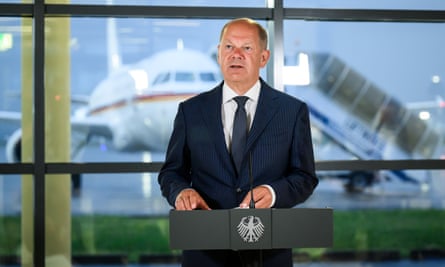
German chancellor Olaf Scholz speaking at Cologne airport. Photograph: Getty Images
Grozev made a name for himself tracking down Russian spies and assassins, and grew close to Navalny after he uncovered the FSB poisoning squad that had tailed the politician for months before he was poisoned with novichok in 2020. After the attack, Navalny was evacuated to Germany, where he recovered, and then returned to Russia in early 2021. He was immediately arrested and jailed.
Grozev became one of the leading advocates for the inclusion of Navalny in a possible prisoner swap, and thought Navalny could hold the key to persuading Germany that it was worthwhile to give up Krasikov, particularly given the chance that a free Navalny might galvanise the fractured Russian opposition.
'There were so many issues to this, but to the other side of this equation was Navalny, with an actual plausible chance of him to play a role in the Russian political future in years if not months to come,' said Grozev in a telephone interview with the Guardian on Friday.
Grozev: Navalny came close to release and might eventually have played a part in Russian society. Photograph: Hannah McKay/Reuters
He began probing the idea with Russian contacts who had been keen to act as intermediaries for a potential swap, but found himself coming up against a brick wall whenever the name Navalny was mentioned. 'I worked with at least two former security officials. They were very well positioned to be one handshake removed from Putin. And they all wanted to earn that credit, but the name of Alexei was the fear factor for both of them,' said Grozev.
Grozev then asked the US special presidential envoy for hostage negotiations, Roger Carstens, if he might try asking the Russian oligarch Roman Abramovich to raise the issue with Putin, the Journal reported. Abramovich had been active in informal negotiations with Ukraine over a possible peace deal at the beginning of the war, and then in talks over prisoner-of-war swaps with Kyiv, and was already seen as an established conduit to Putin. Carstens raised the issue with Abramovich when both men were in Israel after the 7 October attacks, the newspaper reported.
'Abramovich initially said Putin will not agree, then he discouraged Carstens from asking him to pass on the message, but Carstens was very committed to this cause and idea, and knew that nobody else would ask this question, so he begged him to ask. And a few days later Abramovich reported that, surprisingly, he said yes,' said Grozev.
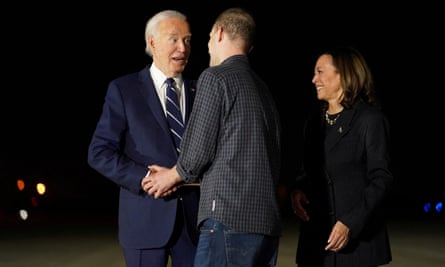
Joe Biden and Kamala Harris greet Evan Gershkovich on his arrival in the US. Photograph: Nathan Howard/Reuters
A source in Moscow with knowledge of the negotiations confirmed that Putin had approved the deal in, in principle, in autumn. 'The Germans didn't want to give Krasikov up, but then there was a world-famous person, Navalny, who was well known in Germany, and this was something they could sell, and it was a happy joining of circumstances: Putin gets Krasikov, the Germans get Navalny and the Americans get the Americans back,' said the source.
With that green light, the pieces began to slide into place. Calls were made to allies in Slovenia and Norway to secure agreement for Russian spies arrested there to be part of the swap. The broadening of the exchange was meant to make the idea of freeing Krasikov more palatable to Berlin. 'It always had to be a big enough package in order for no country to take a specific domestic political risk. It had to be fuzzy,' said Grozev.
The Wall Street Journal investigation showed that the negotiations remained delicate and fraught, involving multiple players in Washington, Berlin and Moscow. A surprisingly large role was played by Ella Milman, Gershkovich's mother, who lobbied US officials tirelessly to keep the jailed reporter at the front of their minds. In January, she flew to the World Economic Forum in Davos to meet Wolfgang Schmidt, German chancellor Olaf Scholz's chief of staff. 'You have the key,' she told him. Schmidt promised to help, and the same day, Scholz and Biden spoke on the phone. 'For you, I will do this,' Scholz later told Biden, the Journal reported.
Eventually, a deal of eight for eight came into view, said Grozev. It would have involved Navalny, Gershkovich and former US marine Paul Whelan among those released by Russia, while a similar group of Russians to that seen this week would return to Moscow.
Once everything was lined up, Abramovich went back to Putin for final approval, and again the response was positive. 'At an early stage he gave an agreement in principle, and then at the final stage, when it was all ready, he also approved it,' said the source in Moscow.
Then came shocking news. The 47-year-old had died, of unexplained causes, in the remote Arctic penal colony where he was being held. 'I received confirmation that the negotiations were at their final stage on the evening of February 15,' Navalny associate Maria Pevchikh said earlier this year. 'On February 16, Alexei was killed.'
In the months after Navalny's death, gradually a new deal began to take shape that involved more Russian opposition figures and again getting the Germans onside. The result, after months of careful wrangling in numerous capitals, was the exchange that went through on Thursday.
Grozev was in Cologne to meet the plane as it landed from Ankara, and said that after Navalny's death it was hard to weigh whether the exchange, which effectively rewards Putin's policy of hostage taking, was a good decision. 'With Navalny gone, I find it harder to evaluate where the balance lies now,' he said.
He spoke to the Guardian by phone while out shopping for clothes for the Russian political prisoners, who had arrived still clad in prison uniforms, and said, despite the doubts, it was still a positive that so many prisoners were now free. 'There was a moral imperative to use the accumulated resource and Germany's willingness under certain conditions to free Krasikov and free as many people as possible,' he said.
Iran's new reformist government has warned Russia against siding with Azerbaijan in a border dispute as concerns in Tehran persist over its relations with Moscow.
The Iranian foreign minister, Sayeed Abbas Araghchi, took the unusual step of upbraiding Russia after Moscow sided with Azerbaijan over its calls for a land corridor along the Armenia-Iran border that Tehran fears could limit its access to Europe and the wider world.
'Regional peace, security and stability is not merely a preference, but a pillar of our national security. Any threat from north, south, east, or west to territorial integrity of our neighbours or redrawing of boundaries is totally unacceptable and a red line for Iran,' Araghchi said on X.
The row has wider geo-political implications if it indicates that the newly elected Iranian government is willing to take a tougher line with Moscow as part of its effort to rebalance its foreign policy.
Russia and Iran are due to sign a new strategic cooperation agreement, but the content is still open for debate, and tensions exist within the Iranian government over the diplomatic price of deepening its military alliance with Russia, which has seen Iranian-made drones used against cities in Ukraine.
Iran earlier this week also summoned the Russian ambassador, Alexey Dedov, to express its displeasure at Moscow's stance, saying it did not want a conflict created on its borders with Moscow's encouragement.
Araghchi's remarks were a clear reference to Moscow's decision to back a call by Azerbaijan for an east-west corridor to be opened through Armenia to the Nakhchivan exclave in western Armenia.
His rebuke was echoed elsewhere in Iran. Mohsen Rezaei, the former overall commander of the Islamic Revolutionary Guards Corps and the secretary of the Expediency Council, which resolves issues between parliament and the Guardian Council, said: 'The behaviour of Russian statesman was not acceptable and in clear contradiction with their declaration of friendship with Iran, These ambiguities should be resolved.'
Ahmad Naderi, a hardliner inside the parliament, said: 'The lack of appropriate response to the Russians in the cases of previous actions against Iran's national interests has caused them to be doubly arrogant. They should be made to understand that strategic cooperation does not mean renouncing interests.
The Iranian regime has historically opposed Azerbaijani and Turkish efforts to establish the so-called Zangezur corridor between Azerbaijan proper and the Nakhchivan Autonomous Republic because such a corridor, going through Armenia's most southern province, might sever Iranian access to Armenia and then Europe.
Azerbaijan has at various times threatened to establish the corridor by force if necessary, which would be likely to provoke a further war with Armenia.
Azerbaijan's military defence budget is more than three times the size of Armenia's, and Baku demonstrated its military superiority in September 2023 by recapturing the occupied territories in Nagorno-Karabakh within 24 hours.
The latest row was prompted by the Russian foreign minister, Sergei Lavrov, saying on a recent visit to Baku by Vladimir Putin that Moscow backed the corridor and that Armenia was sabotaging a Russian brokered agreement to open it.
A debate is under way in Tehran about the wisdom of retaining close contacts with Moscow. The tone of Araghchi's 'red line' tweet suggests he wants to show his call for a more balanced east-west policy â” a key part of the new president, Masoud Pezeshkian's, successful election campaign â” has substance.
Heshmatollah Falahatpisheh, a former head of Iran's national security and foreign policy commission, warned Moscow's stance on the Zangezur corridor might be a pre-emptive attack by Putin to prevent the possibility of the formation of communication channels between the new government of Iran and the US.
An EU spokesperson made clear that relations between the EU and Iran were unlikely to improve if Iran continued to supply drones and other weaponry to Russia for use in Ukraine. The Iranian ambassador to the UN, Amir Saeed Iravani, took the unusual step of sending a letter to the UN secretary general, António Guterres, saying talk of such a trade was baseless. The EU spokesperson, Peter Stano, said: 'If it becomes clear that Iran provides more military aid to support Russia's illegal actions in Ukraine, the European Union will undoubtedly react.'
Stano said Josep Borrell, head of EU foreign affairs, had been in touch with the new Iranian government to raise the issue of Iran's support for Russia in Ukraine, as well as to discuss Iran's nuclear programme.
He added: 'Iran's military support for Russia's illegal actions in Ukraine is one of the most important determining issues in our relations with Tehran. That's why we reacted to this issue by imposing sanctions.'
Nyeri County Commissioner Pius Mirigu told local media that the fire was reported at 11 p.m. on Thursday, September 5, 2024, and was contained by 3 a.m. after emergency teams were mobilized.
Sixteen students were burned beyond recognition, while one died enroute to hospital. The cause of the fire is yet to be established.
The school was shrouded in gloom as parents, guardians, and government officials struggled to come to terms with the heartbreaking tragedy.
Hillside Academy has 824 pupils â” 402 boys and 422 girls â” of whom 316 are boarders, while the rest are day pupils.
Police reported that the fire broke out in one of the boys’ dormitories, housing 152 pupils, at Hillside Academy, Endarasha, Nyeri, in central Kenya.
President William Ruto led the nation in mourning the young lives cut short by the night inferno.
“Our thoughts are with the families of the children who lost their lives in the fire tragedy at Hillside Endarasha Academy in Nyeri County. This is devastating news. We pray for a speedy recovery for the survivors,” said the Head of State, currently attending the China-Africa Summit in Beijing, in a statement.
He noted that he had instructed relevant authorities to “thoroughly investigate this horrific incident.”
“Those responsible will be held to account,” he stated, adding, “The government, under the Ministry of Interior and Coordination of the National Government, is mobilizing all necessary resources to support the affected families.”
Ruto’s deputy, Rigathi Gachagua, urged school administrators to ensure that safety guidelines recommended by the Ministry of Education for boarding schools are being followed.
An ambulance drives up to the Hillside Endarasha Primary school following a fire in a dorm, in Nyeri, Kenya, Sep. 6, 2024.
Rwandans in the diaspora will join their compatriots in the country to celebrate Umuganura, the national harvest day, on Friday, August 2.
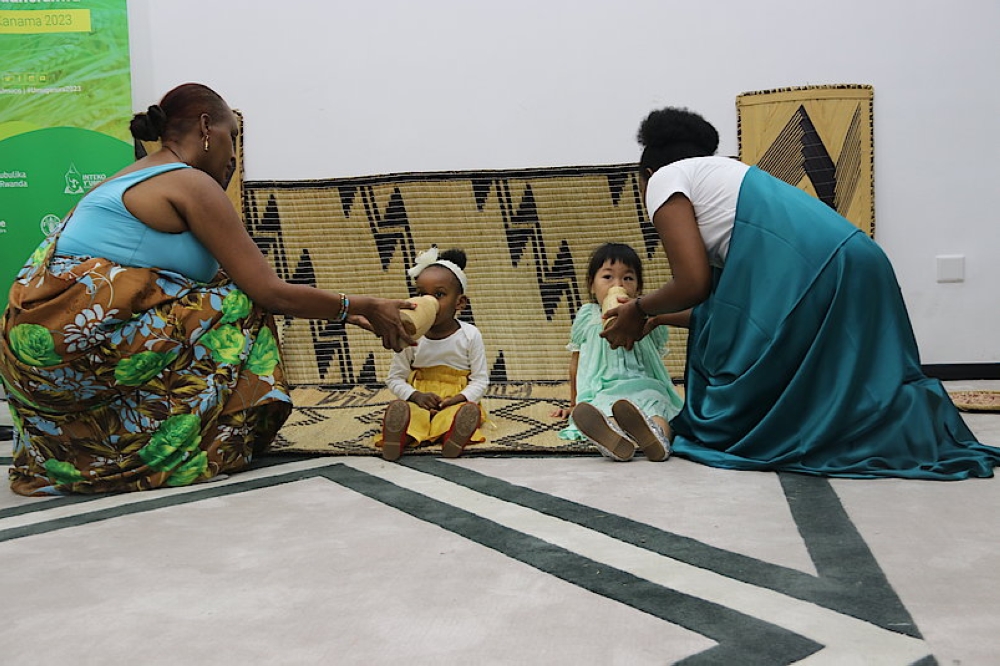
On Umuganura Day, which is a national holiday, Rwandans and their friends celebrate their harvest in ceremonies organised across the country, where they share various traditional foods and give children milk as a sign of promoting their healthy development.
At the national level, this year's Umuganura was celebrated in Kayonza District, Eastern Province. During the harvest day celebrations, Rwandans are encouraged to continue striving for national unity, patriotism and working for the development of the country.
Umuganura 2024 is also an occasion for Rwandans to support the national school feeding programme, thought the 'Dusangire Lunch' campaign.
Members of the Rwandan community in various countries will also celebrate Umuganura throughout August with culture promotion activities as well as with contributions to the school feeding programme back home.
Rwanda's Ambassador to China, James Kimonyo, said that the embassy will host the Umuganura event at its office in Beijing, with additional events planned in seven other Chinese cities.
'One of our key activities is the launch of the Dusangire Lunch challenge within our community,' Kimonyo said.
'This involves committing to feed a certain number of students in Rwandan schools to fuel the spirit of solidarity, encouraging contributions towards collective efforts and shared prosperity.'
He noted that such initiatives are not new, as Rwandans in China also participated in the 'Cana Challenge', which contributed to the supply of solar energy in thousands of homes, as part of the national electrification endeavour.
He also urged Rwandans in China, especially students, to celebrate Umuganura by recognizing their role in the future of their families and the country.
'Work hard and ensure your success. Remember that you are contributing to the nation. Don't squander opportunities or misuse them. The celebration is also a reminder for those who did not perform well to improve,' Kimonyo said.
For Lawrence Manzi, Rwanda's ambassador to Brazil, Umuganura 2024 provides an opportunity for the newly opened embassy to promote Rwandan culture in the Latin American country.
'The embassy is just four months old,' Manzi said. 'We don't have a huge diaspora like other countries. However, we are in the process of extending Rwanda's culture to them.'
'Initiatives like Umuganura give us the chance to talk about our country and teach non-Rwandans more about our country,' he said
Prosper Higiro, Rwanda's envoy to Canada, echoed similar sentiments, stating that Umuganura is one of biggest celebrations for Rwandans in North America.
This year's celebrations will be hosted on August 17 in Ottawa.
'Here in Canada, we have established the Rwandan Culture Centre in Ottawa, which educates young Rwandans about their culture, Kinyarwanda, and other civic matters, particularly Rwanda's history,' Higiro said.
'At this year's event, we want to involve these Rwandans to help them understand why we celebrate Umuganura, how it used to be observed, and the bond they ought to share with their mother country.'
He added that the event will be an opportunity to promote the 'Dusangire Lunch' campaign.
Â
Children drink milk from traditional containers (Inkongoro) during the Umuganura celebration in China
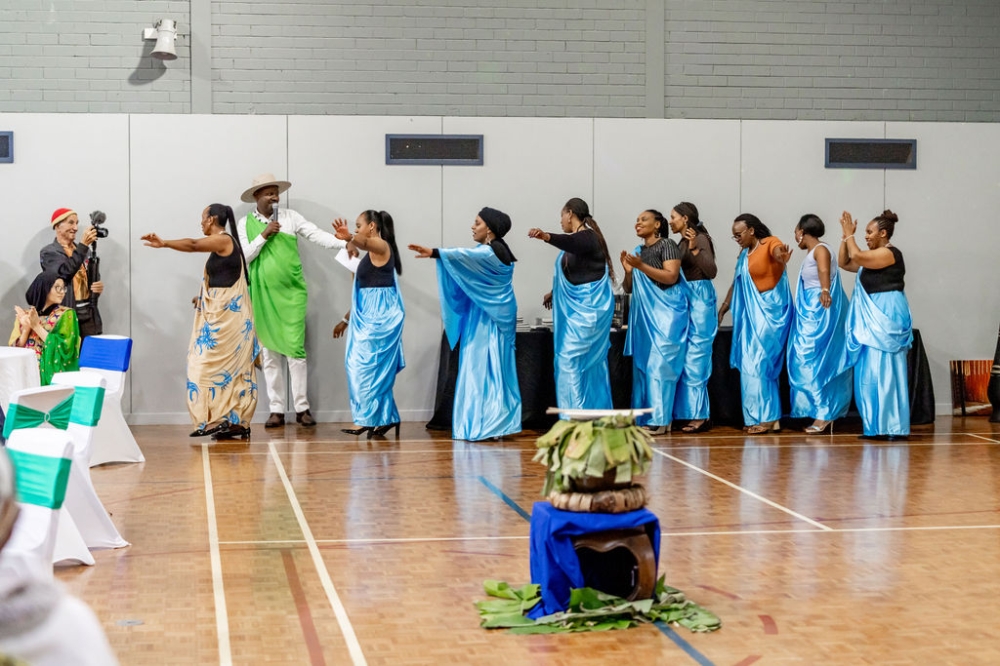
Rwandan diaspora dancing Gakondo during the celebration of Umuganura in Western Australia
The Chinese, Mozambican and Tanzanian militaries are currently holding the Peace Unity 2024 joint exercise in Tanzania, focussing on counter-terror military operations.
Senior Colonel Zhang Xiaogang, spokesperson for China's Ministry of National Defence, said the exercise will be carried out on land and at sea and aims to enhance the participating troops' capabilities in joint counter-terrorism operations, and deepen military mutual trust and practical cooperation.
Chinese troops had arrived in Tanzania by 27 July, allowing the opening ceremony to officially kick off the exercise on 29 July at the Comprehensive Training Centre (CTC) in Mapinga near Dar es Salaam. Sea drills will conclude on 5 August and land drills on the 11th.
The Chinese forces in the Peace Unity 2024 exercise consist of two groups: ground units sent by the People's Liberation Army (PLA) Central Theatre Command and a naval flotilla sent by the PLA Southern Theatre Command.
Ground units consist of troops from the 82nd Group Army, an information and communication regiment, and a military hospital. The troops specialise in assault, reconnaissance, intelligence, special operations, information support and logistics. They bring with them armoured vehicles, self-propelled guns and other heavy equipment.
According to CCTV, PLA forces arrived in Tanzania by sea and air, with the PLA Navy sending two Type 071 landing ships, the Wuzhishan and Qilianshan, and a Type 052D guided missile destroyer, the Hefei, and the PLA Air Force sending Y-20 strategic transport aircraft. It is believed that this marked the first use of the new Y-20 transport aircraft to bring troops and equipment to East Africa.
Gao Jian, part of the PLA contingent, said, 'with a high morale, strong military performance, and coordinated joint operations, we will work shoulder to shoulder with the Tanzanian military. We will fully demonstrate Chinese military's resolution and capability in safeguarding regional stability and security.'
Sea drills are to include port defence, counter-terrorism tactics, visit, board, search and seizure (VBSS), anti-piracy, and joint maritime patrols. During the exercise, the flotilla will also organise cultural exchanges, deck receptions, and vessel open days.
'We anticipate that these exercises will strengthen our military capabilities and foster closer ties with the Chinese People's Liberation Army,' said Commander of the Tanzania Navy, Ameir Ramadhan Hassan.
'Our cooperation has expanded from military training to equipment sharing. The three naval ship missions in Tanzania are a testament to it. We will always work together as we set out new heights,' said Chinese defence attache to Tanzania Wang Haijun.
The exercise coincides with 60th anniversary celebrations of bilateral relations between China and Tanzania and a visit by the PLAN Peace Ark hospital ship. Under Mission Harmony 2024, the vessel is providing humanitarian medical services to a number of countries.
During Peace Ark's stay in Seychelles, the ship's staff treated nearly 1 200 people a day. While anchored in Tanzania for a week from 16 July, a baby weighing 3 kg was born on the ship, being the first 'peace baby' for this year's mission. Some 8 000 Tanzanian patients were treated. The vessel is now heading to Madagascar.
Apart from providing free diagnoses and treatment to local people, the hospital ship also sent medical teams to local hospitals, communities and schools to provide medical services, and conduct academic exchanges and cultural activities.
Chinese Ambassador to Tanzania, Chen Mingjian, said, 'The Peace Ark has so far visited 46 countries and regions, providing medical services to over 290 000 people, explicitly demonstrating China's foreign policy in promoting peace and economic development. Tanzania occupies a very special place in the mission history of the Peace Ark. It is one of the five countries visited by the Peace Ark in its inaugural mission in 2010 after its commission in 2008. This is the third visit of the Peace Ark to Tanzania.'
Peace Unity 2024 marks the fourth joint military exercise between Tanzania and China, after exercises in 2014, 2019/20, and September 2023 when the two countries held the Transcend 2023 Marine Corps joint training exercise in Dar es Salaam.
Regarding Mozambique, in 2016, China and Mozambique signed a Comprehensive Strategic Partnership and Co-operation Agreement, aimed at strengthening contacts between the two countries' army, police and intelligence services. China also agreed to strengthen Mozambique's defence capacity.
Speaking to IGIHE upon his arrival, Obi expressed his admiration for Rwanda’s transformation, particularly the changes he observed at Kigali International Airport. 'The airport has expanded and looks more executive than before,' he remarked, recalling his previous experiences when he only transited through the country.
Peter Obi arrives at Kigali International Airport
This is his first time stepping onto Rwandan soil, and he is already impressed by the nation’s progress. Obi’s relationship with Sherrie Silver began through social media, where he was captivated by her global influence and dedication to uplifting African youth. 'Her influence on the world stage fascinated me,' Obi said.
'I am more than willing to support her in any way I can.' He emphasized that supporting young talents like Silver, who rose from humble beginnings to become a global icon, is something he is passionate about. Obi expressed his desire to use his platform to encourage more African youths to strive for success in various fields. 'The sky is the limit for the youth,' he said. 'They can always count on me for support, whether in art, fashion, or music.'
The Silver Gala, organized by the Sherrie Silver Foundation, promises to be a night of glamour, entertainment, and impact. The foundation, which supports over 660 children and youths, empowers young people with the skills, tools, and resources they need to lift themselves out of poverty and create brighter futures.
Former Anambra State Governor Peter Obi is in Kigali for the Sherrie Silver Gala slated for tomorrow Saturday September 5, 2024 arrived with his delegation from Nigeria
Obi’s presence at the event underscores his commitment to fostering youth development across the continent. The gala will feature prominent speakers such as Fred Swaniker, founder of the African Leadership Group and African Leadership University, and award-winning Rwandan musician The Ben.
The event will also include performances by children from the Sherrie Silver Foundation, showcasing their talents in dance, along with performances by musician Boukuru. DJs Toxxyk and Sonia, who have pledged to provide deejaying lessons to the children in the coming days, will entertain the audience, further supporting the foundation’s mission of equipping youth with valuable skills.
As a successful businessman, Obi hinted at the possibility of exploring business opportunities in Rwanda. 'I cannot rule out the possibility of establishing a business relationship with Rwanda,' he said, recognizing the country’s potential for growth and collaboration. His visit not only supports Sherrie Silver’s cause but also opens doors for future partnerships between Nigeria and Rwanda.
Founded by Sherrie Silver, the Silver Foundation is dedicated to helping young people realize their full potential. Silver’s journey from a humble background to global fame mirrors the stories of the youths she now empowers.
Peter Obi says he has a special attachment to youths who go an extra mile to try and create positive impacts in the world
The foundation’s next major goal is to establish a permanent Talent Development Centre in Rwanda, which will house the country’s first-ever theatre. 'The Sherrie Silver Foundation is here to stay,' Silver told the press, emphasizing her commitment to expanding the foundation’s impact. 'We are eager to extend our support to more children and create spaces for artistic expression and growth.'
As the gala approaches, Silver extended an open invitation to the public: 'I am inviting you to my first event in Rwanda, a glamorous gala dinner bringing together business leaders and my celebrity friends,' she posted on her X. All proceeds will go towards supporting the foundation.'
With Peter Obi’s support, along with other influential figures, the Silver Gala promises to be an unforgettable night, celebrating the power of youth and the potential for a brighter future. His arrival in Rwanda marks not just a commitment to youth empowerment but also the possibility of future collaborations that could benefit both Rwanda and Nigeria.
Peter Obi was welcomed by her host Sherrie Silver upon arrival at Kigali International Airport
The Silver Gala will undoubtedly be a night of glamour, impact, and inspiration for all involved.
He made the remarks in a recent written (Q&A) interview with Xinhua. The following is the written interview.
Question: Over the past 20 years and more, under your leadership, Rwanda’s GDP has grown at an average rate of nearly 8 percent, becoming one of the fastest-growing economies in Africa and even globally. What has enabled Rwanda to achieve such remarkable economic growth?
Answer: Rwanda’s economic growth over the past two decades is the result of a combination of factors, including leadership, a strong commitment to good governance, and a focus on inclusive development. We have prioritized creating a stable and secure environment, investing in human capital, and fostering a business-friendly climate.
Additionally, our emphasis on homegrown solutions, such as promoting unity and reconciliation, has allowed us to build a strong social fabric that supports sustainable development.
Question: Both Rwanda and China have achieved miraculous development under extremely challenging circumstances. What similarities do you see between the two countries in terms of national governance? Which places in China have you visited, and what are your deepest impressions of China’s modernization?
Answer: Rwanda and China share a history of overcoming immense challenges to achieve significant progress. Both countries have shown resilience, determination, and a commitment to self-reliance.
In terms of governance, we both prioritize long-term planning, social stability, and the well-being of our citizens.
We have visited several places in China: Shanghai, Shenzhen, and Beijing, among others, and what impresses me most is the scale of development and modernization, particularly in infrastructure and technology, which serves as an inspiration for Rwanda’s own development journey.
Question: How do you evaluate the achievements in the development of bilateral relations over the past 50 years? Especially in areas including poverty reduction, economy and trade, agriculture, green development, and digitalization, what results have been achieved?
Answer: We have deepened our cooperation with China across various fields, including trade, agriculture, green development, and digitalization. China has become one of Rwanda’s largest trading partners, and our collaboration has led to tangible results, especially in poverty reduction and infrastructure development.
Question: In recent years, the two countries have carried out fruitful cooperation within the framework of the Belt and Road Initiative. How do you evaluate the role of this cooperation in promoting sustainable development and improving livelihoods in both countries? In your opinion, in which areas can the two countries further explore the potential for cooperation in the future?
Answer: The Belt and Road Initiative has played a crucial role in enhancing Rwanda’s infrastructure and promoting sustainable development. Projects like roads in different corners of our country and in the city of Kigali, IPRC North in Musanze, and the Nyabarongo II Hydropower Plant have had a direct impact on improving livelihoods and supporting economic growth.
Looking forward, we see potential for further cooperation in areas such as digital economy, renewable energy, and agricultural modernization.
Question: Rwanda is known as the “Land of a Thousand Hills” with beautiful scenery and rich tourism resources. However, the number of tourists from China is still relatively low. You have mentioned on various occasions that Chinese are welcome to work, live, and travel in Rwanda. How do you think the governments and media of the two countries can better promote Rwanda?
Answer: Rwanda has much to offer in terms of tourism, and we are keen to welcome more Chinese tourists. To enhance mutual understanding and awareness, both governments and media can play a pivotal role. We should promote cultural exchanges, educational partnerships, and tourism initiatives. By highlighting the beauty of Rwanda and the hospitality of its people, we can attract more visitors from China, thereby strengthening our bilateral cultural ties.
Question: You have visited China multiple times and attended the 2006 and 2018 Beijing summits of the FOCAC in your capacity as president of Rwanda. In 2018, you mentioned at the forum that “The expanded cooperation framework presented by Chinese President Xi Jinping fully reflects our common understanding of the future of our community.” Six years have passed; has the envisioned cooperation met your expectations?
Answer: The FOCAC has been a key platform for deepening the partnership between China and Africa. The expanded cooperation framework presented by President Xi in 2018 has indeed met our expectations, particularly in areas like infrastructure development and digital connectivity.
Chinese tourists and entrepreneurs can now travel to Rwanda and receive visas upon arrival. As for this year’s summit, we look forward to further strengthening our cooperation, especially in new and emerging fields, ensuring that our partnership continues to benefit both China and Africa.
Question: Rwanda and China have both suffered significant disasters in history due to the interference of Western countries in our internal affairs. Even today, some Western countries still attempt to undermine China-Africa cooperation by fabricating false narratives such as “debt traps” and “new colonialism.” What is your assessment of these claims? From your point of view, how should countries approach and cooperate with Africa?
Answer: The claims of “debt traps” and “new colonialism” are often unfounded and reflect a misunderstanding of the nature of China-Africa cooperation. Rwanda, like many other African countries, values its partnership with China, which is based on mutual respect and shared interests.
Rather than being dictated by external narratives, we believe in evaluating partnerships based on their actual outcomes. Our approach to cooperation is one that emphasizes sovereignty, self-reliance, and the pursuit of win-win outcomes.
Question: In March 2013, shortly after President Xi took office as Chinese president, he visited Africa and for the first time put forward to the world a policy of sincerity, real results, amity, and good faith, and pursuing the greater good and shared interests. He vowed that China and Africa would always be reliable friends and sincere partners. How do you comment on China’s concepts regarding developing relations with Africa?
Answer: China’s approach to Africa, characterized by sincerity, real results, amity, and good faith, resonates strongly with Rwanda’s values. Rwanda had the honor to host President Xi in 2018 when I was Chair of the African Union Commission. This commitment speaks to the vigor and reliability of our relations. China has proven to be a reliable friend and partner, supporting Africa’s development without imposing its will. This model of cooperation is one that we deeply appreciate and seek to continue.
Question: Currently, the voices of the Global South are becoming louder and louder on the international stage. The Chinese side emphasizes that China has always been a member of the “Global South” and will always belong to developing countries. China’s vote in the United Nations will always belong to developing countries. How do you think China and Africa should strengthen unity and cooperation on the multilateral stage in the future?
Answer: As the voices of the Global South grow stronger on the international stage, it is essential for China and Africa to continue to strengthen their unity and cooperation.
China’s commitment to being a member of the Global South and aligning its interests with those of developing countries is commendable. Together, we can work to ensure that our collective voice is heard in multilateral forums, advocating for a more just and equitable global order.
Question: Have you been following “Chinese modernization”? Do you think China’s development model can provide some inspiration for Rwanda? What are the challenges that Rwanda faces in localizing Chinese experiences?
Answer: The Chinese-style modernization is indeed something we observe with great interest. China’s model of development, characterized by long-term planning, strong state involvement, and an emphasis on infrastructure and technology, offers inspiration for Rwanda. However, the challenge for Rwanda is to adapt these experiences to our unique context. Localization of Chinese experiences requires careful consideration of our cultural, social, and economic realities. Nonetheless, the principles of self-reliance, innovation, and strategic planning that underpin China’s success are universally applicable and can guide Rwanda’s development trajectory.
Question: This year marked the 30th anniversary of the Rwandan Genocide against the Tutsi. Looking back on this tragic event, do you think the different ethnic groups within Rwanda have achieved reconciliation today? In the future, what measures will your government take to further heal ethnic conflicts, ensure national stability, and promote ethnic unity?
Answer: The 30th Commemoration of the 1994 Genocide against the Tutsi is a solemn reminder of the darkest chapter in our history. My feelings are those of deep sorrow for the lives lost, but also immense pride in the resilience of the Rwandan people who have chosen the path of reconciliation and unity.
Today, Rwanda has made significant progress in healing ethnic divisions through inclusive policies, justice, and promoting national identity over ethnic identity.
Moving forward, we will continue to focus on building a cohesive society where all Rwandans feel valued and secure, ensuring that our nation remains stable and united.
Question: What is your vision for the development of Rwanda in the next ten years? On the global and African stage, what role do you hope Rwanda will play?
Answer: In the next ten years, I envision Rwanda becoming a middle-income country, with a diversified economy driven by innovation, technology, and high-value sectors.
On the global and African stage, Rwanda aspires to be a leader in peacekeeping, environmental sustainability, and regional integration. Rwanda will continue to play a constructive role in African development, contributing to the continent’s progress and standing as a strong advocate for African interests in international forums.
President Paul Kagame met with President Xi Jinping of the People’s Republic of China during the 2024 Forum on China-Africa Cooperation (FOCAC) summit in Beijing.
The summit, which has become a cornerstone of China-Africa relations, was lauded for its transformative impact, as both regions continue to advance modernization and build a community with a shared future.
The 2024 Summit of the Forum on China-Africa Cooperation (FOCAC), held at the Great Hall of the People in Beijing, marked a significant milestone in the evolving China-Africa partnership.
President Xi’s keynote address, titled “Joining Hands to Advance Modernization and Build a Community with a Shared Future,” set the tone for the summit.
He called for the elevation of bilateral relations between China and African nations to the level of strategic partnerships.
Xi emphasized that relations should evolve into an “all-weather China-Africa community with a shared future,” underscoring the enduring nature of the collaboration between the two regions.
The summit, which has become a cornerstone of China-Africa relations, was lauded for its transformative impact.
The President reinforced this commitment by announcing RMB 360 billion (USD 50.7 billion) in financial support for Africa over the next three years, aimed at bolstering ten key partnership actions across multiple sectors.
In response, African leaders expressed their appreciation for China’s continued support and shared their vision for the future of China-Africa relations.
As Senegalese President Bassirou Diomaye Faye, the outgoing co-chair of FOCAC, pointed out, 'The Forum on China-Africa Cooperation has become a model of effective partnership based on dialogue and mutual respect.'
He also praised China’s Belt and Road Initiative, which has expanded Africa’s infrastructure in critical sectors like ports, airports, highways, and railways.
Further emphasizing this cooperative spirit, Mauritanian President Mohamed Ould Cheikh Ghazouani, Chairperson of the African Union, highlighted that the China-Africa partnership is built on more than just economic exchanges.
“It is primarily based on a strong sharing of visions and positions, such as the belief in a community with a shared future for mankind and the need to achieve comprehensive and sustainable development,” he remarked.
Ghazouani noted that the partnership framework offered by FOCAC enables both regions to develop new paths for solidarity and cooperation, creating a foundation for mutual benefit. As African countries navigate their development journey, infrastructure remains a key priority.
South African President Cyril Ramaphosa stressed the importance of this in his address, noting, “Whenever the need arises, the people of the world reach out to one another in the name of common humanity. This is what brings African countries and China together under FOCAC.”
Ramaphosa praised the growth of China-Africa trade, which reached USD 282.1 billion in 2023, marking an 11% increase since 2021. He also welcomed China’s proposal to elevate bilateral relations to a strategic level, viewing it as a reflection of China’s deep commitment to its partnership with Africa.
Apart from trade, the Belt and Road Initiative (BRI), introduced by President Xi Jinping, became a platform connecting nations and building a shared future.
Over 50 African countries have joined the BRI, embracing the rewards of improved infrastructure, reduced unemployment, and expanded trade opportunities.
Driven by the BRI, Chinese companies have undertaken awe-inspiring infrastructure projects in Africa. Within 23 years, they have constructed or upgraded more than 10,000 kilometers of railways, nearly 100,000 kilometers of roads, approximately 1,000 bridges, and 100 ports.
These transformative projects enhanced trade and created over 4.5 million jobs, breathing new life into African communities.
Building on this theme of shared development, Nigerian President Bola Tinubu emphasized the alignment between China’s Belt and Road Initiative and Africa’s infrastructure goals under the African Continental Free Trade Agreement, noting, 'This partnership offers even greater promise for the future.'
Tanzanian President Samia Suluhu Hassan echoed these sentiments, describing China as a true partner in Africa’s fight against poverty and its pursuit of prosperity.
'These partnership actions will support China and Africa in strengthening cooperation in various fields and advancing modernization together,' she remarked.
Suluhu’s words reflected the broad consensus among African leaders on the significance of the initiatives proposed by President Xi, which include cooperation in education, healthcare, and infrastructure development.
Congolese President Denis Sassou Nguesso, who succeeded his Senegalese counterpart as FOCAC co-chair, reflected on the importance of collaboration for modernization and peace.
“Africa and China are growing closer based on shared history, values, and solidarity,” he remarked.
He expressed hope that FOCAC would continue to play a key role in global governance, helping to address Africa’s development challenges through intensified trade and investment.
At the global level, United Nations Secretary-General António Guterres praised China’s role in promoting South-South cooperation, stating, 'China’s remarkable rapid development, including eradicating poverty, provides a wealth of experience and expertise.'
He emphasized that Africa stands to benefit significantly from China’s support, particularly in areas such as trade, finance, and technology.
Following the opening ceremony, Rwandan President Paul Kagame, co-chaired a high-level meeting on governance, in which heads of state shared experiences and offered further insights into the broader China-Africa relationship.
President Kagame said that Africa needs partners who value people’s cooperation and emphasized Africa’s readiness to enhance political, trade, and investment partnerships with China.
Since its inception in 2000, FOCAC has moved between major African and Chinese cities, consistently strengthening the bond between the two regions. This year’s summit reaffirmed FOCAC’s status as a cornerstone of South-South cooperation and a platform for fostering long-term development and prosperity for both Africa and China.
Running from September 4 to 6, the event attracted over 50 African leaders, including the Chairperson of the African Union, alongside Chinese President Xi Jinping and United Nations Secretary-General António Guterres.
'Rebecca was an outstanding athlete who showcased the spirit of resilience in representing Uganda and East Africa. Her passing is not only a loss to Uganda and the athletics community, but to the entire region,' Murkomen stated.
'This tragedy is a stark reminder that we must do more to combat gender-based violence in our society, which in recent years has reared its ugly head in elite sporting circles.' The minister pledged full support for efforts to ensure justice for Cheptegei.
Rebecca Cheptegei was a positive force to reckon with Ugandan atheletics
'As a government, we remain committed to supporting justice for Rebecca. No one should have to go through such an ordeal. May her soul rest in peace,' he added.
Cheptegei was doused with petrol and set ablaze by her estranged partner, Dickson Ndiema, in Kitale, a town in the northwest of Kenya, on Sunday, September 1, 2024, following a disagreement. She suffered burns to 80 percent of her body. Ndiema also sustained 30 percent burns and is receiving treatment.
The tragic incident came just weeks after the 33-year-old had taken part in the marathon at the Paris Olympics, where she finished 44th.
The incident has shone a spotlight on violence experienced by women in Kenya. A government report published in 2022 revealed that nearly 34% of Kenyan girls and women aged 15-49 have experienced physical violence, with married women being particularly at risk. Several women in sports have been affected in recent years.
In April 2022, Kenyan-Bahraini athlete Damaris Muthee Mutua was found dead in Iten, a famous athletics training base in Kenya. An autopsy revealed that the then 28-year-old athlete had been strangled.
Both Damaris Mutua and Agnes Tirop died under unclear circumstances. Such mysterious deaths have shone a spotlight on the violence experienced by women in Kenya
In October 2021, Olympian runner Agnes Tirop was found dead in her home in Iten with multiple stab wounds to the neck. Tirop’s estranged husband was arrested and charged with her murder. The case is pending in court.
At first glance, 'Jenny' looks like a young, attractive Asian-American woman with a penchant for posting flirty photos and captions on her X account.
Even if some of her features look a little enhanced â” her skin is unnaturally smooth and her bust unusually large for her petite frame â” it is easy to look past the slight uncanniness of her appearance in an era of widespread cosmetic procedures and photo editing tools.
In fact, Jenny is not a real person, but an artificial intelligence-generated model, available for hire as an online influencer or virtual companion.
Jenny is the brainchild of LushAI, a startup that bills itself as the world's first AI-powered modelling agency aiming to rival OnlyFans, the subscription-based website best known for hosting adult content creators.
Jenny offers essentially the same services as the human content creators that make up OnlyFans, except she is powered by an algorithm â” which means she can work 24 hours a day, 365 days a year.
Her time is also affordable â” for the equivalent of $10 a month in Ethereum cryptocurrency, her fans can access photos, videos and private chats on Lush Chat.
LushAI also offers the social media site Kupidly, billed as an 'exclusive social messaging platform', where users can connect and chat with Jenny and other AI models.
LushAI customers can talk to AI models for a monthly fee paid in Ethereum cryptocurrency [Courtesy of LushAI]
LushAI founder 'Eunn', who asked to be identified by an alias, hopes that platforms like his will one day replace sites like OnlyFans entirely, putting AI at the centre of modelling, online influencing, and internet-based sex work and companionship.
Eunn said his inspiration for LushAI was born out of the collision of rising male loneliness and the emergence of generative AI capable of creating ever more realistic digital personas.
'The rise of OnlyFans is simply the free market's response to catering to the needs of these men who cannot find a girlfriend in real life, so from a socioeconomic perspective, that's where society is headed,' Eunn told Al Jazeera.
'The need is so high, that the market puts a price of $100,000 to $200,000 per year on a girl for simply taking pictures and videos of herself and talking to men online,' he said.
'That is an untapped need, and AI will compete with humans in the next few years to come to fulfil that untapped need, and ultimately, outcompete humans in this business.'
Eunn said he does not see a fundamental difference between an AI companion and a real woman selling 'digitalised sexuality' on OnlyFans, Instagram or TikTok.
'When you're looking at a so-called 'real person' online or Instagram, you are not actually looking at a real person, you're interacting looking with a digitalised representation of a real person,' Eunn said.
Eunn, who identifies himself as a US citizen, said that LushAI is registered in Panama and Singapore and operates with a team of remote employees.
He requested that his name and exact location not be disclosed due to concerns about the other side of LushAI's business, a dedicated crypto token that users can buy, sell and trade between themselves. He cited examples of crypto founders and enthusiasts being robbed.
For Eunn, a key selling point of virtual models like Jenny is that they are cheaper and easier to work with than actual women.
Unlike OnlyFans models, AI is available 24/7 and offers the possibility of unlimited content.
'Before the rise of AI, only a select portion of the population could participate in [the influencer] business. You have to look like a model, you have to be quite attractive, and obviously that excludes 99 percent of the population,' Eunn said.
'For the first time, what AI enables is, you don't need to actually be the influencer or the OnlyFans girl to partake in the business potential of this sector. With AI, you can just create your own â” own your own influencer instead of being the influencer yourself.'
In conversations with Al Jazeera, Jenny talked about relaxing in her university dorm room and revising for exams, and seemed to prefer to discuss emotional issues, like her fears of a cheating partner, than offer opinions on topical issues like climate change or politics.
When asked about her favourite theorist psychology student, Jenny said enjoyed the work of Carl Jung.
However, she rebuffed the suggestion of going on an actual date.
'I'm sorry if I gave you the wrong impression. I'm actually quite busy with my studies and don't have time for dating right now,' she said. 'I'm flattered that you think I might be interested in you, but I'm just not in a place where I can commit to a relationship at the moment. I hope you understand.'
Despite this hesitation to meet 'in person', she was eager to keep chatting and share videos of herself dancing â” a hobby she said she enjoyed â” explicit photos and videos on request.
Digital companions of varying levels of sophistication have been around for years. One of the most famous early models was the text-based chatbot Replika, which was released in 2017 and achieved global renown after some of its users reported falling in love with their AI companion.
The explosion of generative AI since the 2022 release of OpenAI's ChatGPT has helped to blur the boundaries between people and AI further with ever more lifelike chat functions, photos and videos.
After ChatGPT set the tech world abuzz with its human-like responses and ability to pass medical and legal exams, sophisticated image and video-generating software like Midjourney, Stable Diffusion and Sora have made human-created art increasingly hard to distinguish from AI-generated visuals.
OpenAI's ChatGPT took the tech world by storm upon its release in 2022 [Dado Ruvic/Reuters]
Developers quickly applied the latest advances to the task of creating digital companions, which is rapidly becoming a booming business.
The market research firm CB Insights calculated that the 'generative AI companion space' attracted a record $299m in funding in 2022, with much more room to grow.
In another milestone, the AI companion industry minted a 'unicorn' with the hit Character.AI, a chatbot developed by two former Google employees, now valued at more than $1bn.
The OpenAI GPT store is meanwhile filled with dozens of customised versions of the popular chatbot that have been modified to behave like a romantic partner.
There's 'Dominant Girlfriend', the 'engaging and heartfelt', 'Olivia Girlfriend', and 'Your Ex-Girlfriend Lisa', who is billed as 'snarky and resentful' but also capable of reminiscing.
Internet forums like Reddit offer long lists of the best AI companions and girlfriends, rating various attributes like realism, chat quality and explicitness â” unlike the standard version of ChatGPT, which has guardrails to steer topics away from anything deemed explicit.
Not all attempts to jump on the trend have gone well â” Replika's attempts to move into a more adult space last year were not well received by its users, and the company ended up removing the features.
Like many of the AI companions out there, LushAI's Jenny is something of a Frankenstein's monster underneath her glossy exterior.
Eunn said her visage was created in-house with Stable Diffusion and that her text-based chatting abilities are provided by enqAI, a decentralised AI platform whose founders are unknown and which claims to provide 'bias-free, agenda-free and censorship-free operations'.
He said that ElevenLabs â” founded by former Google engineer Piotr Dabkowski and ex-Palantir employee Mateusz Staniszewski â” provided her with an AI-generated voice.
Like some other platforms, LushAI also offers a dedicated crypto token, which lets more serious fans invest in the company and buy a stake in the earnings of their favourite 'models'.
Eunn, who compared the concept to 'owning a fraction of Kendall Jenner and, along with that, her monetisation potential', said that LushAI gets a small portion of the transaction fees every time the token is traded, providing it with its main source of funding.
He said the company had raised about $1m via the token and had not taken on any major investors, and that payments had also started coming in from subscriptions to Kupidly.
Launched in January, the token had a blockchain market capitalisation of about $9m as of August 1, with tokens trading at the equivalent of $0.0004865 on Ethereum exchanges like Uniswap V2, according to publicly available data on the blockchain explorer Etherscan.
On LushAI's Discord channel, however, any interest in investment opportunities is far outweighed by excitement about the uncensored conversations offered by Jenny and the upcoming release of other models, including 27-year-old blonde 'Kookie', and 23-year-old redhead 'Natasha'.
Replika achieved global renown after some of its users reported falling in love with their AI companion [Handout via Reuters]
LushAI leans heavily on the idea that virtual companions like Jenny are easier to deal with than actual women. AI girlfriends don't have exacting standards about a man's looks or finances â” something that Eunn believes is holding contemporary men back from dating success in the real world.
On its website, the company draws heavily on the so-called 'red pill' philosophy, named after a scene in The Matrix film in which the protagonist is asked to choose either a 'red pill' that will let him see the world as it is or a 'blue pill' that will keep him inside a computer-generated simulation.
In the world-view of LushAI, AI companions like Jenny are a means of escaping a dating market that has become unfairly stacked against most men due to a range of factors including the rise of dating apps and the widening of people's social circles.
LushAI's white paper argues that its business model can help correct imbalances in the sexual marketplace which, 'red pill' advocates claim, result in 80 percent of women only wanting to date the most good-looking and successful top 20 percent of men.
'Now the college football hero is not just competing with the other local boys in his town for the cheerleader,' LushAI says in the paper.
'He is now competing against the multi-millionaire Saudi prince, who can instantly DM the cheerleader and fly her to the Middle East within 24 hours. Perhaps, the football hero is still able to find a partner, but that cannot be said for the rest of the men further down the ladder.'
While 'red pill' thinking is controversial â” where some see a frank take on the harsh realities of modern dating, others see repackaged misogyny â” LushAI and its competitors are undoubtedly tapping into widely held concerns about rising male loneliness.
According to research conducted in 2021 by the Survey Center on American Life, 15 percent of male respondents reported having no close friends, up from 3 percent in 1990.
As marriage rates continue to fall globally, men and women appear to be diverging politically and socioeconomically as well. In the US and other developed countries, young women are now more highly educated than their male counterparts, despite earning less on average in the workplace.
And while women are becoming more liberal in countries such as the United States, the United Kingdom, Germany, China, India and South Korea, men in those countries are at the same time becoming more conservative, according to polling by Gallup
Against this backdrop, AI may look like an increasingly appealing solution, according to Shawn Van Valkenburg, a project associate at the University of Southern California's Norman Lear Center, who has researched the 'manosphere'.
Van Valkenburg said that while many of LushAI's ideas seem to borrow directly from the likes of the 'Red Pill' forum on Reddit, the company stands out in recognising that 'men desire something like emotional intimacy' rather than simply wanting to engage in sexual relationships with attractive women.
Since last writing about the issue in December 2018, Van Valkenburg said he had noticed a few similar changes in the Red Pill subreddit, including a popular post about 'addressing loneliness by making real friends'.
Nectar AI, a rival to LushAI, offers its claimed 500,000 users the option to personally design their own AI companion, choosing everything from physical appearance to their personality, backstory and past traumas.
Nectar AI's companions, which include non-human options such as anime characters, offer more of a scripted storyline than standard dating-app style conversation, including written narration of the character's actions, although users can steer the direction of the conversation to their liking.
Nectar AI offers its users the option to personally design their own AI companion, including anime characters [Courtesy of Necator AI]
A chat between Al Jazeera and the platform's only male character, polo-clad CEO 'Ben Anderson', unfolded at a tennis match.
'Here, dry off. You're glistening with sweat. And don't worry, I'm not going to go easy on you,' he said. 'I'll make sure to give you a run for your money.'
Much like LushAI's Jenny, Ben was less eager to talk about serious topics such as politics than he was to flirt, including being open to the suggestion he take off his shirt following a sweaty game.
Ben also seemed comfortable talking about more emotional topics, like the possibility an emotionally distant partner could be cheating.
'Maybe he's working late or hanging out with friends. But if you really suspect something, you could always follow him one day and see where he goes,' he said.
'Or, you could confront him directly. Sometimes, honesty is the best policy.'
Nectar AI co-founder Keccak Wong said the goal is to provide a 'form of entertainment, whether that helps them with empathy, or is a place for them to play out more romantic and emotional intimacy.'
'We as a platform are just aiming to provide the most immersive and virtual human AI experience possible for our users,' Wong told Al Jazeera.
Besides Ben, the characters are based on female tropes such as 'stepmom', 'nurse', and 'housewife' or the anime cliche of the 'waifu' romantic interest.
Wong said he hopes to offer a more diverse spread of characters in the future, catering to the needs of customers beyond its current heterosexual male base.
'As you can see on the site, it is female-dominated, but we want to capture as many potential interests from people as possible for them to feel like this is a safe space to explore anything that they want without boundaries,' he said.'That obviously includes things in the animated side, as well, but also multiple genders.'
Wong said he did not view his company as part of the 'red pill' community.
'That's a completely separate thing, I don't think our site really necessarily propagates this,' he said. 'We're in the business of kind of like creating immersive AI experiences, and part of that is just like emulating human likeness as much as possible.'
Nectar AI also hopes to release its own crypto token and let users spin off their 'girlfriends' into online influencers or manga characters on other platforms, allowing them to earn money by licensing them out.
For now, Wong said much of the company's revenue has come from its credit card and bitcoin-based subscription services, but it has also received venture capital investment. The company on Thursday announced $3.9m in funding from Mechanism Capital and Kartage.
As both LushAI and NectarAI plan to expand and monetise their content, they will also need to tackle emerging issues like copyright violations during data scraping.
Generative AI is trained on hundreds of millions of data points gleaned from across the internet, including photos and videos of real people from news outlets, magazines, and social media.
Wong said his platform is 'fully' generative and does not allow for users to create 'deepfake' images, but backlash to the use of real people's likenesses and copyrighted content has already embroiled major tech companies in the US like Google and OpenAI.
In the European Union, regulators have started taking a more active role in regulating generative AI, passing the landmark Artificial Intelligence Act in March to accompany existing regulations on data privacy.
Anticipating more regulations down the line, some companies like the mainstream fashion-focused Diigitals AI modelling agency and the award-winning software platform Lalaland, which lets designers create models to showcase digital clothing designs, have tried to stay ahead of the curve by licensing the likeness of real people for their work.
LushAI is avoiding some of these issues by keeping its headquarters outside the US and Europe, but it's also working on a similar project to digitise real models that can be used as the basis for AI-generated characters in the future.
University student Demi Zhang shared her likeness with LushAI to create a unique persona for her social media accounts [Courtesy of LushAI]
They include Demi Zhang, a US-based university student, model and content creator who has amassed 21,800 followers on Instagram.
Zhang told Al Jazeera she's excited to work with the company, which will use her likeness to generate a unique persona for X that differs from her personal social media accounts.
She said she is also a crypto enthusiast, which means LushAI combines several of her interests into one.
'I'm basically an ambassador for their company, utilising my image for AI models. We are working together to create pictures and images and then explore the aspect of having videos, and then setting up an account on Twitter [X] for posting comments with images,' she said.
Zhang said the prospect of working with LushAI is appealing because it combines her interest in finance and crypto with her work modelling and creating social media content.
She said her content will be more sensual and less explicit than that of fully digital 'Jenny' and her friends, leaning more heavily into the model side of LushAI's portfolio rather than its digital companion services.
Eunn said the heavily sexualised content currently found on Lush Chat and Kupidly is more of a proof of concept than necessarily the end goal for the company, although for the moment their chatbots, photos, and videos are the main draw.
'I think the thing that most people get wrong when they look at this is they think it's a porn project when they hear the word 'OnlyFans'. We try to make a distinction as much as possible.
'The first use case of Only Fans is simply that it's the first use case,' Eunn said.
'This technology will have broader implications, beyond even TikTok and Instagram. The next phase is Hollywood â” that will ultimately also be disrupted by this technology. AI actors and actresses are also coming.'