Prime Minister Édouard Ngirente announced President Paul Kagame’s decision to drop Dr. Mujawamariya from the Cabinet on Thursday morning, citing matters of accountability under investigation.
'Pursuant to the Constitution of the Republic of Rwanda, especially its Article 116; today, 25th July 2024, Dr. Jeanne d’Arc Mujawamariya has been dismissed from her position as Minister of Public Service and Labour (MIFOTRA) due to matters of accountability under investigation,' the Prime Minister announced.
Dr. Mujawamariya’s dismissal comes barely two months after she was appointed Minister of Labour.
The long-serving public officer, with a career spanning more than two decades in government, was among several ministers affected by a Cabinet reshuffle initiated by President Kagame on June 12, 2024.
She previously served as Minister of Environment for the Republic of Rwanda from 2019.
From 2013 to 2019, she served as the Ambassador of Rwanda to Russia. Prior to that, she had been the Vice Chancellor and Rector of the Kigali Institute of Science and Technology from 2011 to 2013.
From 2008 to 2011, she held the position of Minister in the Prime Minister’s Office in charge of Gender and Family Promotion.
She was the Minister of Education from 2006 to March 2008, and before that, from 2005 to 2006, she served as the Minister of State in Charge of Higher Education within the same ministry.
Between 2003 and 2005, she was the Minister of State for Primary and Secondary Education in the Ministry of Education of the Rwandan government.
Earlier in her career, from 2001 to 2003, she worked as a lecturer of Physical Chemistry in the Faculty of Education, Department of Biology and Chemistry at the National University of Rwanda.
Prime Minister Édouard Ngirente announced President Paul Kagame’s decision to drop Dr. Mujawamariya from the Cabinet on Thursday morning, citing matters of accountability under investigation.
Joe Biden addressed the nation Wednesday to explain his historic decision to withdraw from the presidential race, delivering a reflective and hopeful message about the need to begin a new chapter in America's story.
'I believe my record as president, my leadership in the world, my vision for America's future all merited a second term, but nothing â” nothing â” can come in the way of saving our democracy. That includes personal ambition,' Biden said in the Oval Office.
'So I've decided the best way forward is to pass the torch to a new generation. It's the best way to unite our nation. You know, there is a time and a place for long years of experience in public life. There's also a time and a place for new voices, fresh voices â” yes, younger voices. And that time and place is now.'
The speech came three days after Biden stunned the country with the announcement he would abandon his presidential campaign less than four months before election day. As he contemplated the legacy of his five decades in public life, Biden pledged to keep working to better Americans' lives as he concludes his first â” and now only â” term as president. Some Republican lawmakers have suggested Biden should resign rather than finish out his term, but the president firmly rejected those calls on Wednesday.
'Over the next six months, I'll be focused on doing my job as president,' he said. 'That means I'll continue to lower costs for hard-working families [and] grow our economy. I'll keep defending our personal freedoms and our civil rights â” from the right to vote to the right to choose.'
Biden specifically vowed to 'keep working to end the war in Gaza, bring home all the hostages and bring peace and security to the Middle East'. Hours before Biden's speech, Benjamin Netanyahu, the Israeli prime minister, delivered a divisive address to a rare joint session of Congress in which he called for 'total victory' in the war.
Biden cited his own leadership on foreign policy, including his staunch support for Ukraine amid its war against Russia, as one of his proudest accomplishments. He reminded voters about the legislation he has signed to tackle the climate crisis, reduce gun violence and expand healthcare access. Harkening back to the day of his inauguration in 2021, weeks after the January 6 attack on the Capitol and less than a year into the start of the coronavirus pandemic, Biden marveled at how far the country had come in such a short time.
'We were in the grip of the worst pandemic in the century, the worst economic crisis since the Great Depression, the worst attack on our democracy since the civil war,' Biden said. 'We came together as Americans. We got through it. We emerged stronger, more prosperous and more secure.'
After withdrawing from the race on Sunday, Biden endorsed his vice-president Kamala Harris, who has already consolidated the support of enough delegates to capture the Democratic nomination next month. In his speech, Biden reiterated his praise of Harris and underscored the immense choice facing voters this November.
'I'd like to thank our great vice-president, Kamala Harris,' Biden said. 'She's experienced, she's tough, she's capable. She's been an incredible partner to me and a leader for our country. Now the choice is up to you, the American people.'
Before Biden's announcement on Sunday, more than 30 Democratic members of Congress had called on the president to drop out of the race following his disastrous debate performance last month. In the days leading up to the announcement, polls showed an increasing number of Democrats believed Biden should step aside as Donald Trump's narrow lead in the race began to grow.
Early surveys taken since Sunday suggest a neck-and-neck race between Trump and Harris, but the vice-president already appears to be in a slightly stronger position than Biden was. Even as polls indicate a tight race, Biden expressed confidence that Americans would choose to preserve democracy this November. Quoting the Declaration of Independence and founding father Benjamin Franklin, Biden made the time-honored argument for American exceptionalism.
'America is an idea, an idea stronger than any army, bigger than any ocean, more powerful than any dictator or tyrant. It's the most powerful idea in the history of the world,' Biden said. 'That idea is that we hold these truths to be self-evident. We're all created equal, endowed by our creator with certain inalienable rights: life, liberty, pursuit of happiness. We've never fully lived up to it, to this sacred idea, but we've never walked away from it either, and I do not believe the American people will walk away from it now.'
It was a message that echoed Biden's campaign slogan in 2020, which framed the election against Trump as a 'battle for the soul of the nation'. That battle remains ongoing, Biden said, and it will now be up to the American people to decide how it will end.
'The great thing about America is here, kings and dictators do not rule. The people do,' Biden said. 'History is in your hands. The power is in your hands. The idea of America lies in your hands. You just have to keep faith â” keep the faith â” and remember who we are.'
Shortly after Biden spoke, Barack Obama, under whom Biden served as vice-president for two terms, thanked him. On X, Obama quoted part of a line from the speech â” 'The truth, the sacred cause of this country, is larger than any one of us,'â” and said, 'Joe Biden has stayed true to these words again and again over a lifetime of service to the American people.' Obama has so far notably refrained from endorsing Kamala Harris as the Democratic candidate.
House speaker emerita, Nancy Pelosi, said in a statement that Biden has shown he is on the right side of both history and the future. In a statement released after Biden's Oval Office address, she called him 'one of America's most consequential presidents'.
And Senate Majority leader Chuck Schumer called Biden's decision to withdraw 'a great act of patriotism for this country you love so much'.
At least 26 people were killed, including 16 children, during attacks by a gang of young men on three Papua New Guinea villages last week, police have said, adding that their houses were torched and other villagers were still missing.
Angoram police station commander Inspector Peter Mandi told reporters on Thursday an unconfirmed number of women and girls were also raped before being killed in the Sepik River villages of Tamara, Tambari, and Angrumara in East Sepik's Angoram district.
The rapes and massacre were carried out by a group of more than 30 young men from a gang who call themselves 'I don't care', he said.
'Last Wednesday, on the 17th, the group armed with guns, machetes and wire catapults attacked Angrumara village, burned houses and killed an elderly man and a 5-year-old boy,' he said.
'The next day, they attacked Tambari village, raped women and young girls and then slashed them with machetes, young children were also slashed with the machetes.' He said three people had been confirmed dead on Angrumara and 23 in Tambari, with 16 children among them.
'So far, 26 are confirmed dead from both villages, whilst the villagers who fled are still unaccounted for,' he said. It was unclear when the third village, Tamara, was attacked.
Police have yet to reach the villages, which are located in a remote area that is difficult to access by road. Many of the survivors fled into the surrounding bush.
One survivor of the Tambari massacre who reached the police station in Angoram said that all the homes in their village had been burned to the ground and that villagers had fled with only the clothes on their backs, according to a police statement. Locals feared further attacks by the gang, it said.
Mandi said that police had yet to establish why the gang attacked the villages and called for additional police manpower to arrest its members, all of whom were still at large.
Earlier the UN high commissioner for human rights, Volker Türk, had said he was 'horrified by the shocking eruption of deadly violence in Papua New Guinea, seemingly as the result of a dispute over land and lake ownership and user rights.'
He said the number of dead could rise to more than 50 and called on Papua New Guinea authorities 'to conduct prompt, impartial and transparent investigations and to ensure those responsible are held to account. It is also vital that victims and their families receive reparations, including adequate housing, effective protection against further attacks and necessary psychosocial support.'
He urged authorities 'to work in and with the affected communities to address the root causes of land and lake disputes, and so prevent recurrence of further violence'.
His comments echoed those made by his office in February calling on Papua New Guinea to address the root causes of escalating tribal violence in the country after dozens were killed in a particularly violent clash between rival tribes.
Conflicts among 17 tribal groups had progressively escalated since elections in 2022 over issues including land disputes and clan rivalries, a spokesperson said at the time.
Clans have fought each other in Papua New Guinea for centuries, but an influx of mercenaries and automatic weapons has inflamed the cycle of violence.
The country's population has more than doubled since 1980, placing increasing strain on land and resources, and deepening tribal rivalries.
“My deepest sympathies to Prime Minister Abiy Ahmed Ali and the victims of the devastating landslides that have claimed hundreds of lives in southern Ethiopia. Rwanda stands in solidarity and support with the people of Ethiopia during this difficult time,' President Kagame posted on his X handle.
According to media reports, the landslides occurred on Sunday evening and Monday morning, triggered by heavy rains in the remote mountainous area of the Gofa zone in Southern Ethiopia.
Local authorities have reported that the search for survivors is “continuing vigorously,” but warned that the “death toll could rise.”
The Communications Affairs Department in Ethiopia disclosed that at least 148 men and 81 women were killed in the Kencho-Shacha locality in the Gofa Zone on Monday.
In May 2024, floods affected more than 19,000 people across several zones in Ethiopia, displacing over 1,000 and causing significant damage to livelihoods and infrastructure.
In 2017, at least 113 people died when a huge Stack of rubbish collapsed in a landfill on the outskirts of Addis Ababa.
Rwanda has also experienced similar tragedies. On the night of Tuesday, May 3, 2023, heavy rains led to floods and landslides that claimed over 130 lives.
However, the region has witnessed other devastating landslides.
In February 2010, mudslides in the Mount Elgon region of Eastern Uganda killed more than 350 people. The deadliest landslide in Africa occurred in Sierra Leone’s capital, Freetown, in August 2017, where 1,141 people died.
The landslides occurred on Sunday evening and Monday morning, triggered by heavy rains in the remote mountainous area of the Gofa zone in Southern Ethiopia.
Local authorities have reported that the search for survivors is “continuing vigorously,” but warned that the “death toll could rise.”
In a twist of events, Ruto handed critical dockets including Finance, Energy, and Trade, to opposition leader Raila Odinga’s allies in what has been perceived as an attempt to appease the protesters demanding radical changes in government.
Addressing the media at State House, Nairobi, Ruto hoped his new cabinet would revive efforts to deflate anti-government protests that have been going on for weeks.
President Ruto nominated the chairman of the ODM party, John Mbadi, as Cabinet Secretary for National Treasury and Economic Planning (Finance). He also picked ODM deputy leaders Wycliffe Oparanya and Ali Hassan Joho to head plum dockets previously held by his loyalists.
Oparanya has been nominated to head the Ministry of Co-operatives and Micro, Small, and Medium Enterprises (MSMEs) Development, while Joho will be in charge of the Ministry of Mining, Blue Economy, and Maritime Affairs.
Minority Leader Opiyo Wandayi, also a senior member of Odinga’s ODM party, has been nominated as Cabinet Secretary for Energy and Petroleum.
Salim Mvurya was moved from the Ministry of Mining and Blue Economy Investments, Trade, and Industry. Kipchumba Murkomen is set to become the Minister of Youth Affairs, Creative Economy, and Sports after a stint at the Road and Transport docket.
Former Trade Minister, Rebecca Miano, will be in charge of the Tourism and Wildlife portfolio.
Alfred Mutua has been nominated to head the Ministry of Labour and Social Protection, while former Attorney General Justin Muturi has been nominated to head the Ministry of Public Service and Human Capital Development. Stella Soi Lang’at is set to take over as the new Minister for Gender, Culture, the Arts, and Heritage.
The ODM party is the main opposition party in Kenya. It is also the largest party in the Azimio la Umoja â” One Kenya coalition, which was formed in the run-up to the 2022 presidential elections.
The Ministry of Finance and Planning recently found itself at the center of the Kenyan protests after drafting the Finance Bill 2024, which sought to raise $2.7 billion local revenue through collection of additional taxes.
Former Prime Minister, Raila Odinga last week opposed calls for President Ruto to resign over government failures and instead called for dialogue to resolve the issues raised by the youth.
While announcing the additional members of the cabinet, Ruto promised to tackle corruption in government by undertaking stringent measures.
'I will be proposing the amendment of the Evidence Act, Criminal Procedure Code, as well as other necessary changes, to expedite and prosecute corruption cases within six months,' he said.
Additionally, the president pledged to propose amendments to the Witness Protection Act to protect and incentivize whistleblowers as well as enhance witness protection.
Kenya’s President William Ruto handed critical dockets including Finance, Energy, and Trade, to opposition leader Raila Odinga’s allies in what has been perceived as an attempt to appease the protesters demanding radical changes in government.
This facility inaugurated on July 24, 2024 has the capacity to process up to 650,000 liters of milk daily and receives 50,000 liters of milk per hour.
Speaking at the event, Ngirente emphasized that the new factory will significantly benefit farmers and herders while advancing the country.
He highlighted that the factory’s capacity to process and store 650,000 liters of milk per day ensures a steady market for herders’ milk, reducing waste.
“It will address the milk market issue, particularly for the herders’ milk we want to prevent from going to waste,” he stated.
Rwanda’s milk production increased from 776 million liters in 2017 to over a billion liters in 2023.
Ngirente urged livestock farmers to increase milk production by raising high-yield cows and using modern grass seeds.
He also stressed the importance of addressing livestock diseases collectively, assuring continued government support.
Standard guidelines stipulate that supplied milk is first inspected to ensure it meets quality standards, then filtered and cooled to 4 degrees Celsius before being stored.
Arsene Ntazinda, the Milk Powder Plant Manager, explained that the facility has two reception areas for milk, each capable of handling at least 25,000 liters.
The milk must be transported in specialized vehicles and then processed to separate the cream, resulting in distinct cream and milk products.
Ntazinda mentioned that milk consists of 87-90% water. During processing, the water is evaporated, leaving 10-12% of the original milk volume.
The plant uses technology to ensure that the milk’s nutrients are preserved during processing. The water removed from the milk is treated to be environmentally safe and is used for irrigation and other plant operations.
The plant has two state-of-the-art laboratories: A Physico-Chemistry Lab and a Microbiology Lab, which provide results within 24 hours.
'Normally, results might take 48 hours to five days, but here we receive them very quickly,' Ntazinda stated.
James Biseruka, the Managing Director of Inyange Industries, highlighted that the plant sources milk from across the country, producing goods for both domestic and international markets.
'We can process 650,000 liters of milk from across the country, and it’s exciting that our nation is now entering the international market. Unlike before, when we imported powder milk, Inyange now produces it locally,' he said.
Biseruka revealed that over $54 million has been invested in the plant. Since April 2024, the plant has processed 4.2 million liters of milk sourced nationwide.
'This investment has provided farmers with reliable market for their milk,' he emphasized.
Biseruka also mentioned that the products made at the plant would reduce the need for some imports.
'This plant allows us to cut down on imports and provides alternatives to imported milk powder.'
Besides milk powder, the Inyange Milk Powder Plant also produces ghee, cheese, and other dairy products. The milk powder is packaged in 25kg and 50kg bags, primarily for industrial use. It is designed to reconstitute into liquid milk when mixed with water.
Biseruka emphasized that Inyange Industries continually drives innovation, with its daily operations requiring packaging materials, chemicals, and other supplies that foster the growth of related industries.
The plant, equipped with advanced technology, employs 270 workers, and farmers supplying milk have been paid Rwf1.3 billion since April 2024.
The construction of the milk powder factory in Nyagatare Sector, Rutaraka industrial zone, began in October 2021.
PM Ngirente has inaugurated state-of-the-art milk powder plant in Nyagatare district
A Russian chef who has lived in France for 14 years has been arrested on suspicion of plotting with a foreign power to stage 'large scale' acts of 'destabilisation' during the Olympic Games in Paris.
The 40-year-old man was arrested during a raid of his apartment in central Paris on Sunday where a document linked to an elite Russian special forces unit operating under the command of the FSB, an heir to the KGB, was reportedly found.
A judicial investigation has been opened into allegations of sharing 'intelligence with a foreign power with a view to provoking hostilities in France,' a crime punishable by 30 years of imprisonment. The alleged plot is not believed to have been terror related.
The man, who has not been named, was indicted on this charge on the same day and placed in pretrial detention.
The ambitious opening ceremony of Paris 2024 will be staged on the banks of the Seine on Friday evening and there has long been concern that Russia could seek to meddle in events.
Prosecutors in Paris said the search of the Russian national's apartment had been carried out at the request of the French interior ministry.
According to briefings given to the French media, agents found evidence suggesting the man was preparing a 'large-scale project' that could have had 'serious' consequences during the three weeks of games.
The French newspaper, Le Monde, reported that the intelligence services had listened into a call two months ago between the individual and a Russian intelligence services handler in which the suspect had stated that 'the French are going to have an opening ceremony like there has never been before'.
No details have been provided as to the nature of the alleged conspiracy to destabilise the games.
The paper reported that the detained man had been trained as a chef in Paris and that he had participated in Russian reality and cooking shows. He had described himself on his CV as a 'private chef'.
He first arrived in France in 2010 and spent some time in Courchevel, a ski resort popular with the Russian elite, where he worked in a Michelin starred restaurant, before leaving for Paris in 2012.
According to emails dating from September 2012, and seen by Le Monde, the suspect had told his landlady, named by the paper as Viviane, that he was returning to Moscow to work as an official in the Russian government. But he took part in a civic training day, a mandatory integration step in France, in April 2013.
The intelligence services had tracked him for months. They picked up on his alleged phone call to his handler in May during at a time when he was returning from a trip to Istanbul to his home in Paris.
He missed his flight due to excessive alcohol consumption and instead returned via Bulgaria, at which point the conversation about the Olympics opening ceremony was monitored, according to Le Monde.
At 6am on Sunday, police officers from the elite 'research and intervention brigade (BRI), called in by the General Directorate of Internal Security, raided the suspect's home on Rue Saint-Denis on the right bank of the Seine. It is claimed that the police found 'documents of diplomatic interest' among his possessions.
Last month Microsoft said Russia was seeking to undermine the Olympics with the creation of fake websites replicating authentic French media outlets and the use of artificial intelligence to fuel concern about violence and terrorism.
The French interior minister, Gérald Darmanin, said this week that authorities had screened over one million people ahead of the games.
'We are here to ensure that sport is not used for espionage, cyberattacks or to criticise and sometimes even lie about France and the French,' Darmanin said.
Sitting on a stack of ammunition crates at a secret military base, Col Gen Oleksandr Syrskyi was tight-lipped about when Ukraine will receive a long-awaited delivery of F-16 fighter jets. The Dutch and other allies have said they will arrive soon. This week? Or maybe August? 'I know. But I can't tell you about it, unfortunately,' he said, with an apologetic grin, as gulls squawked nearby.
Syrskyi is Ukraine's new commander-in-chief. His unenviable task is to defeat a bigger Russian army. Two and half years into Vladimir Putin's full-scale onslaught, he acknowledges the Russians are much better resourced. They have more of everything: tanks, infantry fighting vehicles, soldiers. Their original 100,000-strong invasion force has grown to 520,000, he said, with a goal by the end of 2024 of 690,000 men. The figures for Ukraine have not been made public.
'When it comes to equipment, there is a ratio of 1:2 or 1:3 in their favour,' he said. Since 2022 the number of Russian tanks has 'doubled' â” from 1,700 to 3,500. Artillery systems have tripled, and armoured personnel carriers gone up from 4,500 to 8,900. 'The enemy has a significant advantage in force and resources,' Syrskyi said. 'Therefore, for us, the issue of supply, the issue of quality, is really at the forefront.'
It is this man and machine superiority that explains recent events on the battlefield. Since last autumn Ukraine's armed forces have been going steadily backwards. One of his first acts when he got the job in February 2024 â” replacing Valerii Zaluzhnyi, now Ukraine's ambassador to the UK â” was to order the withdrawal of his troops from the eastern city of Avdiivka. The retreat coincided with a six-month gap in the US supply of weapons.
More have recently arrived. The Russians, however, are still seizing fields and villages in the eastern Donbas, using airdropped bombs to blast a path forward. They have gobbled up territory north-west of Avdiivka, towards the garrison town of Pokrovsk, and besieged the hilltop settlement of Chasiv Yar. In May Russian forces opened a new front in the Kharkiv region, storming the city of Vovchansk. Ukraine anticipated this attack. Seemingly it couldn't stop it.
In an exclusive interview with the Guardian, his first with a foreign newspaper as overall military chief, Syrskyi admitted things were 'very difficult'. 'The Russian aggressor attacks our positions in many directions,' he said. Could Russia's advance be halted? 'Yes, of course. First of all, it depends on our brave soldiers, our officers,' he said. Quite frequently 'resilient and heroic' Ukrainian units defeated bigger enemy groups, he said.
By way of example, he cited Russia's latest attempt to seize Kharkiv and the neighbouring province of Sumy. 'It failed,' Syrskyi said. Fighting continued but he said Putin's attempt to create a 'so-called security corridor' next to Russia's border and Belgorod region had been thwarted. What about rumours Moscow was planning another assault in the southern Zaporizhia region? If it happens 'we can give them a good response', he replied.
Overall, Syrskyi sought to put recent setbacks in context. He described Russia's creeping victories as 'tactical' ones â” local gains rather than an 'operational' breakthrough, such as the capture of a major city. 'In principle, the enemy has not made any significant progress,' he said. The frontline, he added, was 3,700km long. Active hostilities were taking place across '977km' of it, or 'twice the length of the border between Germany and France'.
Russia's successes, meanwhile, came at a staggering human cost. The Kremlin's casualties were 'three times' higher than Ukraine's, and 'even more' in certain directions, Syrskyi said. 'Their number of killed is much bigger,' he emphasised. In February Volodymyr Zelenskiy said 31,000 Ukrainian service personnel had died since 2022. Could Syrskyi update this figure? He declined, saying losses were 'sensitive' and a topic Moscow could exploit.
Syrskyi contrasted his battlefield tactics with those used by Russian commanders, who are known for sacrificing huge numbers of infantry troops to gain '100 to 200 metres'. 'It's very important for us to save the lives of our soldiers. We don't defend ruins to the death,' Syrskyi said. He said he was not willing to 'achieve goals at any cost', or to chuck his men into 'futile meat assaults'. Sometimes it was necessary to move to 'more favourable positions'.
Amid scepticism about Ukraine's prospect of achieving outright victory, Syrskyi noted various positive developments. F-16s would strengthen Ukraine's air defences. They would allow Kyiv to work more effectively against Russian cruise missiles and to hit ground targets accurately. However, there were limits to what F-16s might achieve, he stressed. They had to remain '40km or more' from the frontline because of the risk Moscow would shoot them down.
Syrskyi says drones play as big a role as artillery. Photograph: Alessio Mamo/The Guardian
Russia had 'superior aviation' and 'very strong' air defences. Because of this Ukraine was increasingly turning to unmanned aerial systems, Syrskyi said. It used drones 'very effectively' and was trying out 'robotic ground systems' â” land robots that could deliver ammunition or rescue a wounded soldier. There was a new unmanned systems command, the first of its kind. 'We fight not by quantity but quality,' he said, adding that drones played 'as big a role as artillery'.
Ukraine's armed forces were successfully using long-range kamikaze drones to strike deep inside Russia, he said. So far they had targeted 'about 200 critical infrastructure sites'. All were connected with 'military logistics', and included factories, fuel dumps and munition depots. Speedboat-like sea drones, meanwhile, had sunk about a third of Russia's Black Sea naval fleet. 'It really became a trap for them and for some [vessels] a grave,' Sryskyi said.
The Kremlin, he added, has been forced to 'completely pull out' from the Crimean port of Sevastopol, after a series of Ukrainian attacks. Drone and missile strikes have wiped out radar and rocket installations. A key Ukrainian objective is to destroy the Kerch road and rail crossing connecting the occupied peninsula with Russia. Syrskyi declined to say when this might happen. Two earlier attempts featured a truck bomb and a drone strike.
He said Kyiv had a plan to get back Crimea, more than a decade after Vladimir Putin illegally annexed it. Was this really feasible? 'It's realistic. Of course, it's a big military secret,' the general said. He continued: 'We will do everything we can to reach the internationally recognised borders of 1991 [when Ukraine voted for independence from the USSR]. We have to win ⦠to liberate our citizens who are in the occupied territories, who are suffering.'
Aged 58, Syrskyi was born in Vladimir, a city outside Moscow, in what was then the Soviet Union. Since the 1990s he has served in Ukraine's armed forces. Critics accuse him of Soviet military thinking. Supporters describe him as a disciplined and talented commander who â” in contrast to his charismatic predecessor, Zaluzhnyi â” is often on the frontline. In February 2022, as head of ground forces, he led the defence of Kyiv. Zelenskiy made him a hero of Ukraine and six months ago promoted him to commander-in-chief.
Close up, Syrskyi is warm and personable. His handshake is suitably iron. Meeting Syrskyi involved cloak-and-dagger arrangements and a mysterious ride in a van. The Kremlin, you imagine, is keen to kill him. Aides built a small stage for his rare media appearance, with a camouflage netting backdrop.
Like many serving soldiers he sees his family rarely. 'They suffer without me, so it's maybe it's an issue for me too,' he said. 'But I know that we will win. I know how I have to do it. And I'm sure that we will do it.' The general says he doesn't sleep 'many hours'. In rare moments off he read books on Ukrainian history, in order to understand past 'processes'. 'We have brave people and a difficult history,' he observed.
One of Syrskyi's most pressing challenges is to find new recruits to replace Ukrainian soldiers who have been killed and injured. Those fighting in trenches are exhausted. The patriotic fervour that led many in spring 2022 to volunteer has worn off. The government recently reduced the conscription age from 27 to 25. Last week a new law came into effect requiring men to register their details with military recruitment centres. Many have done so. Others are hiding.
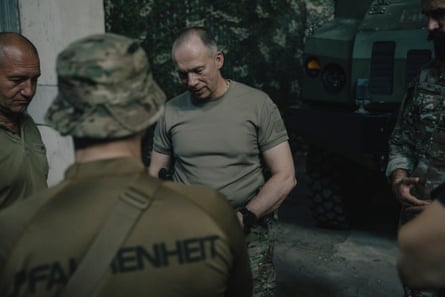
Oleksandr Syrskyi with his troops. Photograph: Alessio Mamo/The Guardian
Syrskyi said that without mobilisation he could not create new reserves and brigades, which were needed as Russia multiplied its own land forces. 'It's very important for us that all citizens of Ukraine fulfil their constitutional duty,' he said. He urged Ukrainians living outside their country to take part as well. 'I hope that after victory they will be able to tell their children where they were. Where were you when all citizens of Ukraine were fighting in such fierce battles? That is the question.'
One initiative is taking shape in neighbouring Poland. Ukrainians abroad will soon be invited to join a new legion there. Training will take place in Poland itself, building trust between men and officers. Later the legion will transfer to the frontline. Syrskyi credited Zelenskiy with this 'different approach'. One senses relations between them are harmonious, helped perhaps by the fact the commander has zero political ambitions and a lower profile than Zaluzhnyi. Syrskyi is celebrated in a cat meme, though.
Russia began its armed takeover of Ukraine in 2014, when it covertly grabbed parts of the Donetsk region. More than a decade on, there seems little likelihood Europe's biggest war since 1945 will finish this year, or next, Donald Trump's pledge to end the war in one day notwithstanding. Could Ukraine win? And if so, how long before victory? 'I think you have to be very, very brave to say when. We do everything to make it happen. There is simply no more important task for us,' Syrskyi said, leaving the stage and striding back to work.
Cinephiles lie awake at night worrying that talented young film-makers are deserting cinema for TV. Jane Schoenbrun, one of the most gifted around, has just made a superb feature film about a fictional TV show, imagined here with such loving and unnerving intensity that it surely can't be long before they are called upon to conjure up a dozen or so episodes for real. With a compelling cod-90s score by Schoenbrun's musical collaborator Alexander Giannascoli, or Alex G, I Saw the TV Glow lives on in my head. It deserves cult classic status without the 'cult'; it is deeply scary, deeply strange and deeply sad, a deadly serious new version of Gore Vidal's Myra Breckinridge for the 2020s.
Schoenbrun made a brilliant impression with a startling debut in 2021 that exploited the lockdown-Zoom aesthetic with an ingenuity that, for me, is still unmatched by any other film, the no-budget chiller We're All Going to the World's Fair, about a young woman drawn into the world of online gaming and collaboratively authored creepypasta-type online horror. There were no in-person dialogue scenes: everyone was alone in an atomised universe. Now we are in the pre-internet world of the 1990s, in a high school where parents are voting for a second Clinton term. Owen, played by Ian Foreman as a kid and as an adult by Justice Smith (from Benjamin Caron's thriller Sharper), is a deeply unhappy person, unsure about his relationship with his mother, about his sexuality, about everything. He meets the older, supercool, emo-ish Maddy (Brigette Lundy-Paine, channelling a very young Winona Ryder), equally unhappy and abused by her stepdad. She is queer (as hardly anyone used to say in 1996) and, asked about his own preferences, Owen says shyly that he 'likes TV shows'.
So Maddy introduces him to one called The Pink Opaque and lends him her recorded VHS copies of all the episodes. It's a story of two girls, Isabel and Tara (pronounced 'terror'), who have an intense relationship that clearly goes beyond anything as banal as romance, battling each week against supernatural foes under the direction of villainous Mr Melancholy, who lives in the sky like Georges Méliès's man in the moon.
Owen and Maddy become passionately addicted both to the show and, asexually, to each other. They don't obsess about the actors or directors and their careers (this is when the internet was in its infancy, when discovering these things was pretty difficult). They obsess about the show itself. It speaks to them; The Pink Opaque is their world, incomparably more real and more important than anything in their boring town and boring lives. They yearn for self-reinvention, for escape and the show is the key. But Maddy mysteriously disappears, declared dead, and reappears after a decade, during which Owen has got much older and more depressed, brooding on something about adulthood that no one had told him: years go by quicker than skipped DVD chapters. Where has Maddy been?
Audiences familiar with 90s TV may recognise the dynamic between Owen and Maddy as something like Rickie Vasquez and Rayanne Graff in the small-screen classic My So-Called Life, while the mixture of genuine fear and rapture â” and genuine longing for a compromised teen past â” has something of those 90s masters Bret Easton Ellis and Douglas Coupland. It's a nostalgia: not for the past, but an alternative imagined present. And as for that other towering 90s classic, perhaps Maddy has seen through the Wachowskian Matrix and maybe she hasn't.
The force of this film, which Schoenbrun delivers so matter-of-factly, is that it almost doesn't matter. Maddy is ecstatic about something about which Owen can only feel fear, and his own life is to play out in dreary sadness; living in his late parents' house, getting terrible jobs, ditching the old boxy TV for a new plasma model, and talking about loving his new 'family', by which he means the people he sees on the flatscreen. I Saw the TV Glow is claustrophobic, unwholesome and brilliant.
The acquisition was disclosed on the evening of Tuesday, July 23, 2024, though details about the deal are still scanty. IGIHE has learnt that deal was finalized on July 18, 2024.
In a brief interview, Mahmoud Nasr, the CEO of Prime Cement, confirmed the development. Asked what could have triggered the deal, Mahmoud declined to divulge more details.
'It is the responsibility of the government. You should be asking them why the takeover happened,' he said before hanging up.
The CEO of the Rwanda Stock Exchange (RSE), Pierre Celestin Rwabukumba, also confirmed that CIMERWA had informed them about the acquisition last week.
“They informed us last week, and the process is ongoing. This acquisition has significant implications for CIMERWA and its shareholders. Prime Cement was a major competitor in the market. When you acquire a competitor, you are essentially taking over the market. National Cement Holdings Ltd, which acquired CIMERWA, aims to lead the market wherever they operate by reducing the importation of cement into the country,” he stated.
The amount CIMERWA paid to acquire Prime Cement has not been disclosed yet. This move follows CIMERWA’s acquisition by National Cement Holdings Limited, which owns cement manufacturing plants across Africa.
In November 2023, CIMERWA’s management announced that the company had been acquired by National Cement Holdings Limited after it secured 99.94% of its shares.
By January 2024, National Cement Holdings Ltd’s management announced they had completed the payment for the 99.94% shares in CIMERWA, amounting to $85 million, equivalent to Rwf107,963,175,000.
They committed to satisfying the cement demand in Rwanda by eliminating the need for imports thereby ensuring affordable prices to Rwandans.
CIMERWA, established in 1984, became the first cement factory in Rwanda. Its cement has been used in major projects such as BK Arena, Bugesera International Airport, Amahoro Stadium, various roads, and over 2000 classrooms.
Prime Cement, the newly acquired factory, had a capacity of processing 600,000 tons of cement per year. CIMERWA earlier announced through local media outlets that the acquisition of Prime Cement’s assets was an “off-market transaction.”
'CIMERWA Plc will take over all operational assets of Prime Cement, with the government retaining any outstanding liabilities. The company believes this acquisition will significantly boost its capabilities and market position,' reads a statement.
CIMERWA, Rwanda’s leading cement manufacturing company, has completed the acquisition of Prime Cement.