Category: Uncategorized

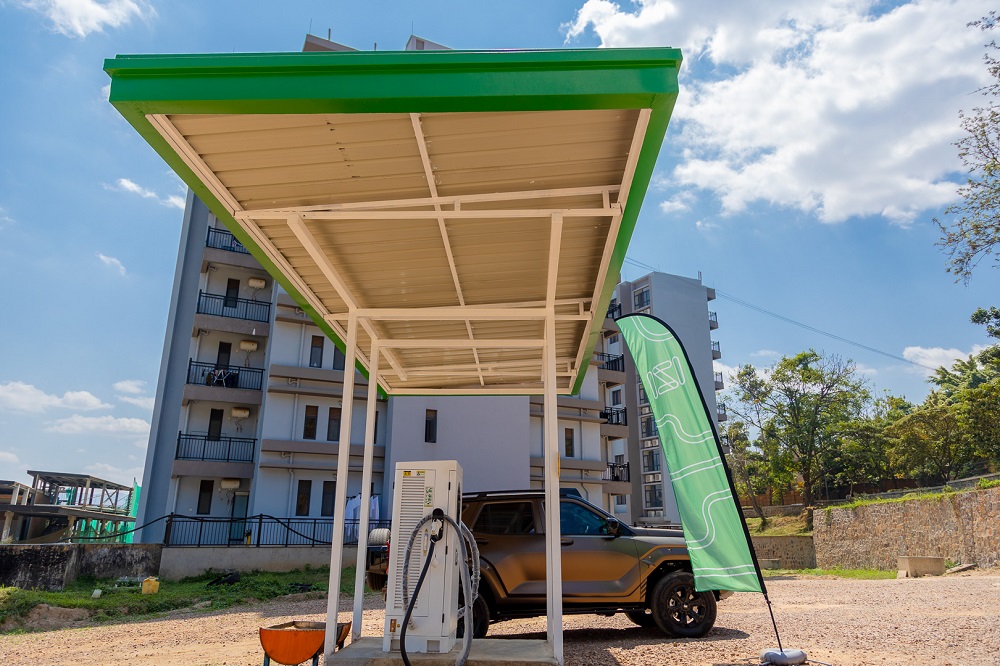
  • Rwanda to expand EV charging stations in areas with limited private investor interest #rwanda #RwOT

    The move is intended to expand the charging network across the country and make it easier for electric vehicle owners to travel without worrying about where to recharge.

    Rwanda is expected to have 218 electric vehicle charging stations by 2027.

    Byiringiro Alfred, Chief Technical Advisor for Transport at MININFRA, said the government has already identified priority locations for charging infrastructure and will work with private investors to develop the sites.

    He made the remarks at the Renewable Energy for Sustainable Growth (RE4SG) 2026 in Kigali.

    'Some areas may not offer enough commercial returns to attract private investment in electric vehicle charging infrastructure. In such cases, the government needs to support private investors and may also invest directly to ensure the necessary facilities are built,' Byiringiro said.

    He said a reliable charging network was essential to the wider adoption of electric vehicles.

    'You cannot promote electric mobility without adequate charging infrastructure. It is essential to have that infrastructure in place,' he said.

    The government has already supported the sector by helping investors access land for charging stations and providing tax incentives.

    Since 2021, Rwanda has introduced a range of measures to encourage the adoption of electric vehicles, including reducing or removing some taxes on electric vehicles and related equipment.

    MININFRA is also working on standards for electric vehicles and charging equipment to ensure that products entering the Rwandan market meet required quality and durability standards.

    'We need appropriate standards for both vehicles and charging infrastructure to ensure that people who buy electric vehicles can use them for many years rather than having them last only one or two years,' Byiringiro said.

    More than 7,000 electric vehicles had been registered in Rwanda by the end of 2024, following their introduction to the country in 2020.

    Rwanda plans to fund EV charging stations in areas with limited private investment.

    Source : https://new.igihe.com/english/rwanda-to-expand-ev-charging-stations-in-areas-with-limited-private-investor-interest/

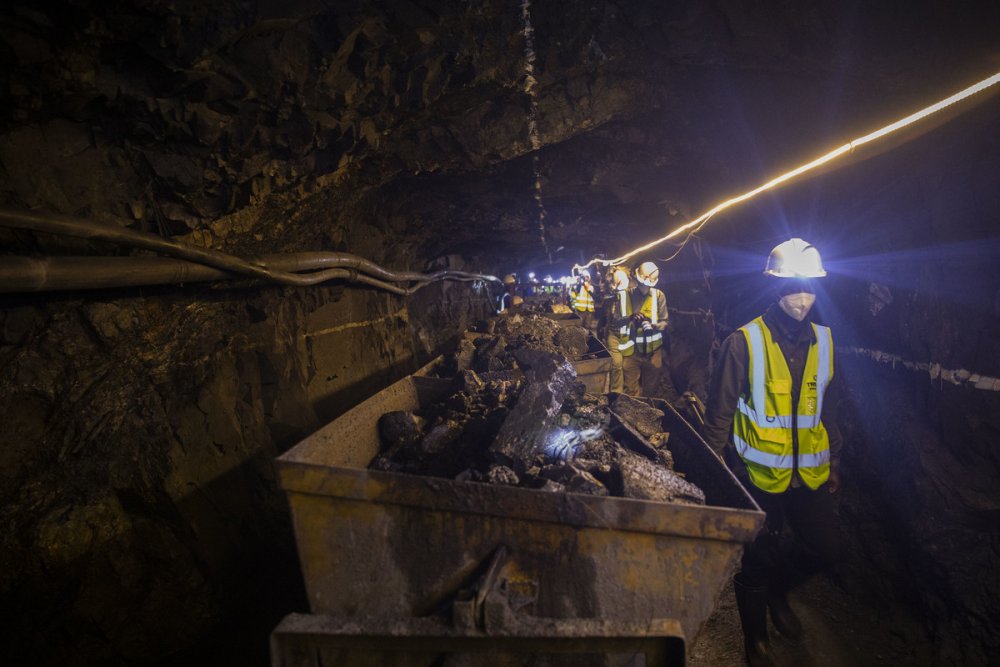
  • Rwanda, Almonty partner on tungsten exploration and processing  #rwanda #RwOT

    Under the agreement, the government will receive a 25% stake in Almonty Rwanda Pty Ltd in exchange for contributing the Shyorongi tungsten exploration concession and a mineral processing licence, while Almonty will hold the remaining 75%.

    The Shyorongi exploration block covers approximately 32 square kilometres in Rulindo District, Northern Province.

    The partnership will initially allow Almonty Rwanda to acquire ore, pre-concentrate and panning tailings from Rwandan mining licence holders, including small-scale operators, for upgrading and sale. The company also plans to use a mobile processing unit near existing tailings dams before establishing a collection and processing plant in Rwanda.

    Almonty Chairman, President and CEO Lewis Black said the arrangement would allow the company to work with material already being produced in Rwanda.

    'The most immediate opportunity here is the material that is already being produced. Rwanda's small-scale license holders are producing ore, pre-concentrate and panning tailings today, and this agreement allows us to collect, upgrade and export that material while we build out the collection and processing plant,' he said.

    Black said the company would combine Rwanda's existing production with modern processing, traceability and exploration.

    Rwanda Mining Board CEO Alice Uwase said the partnership would contribute to the transformation of the country's tungsten industry.

    'Rwanda is pleased to welcome Almonty as a strategic partner in the development of our tungsten industry. This investment will help to transform our mining sector by introducing world-class processing infrastructure, international standards for environmental and social governance, and a comprehensive training program to develop Rwandan talent,' she said.

    Almonty Industries is an international company focused on the mining, processing and trading of tungsten. It is particularly known for taking over underperforming mines or mining projects and upgrading them to improve their operations. The company has projects in South Korea, Portugal and Spain.

    Almonty was previously headquartered in Toronto, Canada, but relocated its headquarters to Dillon, United States, in April 2026.

    The company is also listed on the Nasdaq stock exchange, one of the world's major financial markets.

    Tungsten is a mineral used to produce hard metals for applications in construction, aircraft, tanks, spacecraft, firearms and ammunition.

    The Rwanda Mines, Petroleum and Gas Board (RMB) indicates that Rwanda exports at least 24 tonnes of tungsten every week.

    Tungsten is one of the minerals found in significant quantities in Rwanda. The country has a geological zone known as the Tungsten Belt, which stretches from Mageragere in Kigali City through Rulindo and continues to Gifurwe and Bugarama in Burera District.

    Rwanda has joined Almonty in new tungsten exploration venture.

    Source : https://new.igihe.com/english/rwanda-almonty-partner-on-tungsten-exploration-and-processing/

  • Rwanda, DR Congo delegations to meet in Geneva #rwanda #RwOT

    The two-day meeting will bring together members of the Joint Security Coordination Mechanism (JSCM), a body established to coordinate and monitor the implementation of the parties' security commitments.

    The talks will also be attended by facilitators including the United States, Qatar, Togo and the African Union Commission.

    The meeting comes as fighting continues in eastern DRC, while some key provisions of the peace agreement have yet to be fully implemented.

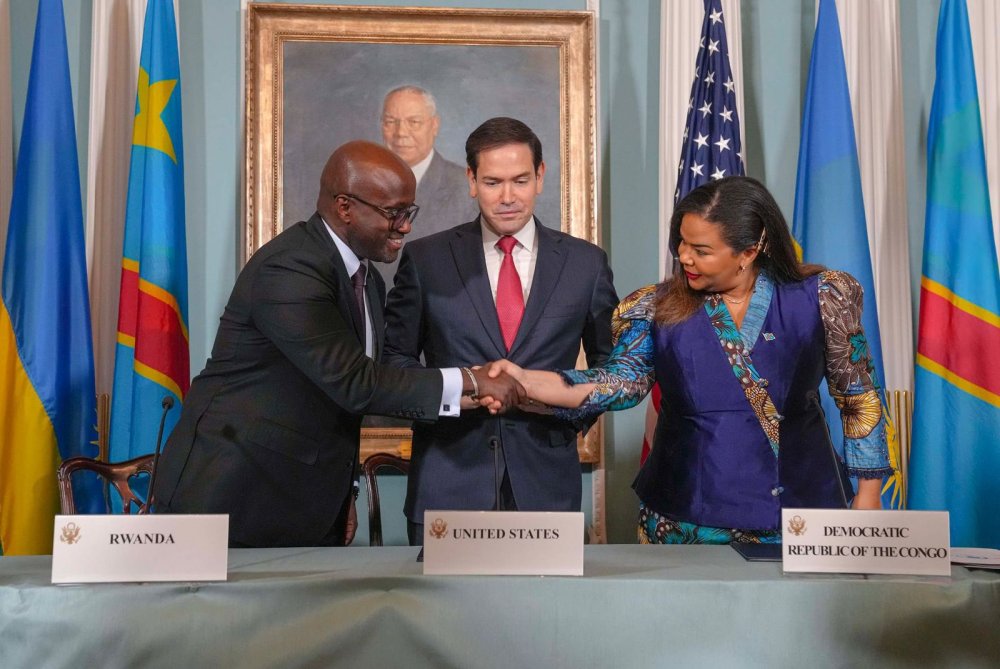
    The Rwanda-DRC peace agreement was signed in Washington on June 27, 2025, and was later reinforced by the Washington Accords for Peace and Prosperity signed on December 4.

    Among the key commitments is the complete dismantling of the Democratic Forces for the Liberation of Rwanda (FDLR) by the DRC, while Rwanda is expected to lift its defensive measures in line with progress on that commitment.

    The FDLR is expected to remain a major issue in the Geneva talks. Rwanda has repeatedly accused the DRC of supporting, arming and cooperating with the group.

    On July 28, the DRC government said part of the FDLR terrorist group had agreed to a process involving disarmament, demobilisation and relocation to designated sites. Kinshasa presented the move as progress towards fulfilling its commitments.

    Rwanda, however, rejected the approach, arguing that the Washington agreement requires the complete dismantling of the FDLR rather than negotiations with the group.

    Meanwhile, fighting between the DRC army, FARDC, and M23 has continued in North and South Kivu. M23 captured several areas in 2025, including Goma and Bukavu.

    The September talks will follow the sixth JSCM meeting held in Geneva on August 12 and 13, where both sides agreed to strengthen mechanisms for monitoring and verifying implementation of the Washington agreement.

    Delegations from Rwanda and the Democratic Republic of Congo are expected to meet in Geneva, Switzerland, on September 16 and 17, 2026, for talks on the implementation of the Washington peace agreement.

    Source : https://new.igihe.com/english/rwanda-dr-congo-delegations-to-meet-in-geneva/

  • Weight-loss drug firm accused of prioritising profits after halting insulin pen production #rwanda #RwOT

    The pharmaceutical company behind injectable weight-loss drugs has been accused of prioritising profits over the health of people in developing countries by halting production of its insulin pens.

    People living with type 1 diabetes who are reliant on the human insulin produced by Novo Nordisk, will instead be given glass vials and syringes – which they say are inconvenient and harder to use with the same accuracy.

    Novo Nordisk has told governments and non-profit organisations that it will no longer be producing human insulin in pens and has already stopped supplying in South Africa, where patients have had to switch to glass vials.

    Campaigners claim the move is to allow the scaling-up of the production of injectable weight-loss drugs such as Ozempic and Wegovy.

    Novo Nordisk will no longer produce human insulin in pens.
    Novo Nordisk has already stopped supplying human insulin in pens to South Africa. Photograph: Tom Ittle/Reuters

    Novo Nordisk this year announced a $4bn (£3bn) investment in a production plant in the US to 'grow its ability to produce current and future injectable treatments for people with obesity and other serious chronic diseases'.

    Lecritia Roberts, 31, from South Africa, has type 1 diabetes. She said it feels as if the clock has been turned back on treatment.

    'It makes me angry. They don't understand how much harder they are making our lives,' she said. 'Why are they making things more convenient for people who want to lose weight over people struggling with a disease?'

    Roberts used vials to inject insulin as a teenager but said it was difficult to accurately administer, was often embarrassing in public and required a lot of caution, as dropping the bottles could result in losing a month's worth of medicine in one go.

    She said the pens transformed how she managed her diabetes because they were easier to carry and could be discreetly used, even while at her desk at work.

    'When I was younger it was challenging, I didn't like injecting. Sometimes I injected it into the floor because I didn't like having the needle in my arms or thighs,' said Roberts. 'If your break the vial and don't have any [saved] back, you basically don't have any insulin unless you buy it, but people in rural areas can't afford it.'

    She said she had recently seen a blind diabetes patient in hospital having to learn how to use the vials and feared for her – the clicking sound made by a pen helps people with visual impairments to measure dosage.

    A survey by the medical charity Médecins Sans Frontières (MSF) and T1International, which campaigns for people with type 1 diabetes, found that 82% of patients preferred pens over syringes and vials.

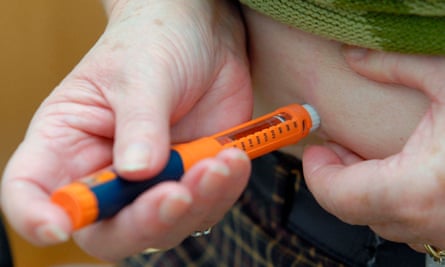
    A patient injects herself with an insulin pen.
    A patient injects herself with an insulin pen. Photograph: Guido Krzikowski/Bloomberg/Getty Images

    Novo Nordisk will continue to produce pens for analogue insulin – synthetic substances that are more costly than human insulin, putting them out of budget for many in developing countries.

    Candice Sehoma, advocacy adviser for MSF's Access Campaign said Novo Nordisk's decision would result in unequal care around the globe, and pointed out that syringes and vials are outdated and rarely used in wealthy countries.

    'While the corporation continues to profit immensely by supplying newer, more expensive insulin and semaglutide pens (Ozempic and Wegovy) to wealthier nations, its decision to withdraw human insulin pens may push people with diabetes in resource-limited settings, who rely on insulin for survival, to revert to using vials and syringes, which virtually nobody uses any more in high-income countries,' she said.

    Novo Nordisk denied that the discontinuation of insulin pens was to make way for the production of weight-loss drug pens, saying that a different type of device was used. A spokesperson said it was phasing out products to address 'capacity constraints'.

    'Patients in a number of countries, including South Africa, will eventually have limited access to our human insulin in pens,' the spokesperson said.

    'We recognise the impact these decisions will have on patients and we are in dialogue with local health authorities to ensure that patients continue to have access to the treatment they need. We will continue to deliver our newer insulins in pens.'

    Advertising for Wegovy and other weight loss injections outside Penn station in New York earlier this year.
    Advertising for Wegovy and other weight loss injections outside Penn station in New York earlier this year. Photograph: Richard Levine/Alamy

    The scientists who discovered insulin assigned the patent to the University of Toronto to ensure its accessibility, but today more than 90% of the medication's production is in the control of three companies. The same firms produce the new weight-loss drugs, developed initially to treat diabetes, and have been accused of having a 'stranglehold' on that market, charging up to 400 times more than needed for products.

    MSF has called on other insulin manufacturers to guarantee lower prices for all types of the devices, which it says could still be profitable at $1 a pen.

    'The profiteering on a lifesaving medicine that has been available for more than a century must stop now,' said Sehoma.

    The post Weight-loss drug firm accused of prioritising profits after halting insulin pen production appeared first on The Custom Reports.

    Source : https://thecustomreports.com/weight-loss-drug-firm-accused-of-prioritising-profits-after-halting-insulin-pen-production/

  • Death toll from Israeli airstrikes on Lebanon's Nabatieh rises to 6, with 43 injured #rwanda #RwOT

    The death toll from Israeli airstrikes on a municipality building in the southern Lebanese city of Nabatieh has risen to six, with 43 injured, according to the Lebanese ministry of health.

    Rescue workers continue to remove debris from the attack, the ministry said. The attack also killed the city's mayor.

    Walid Al-Hashash, director of the operations unit of Lebanon's civil defense force, said a civil defense worker was among those killed in the strikes.

    Alexy Nehma, director of emergency medical services at the Lebanese Red Cross, told CNN that responders struggled to reach people in need due to repeated strikes and had to withdraw their team from the area.

    Ahmad Kahil, the mayor of Nabatieh, was killed in the strike, Lebanon's National News Agency (NNA) reported earlier.

    The post Death toll from Israeli airstrikes on Lebanon's Nabatieh rises to 6, with 43 injured appeared first on The Custom Reports.

    Source : https://thecustomreports.com/death-toll-from-israeli-airstrikes-on-lebanons-nabatieh-rises-to-6-with-43-injured/

  • US officials expect Israel's counterattack on Iran will come before US Election Day #rwanda #RwOT

    American officials expect Israel will retaliate against this month's Iranian attack before November 5, sources tell CNN — a timeline that would thrust the growing volatility in the Middle East squarely into public view within days of the US presidential election.

    The timeline and parameters of Israel's retaliation against Iran have been subject to intense debate inside Israel's government and are not directly related to the timing of the US election, the sources said.

    Still, Israeli Prime Minister Benjamin Netanyahu — described by senior US administration officials as deeply attuned to American politics — appears highly sensitive to any potential political ramifications of Israel's actions in the US, they said.

    The growing conflict in the Middle East has emerged as persistent issue in the American election. President Joe Biden, and by extension Vice President Kamala Harris, have faced pressure from progressives for their handling of the situation. Meanwhile, Republicans — including former President Donald Trump — have accused the administration of bungling the crisis and sending the world into chaos.

    As the election nears, the administration has begun applying new pressure on Israel to improve humanitarian conditions inside Gaza. In a stern letter revealed this week, Secretary of State Antony Blinken and Defense Secretary Lloyd Austin warned Israel a failure to deliver more aid to the enclave could trigger a cutoff of military assistance.

    But in a sign of the fraught political dynamics, the letter was not signed from the president or the vice president, neither of whom has publicly threatened to cut off aid to Israel, despite pressure from the left. Its deadline for allowing more humanitarian aid into Gaza falls after the election. And the warning came the same week some military personnel and components of the advanced air defense system the US is providing to Israel arrived in the country.

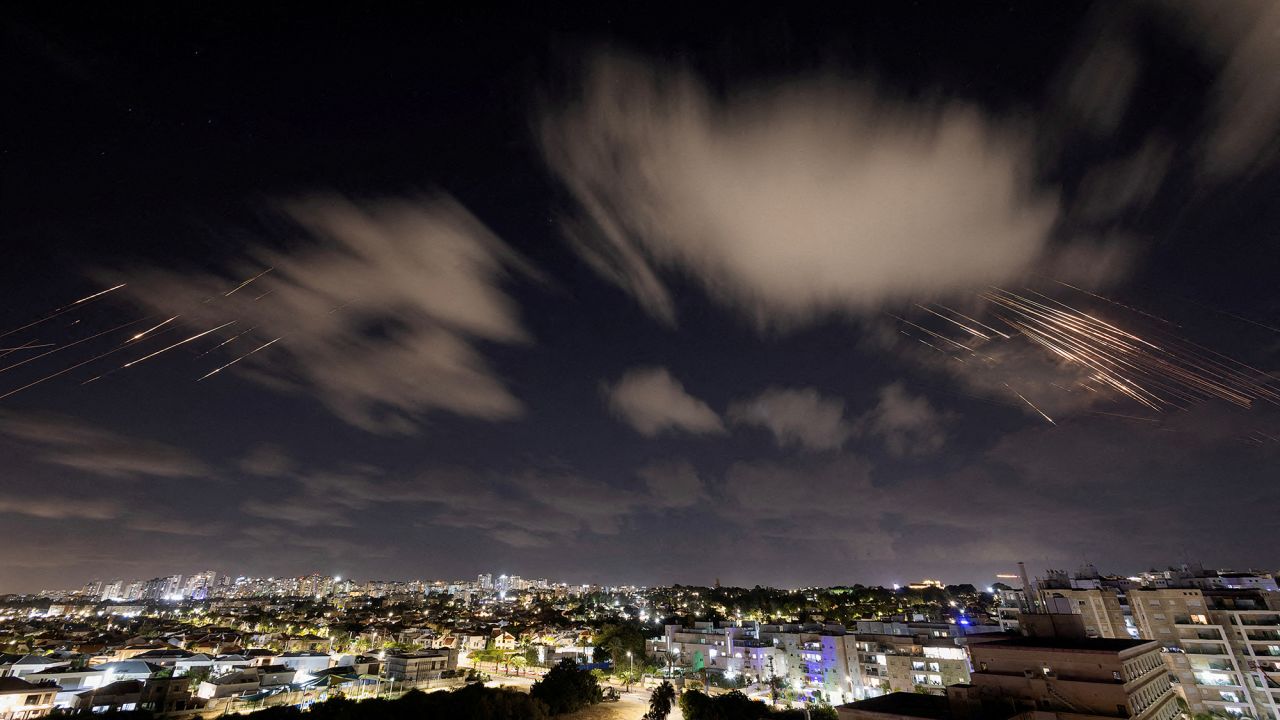
    Israel's Iron Dome anti-missile system intercepts rockets after Iran fired a salvo of ballistic missiles, as seen from Ashkelon, Israel, on October 1.

    The post US officials expect Israel's counterattack on Iran will come before US Election Day appeared first on The Custom Reports.

    Source : https://thecustomreports.com/us-officials-expect-israels-counterattack-on-iran-will-come-before-us-election-day/

  • Inside a secretive Ukrainian drone unit targeting Russian territory #rwanda #RwOT

    The spluttering roar of a propeller punctuates the perfect silence. Car headlights flick on, splitting the darkness. Their beams reveal not just a section of tarmac ahead, but one of Ukraine's most top-secret weapons, controlled by its most clandestine agency.

    Stuck to the nose of the gray machine is a yellow emblem of an owl, wings spread and grasping a sword – the unmistakable logo of Ukraine's defense intelligence, the GUR.

    Two pilots sporting the same owl patches on their fatigues make their final checks inside the car before a thumbs up: 'Let's go!'

    A high-speed, 50-second chase ensues, before the 13-foot long, 23-foot wingspan AN-196 Liutyi drone disappears in an instant into the inky-black Ukrainian night.

    The drone's destination is a target deep inside Russian territory.

    Only two people were authorized to speak on the record, and then only using their callsigns: Serge, the long-range drone operations commander of GUR, and Vector, unit commander. Serge said he had personally overseen more than 500 long-range drone attacks into Russia since its full-scale invasion of Ukraine in February 2022.

    CNN spent two days traveling across the country with the drone unit as it prepared to launch more than 100 drones overnight into September 29 on a mission into Russia. CNN is not disclosing the location of the sites visited for operational security reasons.

    Their target: an ammunition facility, specifically train carriages sitting inside the depot loaded with recently delivered Iranian missiles, according to the Ukrainians.

    Sources told CNN in September that Tehran had recently completed the delivery of short-range ballistic missiles to Russia. Iran has vehemently denied supplying any. 'Iran has NOT delivered ballistic missiles to Russia. Period!' Iran's Foreign Minister Abbas Araghchi recently stated on his X account.

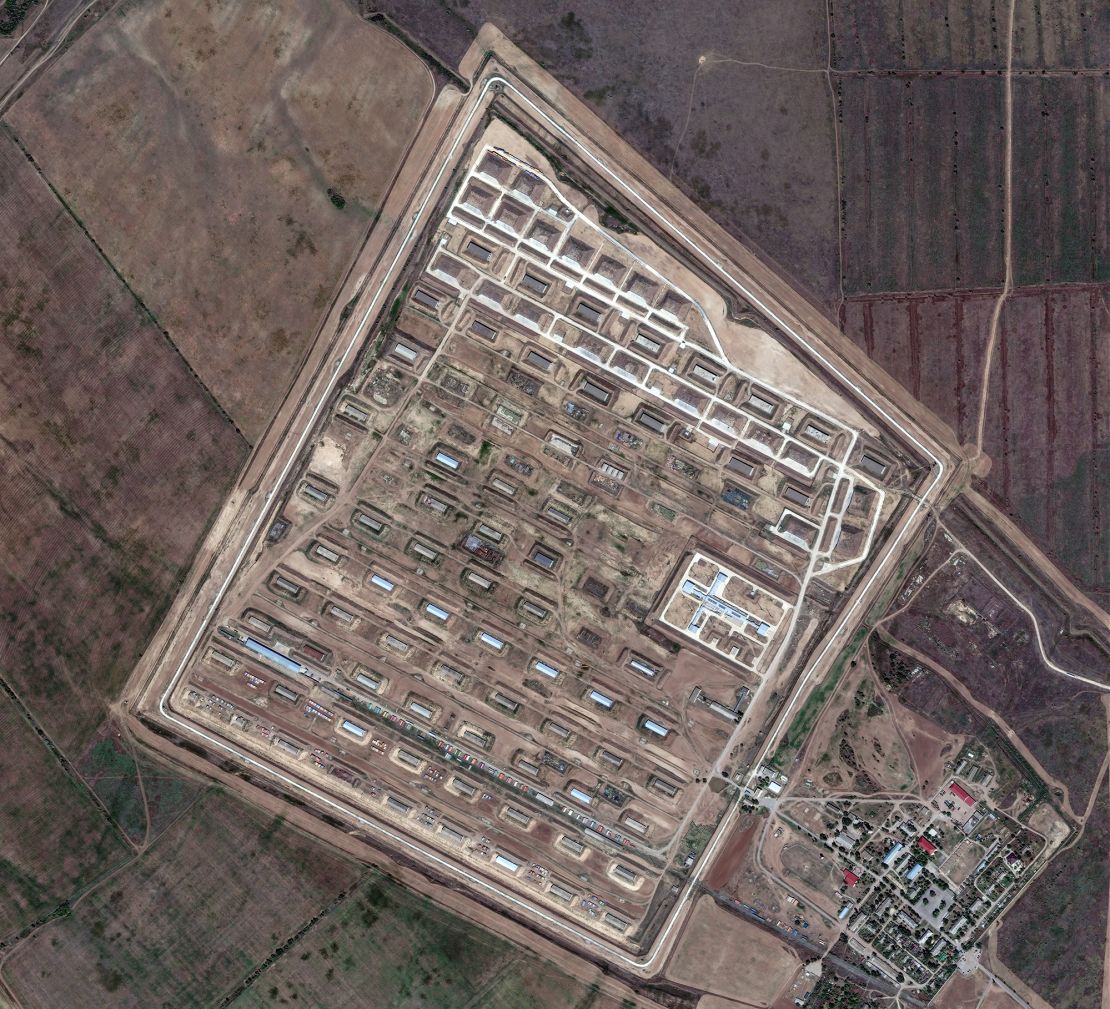
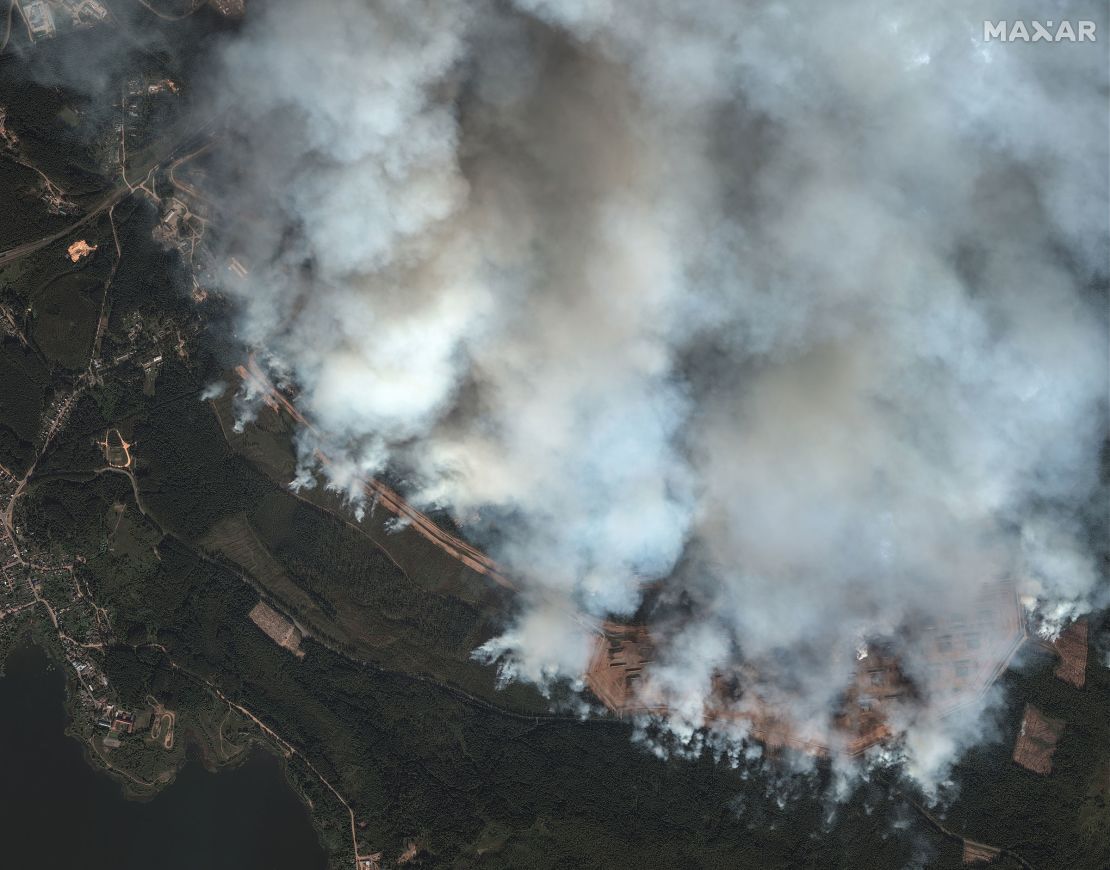
    The facility sits on the outskirts of the tiny village of Kotluban, in the Volgograd region of southwestern Russia.

    A satellite image of the Kotublan ammunition depot taken on August 4, 2024.
    A satellite image of the Kotublan ammunition depot taken on August 4, 2024. 

    Maxar Technologies

    Long-range drone attacks have become an increasingly prominent part of the Russia-Ukraine war. As the land war has become more attritional, the air war has gathered speed, with the major development being in drone warfare.

    In September, the unit's drones hit a Russian ammunition depot between Moscow and St. Petersburg, in Tver region. The attack on Toropets, the Ukrainians claimed, resulted in the destruction of a depot storing Iskander tactical missiles, as well as aerial glide bombs and artillery munition. The strike caused massive explosions, visible for miles.

    A satellite image shows smoke rising from multiple explosions at the ammunition depot in Toropets, Tver region, Russia, on September 18, 2024.
    A satellite image shows smoke rising from multiple explosions at the ammunition depot in Toropets, Tver region, Russia, on September 18, 2024. 

    Maxar Technologies

    And in July the Ukrainians say they hit an oil refinery on Russia's Black Sea coast, causing a major fire there.

    But Russian air defenses thwart many Ukrainian drone attacks. The GUR's success rate, the unit tells CNN, could be transformed from 50% to 95% if the United States gave permission to use Western weapons in attacks on Russian soil.

    Russian President Vladimir Putin has warned, however, that Moscow would consider any assault on it supported by a nuclear power to be a joint attack, singling out a mass launching of drones as one potential example.

    Vector said many of Russia's airfields, the origin-point of many of the air raids it conducts against Ukraine, are out of range. His drones, while highly effective, are not always that efficient – swarms of them are required to ensure their targets are hit. 'Of course, we can send the UAVs (unmanned aerial vehicles), and we destroyed many places. But it's not enough,' Vector says.

    'We're not asking only about the permission to send the missiles anywhere in Russia, we speak about the weapons which can help us to move this war from our territory,' Vector adds.

    Inside the mission

    Serge and Vector have been leading their unit's attempts to hurt Putin at home.

    Regardless of targets, their missions follow a rigid set of operating procedures that include meetings at various locations across Ukraine.

    In an underground office with dark brown, seemingly never-ending Soviet corridors, Serge sits across from Vector in a white-walled room. No pictures hang on the wall, even the whiteboard remains blank. The meeting is to the point.

    'There will be about 12 drones,' Serge says to Vector, who has a map in front of him detailing the target and range of the Russian air defense and electronic warfare systems.  They then agree the target approach time of around 3 am and the launch intervals for the drones.

    Vector scribbles two notes before standing abruptly and saying, 'Everything is clear. Ready to complete the task.'

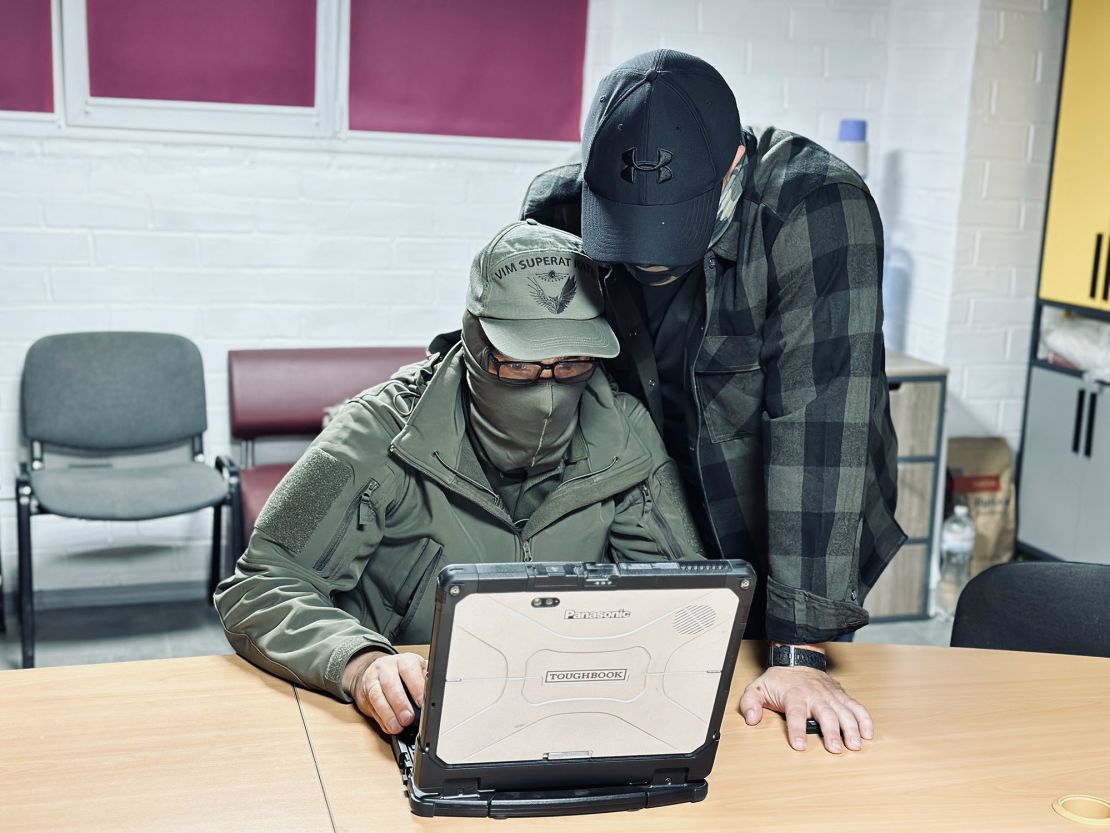
    Planning the routes into Russia is done from a secret location. The routes the Liutyi takes can include more than 1,000 waypoints to avoid detection
    Planning the routes into Russia is done from a secret location. The routes the Liutyi takes can include more than 1,000 waypoints to avoid detection 

    Sebastian Shukla/Daria Tarasova-Markina/CNN

    Outside on the street, Vector climbs into his vehicle. He beckons the CNN team to follow him, phones turned off.

    As dusk draws in, the convoy pulls into a compound, articulated lorries lined up. A tiny room with a desk and two sets of bunk beds serves as the only light source for miles around.

    Men dressed in black, balaclavas over their faces, wait to hear their orders. Vector delivers a short brief, adding that this mission will also involve other units. He orders his men to start preparing the routes and hands over a small USB key containing the information for the mission ahead.

    'Any questions?' he asks. 'None? Okay. Let's get working.'

    As his men scatter across the compound, Vector explains that the planning phase of these missions is critical. 'Planning is maybe 60% part of the success, everything depends on the planning,' he tells CNN.

    He points to the quality of Russia's air defenses, especially over the past 12 months. 'We're successful guys and we find the windows,' he says, but it's a challenge.

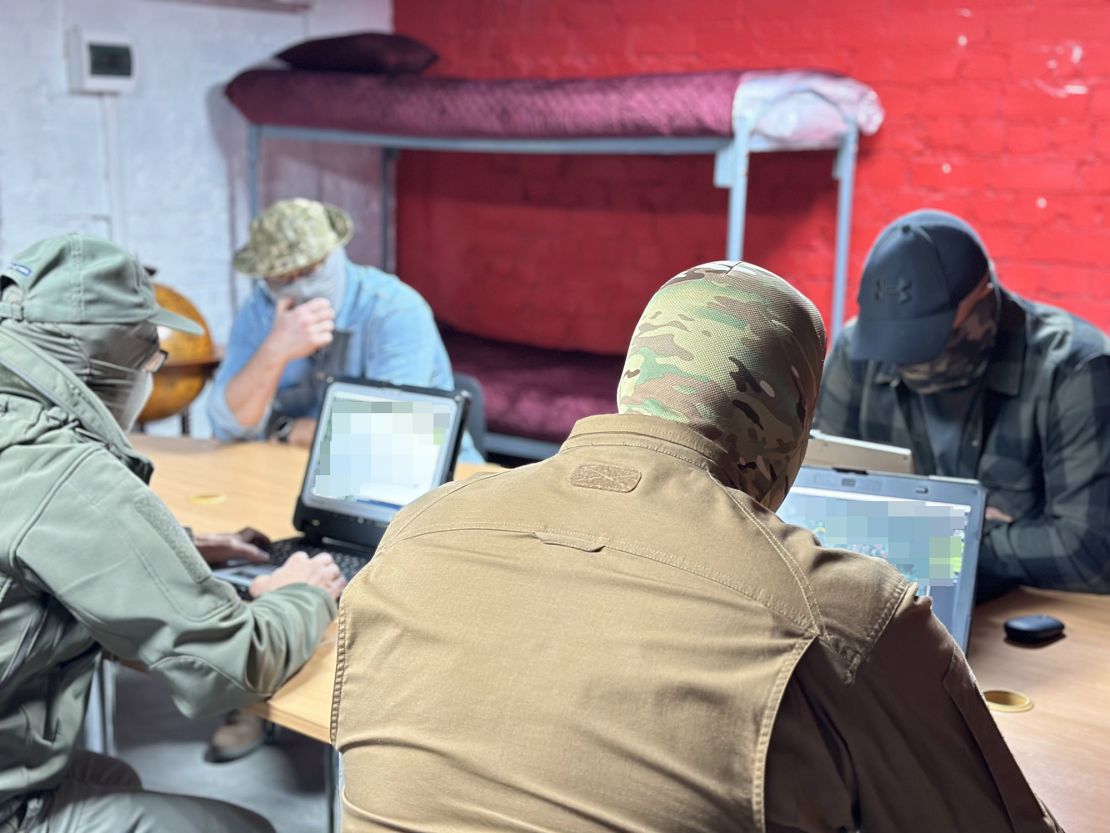
    Route planning is seen underway. CNN has added blurs to this image for security reasons.
    Route planning is seen underway. CNN has added blurs to this image for security reasons. 

    Sebastian Shukla/Daria Tarasova-Markina/CNN

    Each drone will be programmed with more than 1,000 different waypoints, to evade Russia's comprehensive air defense systems. There is tacit acceptance from Vector that some of this resembles a video game.

    'It looks like we play with them,' Vector says jokingly, 'but it's not a game. It's a war.'

    Serge adds that not all men in his unit are career soldiers like him. He has served more than 20 years in the Ukrainian army and began flying drone missions in 2014 as Russian-backed separatists in Ukraine's eastern Donetsk and Luhansk regions split away from Kyiv.

    Decoy machines

    In a warehouse, a Liutyi drone, produced predominantly in Ukraine, wingless for the time being, stands surrounded by green camouflage-painted crates containing multiple Rubaka kamikaze drones.

    Vector explains that these smaller drones are crucial to the success of any mission. The aim is simple: to overwhelm the air defenses and draw Russian fire away from the Liutyi, which often carries a payload as great as 250 kilograms (550 pounds).

    'They're very simple, and we can use them with and without payloads,' he says of the smaller drones.

    Cracking open one of the crates, he pulls out one of the decoy machines. Strips of metal foil have been added to the wings to fool Russian radar.

    'We try to mix them, and we try to send them from different distances, different launch places… they try to destroy them. They send helicopters and missiles, they turn on the radio electronic warfare,' Vector explains.

    Their targets are only military targets, Vector states. 'Russia came inside our country. They destroyed a lot of electricity, a lot of houses, cities, villages.' But, he adds, 'not all of them are stupid, and when they understand that war can come to them like they come to us, they will change something in their country. They will change the politics.'

    One of the many articulated lorries has backed up for loading. In near darkness, drone bodies, followed by wings, are loaded three per truck by men whose faces are totally covered by balaclavas, and strapped down, ready to be taken to their launch sites.

    Pilots make final checks to the drone before launch. They follow the drone at high speed until takeoff, then it flies autonomously to its target. CNN has added a blur to this image for security reasons.
    Pilots make final checks to the drone before launch. They follow the drone at high speed until takeoff, then it flies autonomously to its target. CNN has added a blur to this image for security reasons. 

    Sebastian Shukla/Daria Tarasova-Markina/CNN

    Across other parts of Ukraine roughly 80 other GUR operatives are preparing 90 other drones, not all the Liutyi, for flight.

    Some 30% of all the drones being launched will be on decoy missions, Serge says. The drones have been programmed to fly anywhere between 450 and 550 miles, with the Liutyis being the spearhead, destined for the small town-turned-ammunition hub of Kotluban.

    The men load the warheads carefully into the bodies of the drones. Each compartment is then sealed with the squeal of a drill.

    Serge and Vector, now in full combat uniform, observe the final preparations. This launch is one of the largest Serge has ever conducted, he says.

    'Maybe (the Russian people) don't understand what's going on in Ukraine, but when these UAVs arrive, they understand clearly what we have been living (with) for the past 10 years,' Vector chimes in.

    Tracking the drones' flight

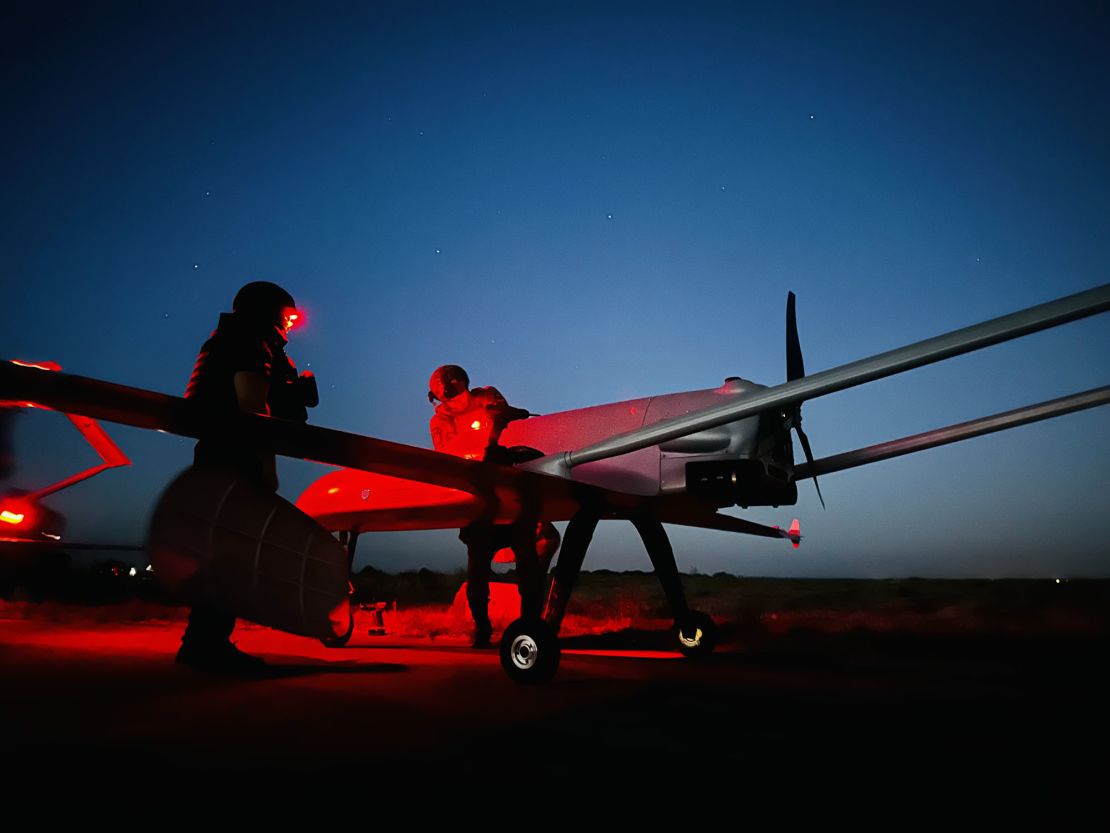
    In total darkness, the drones are pushed into position. The car with the pilots moves in behind. The propeller spurts into life and the pilots ensuring a smooth takeoff begin their high-speed chase down the tarmac. Once airborne the fully autonomous drone starts ticking off the myriad waypoints.

    Vector hurtles after the drone before slamming on the brakes and proclaiming 'perfect.' He turns the car around and blasts a patriotic song from his radio.

    Back at the planning base, the hours tick by and Vector, Serge and others keep tabs on the drones via trackers.

    The success of the mission is monitored in three ways, they say: through human intelligence on the ground, the messages seen on Russian Telegram groups and, later, analysis using satellite technology. Only once all three have been assessed can a mission be deemed a success or not.

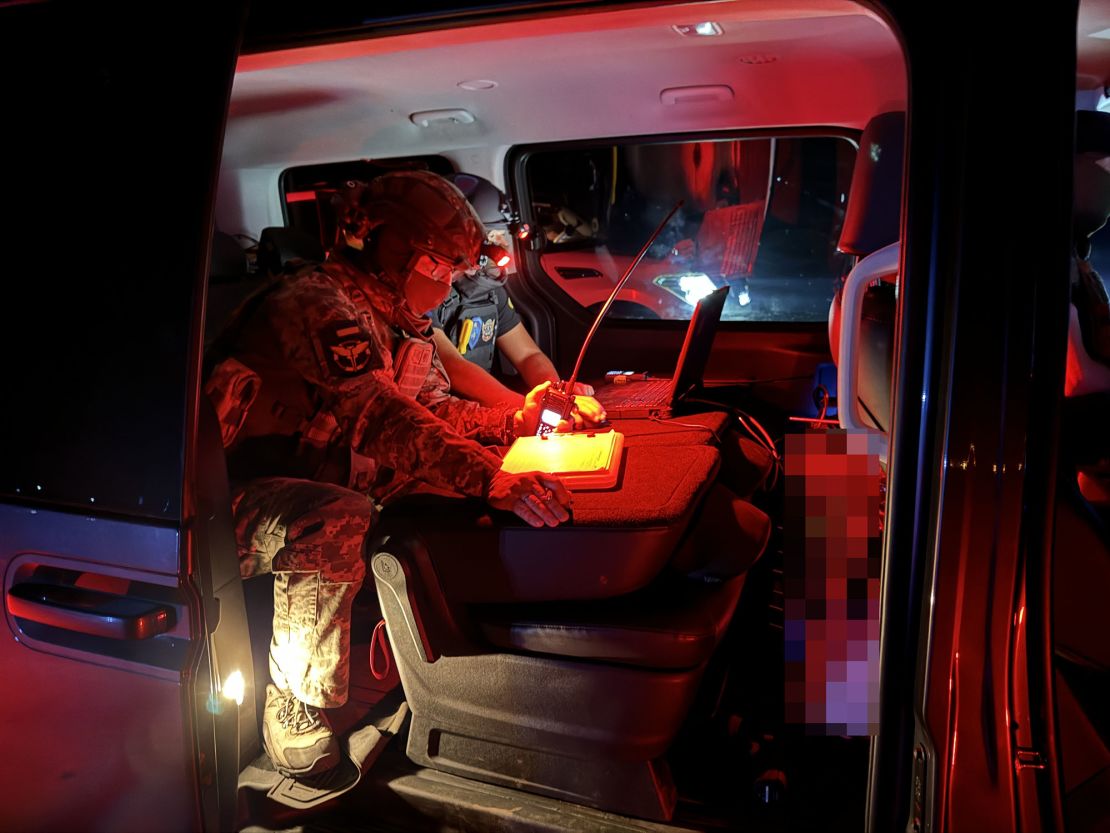
    Preparations for drone launches take place under cover of darkness, with red lights used to minimise the chances of detection by reconnaissance drones.
    Preparations for drone launches take place under cover of darkness, with red lights used to minimise the chances of detection by reconnaissance drones. 

    Sebastian Shukla/Daria Tarasova-Markina/CNN

    As the 3 am arrival window nears, Serge starts reading out messages he is seeing from Telegram channels across Russia. The widespread nature of this attack starts to become clearer. Various cities in southern Russia – Voronezh, Yesk, Rostov and Volgograd – all start reporting drones arriving in their airspace.

    One video from Voronezh shows one of the decoy drones whizzing overhead. An audio clip of a woman in clear distress at what is happening above her head leaves Vector laughing.

    Through these Telegram channels, he says, 'we understand that we are having some success.'

    Initial satellite imagery of the ammunition depot in Kotluban shows scorched fields, a result of burning grass, but seemingly little evidence of major explosions within – apparent signs of a near miss.

    However, the GUR shared with CNN a video from the region of the depot. CNN was able to independently view and verify aspects of the video without a blur to check its authenticity.

    A defense intelligence source told CNN that their knowledge of the camera's location, combined with its distance from Kotluban, allowed them to ascertain that the explosions inside the depot were large.

    The video, sped up, shows 11 explosions all occurring in a 56-minute timeframe between 2:22 and 3:18 am – exactly the period during which the drones arriving from Ukraine were expected to land.

    CNN was able to independently verify, through sources, that a direct hit on the facility had taken place. CNN is not publishing the image to protect the source's anonymity, but it was taken within 72 hours of the attack.

    The image shows a number of objects scattered around the building and a building badly damaged.

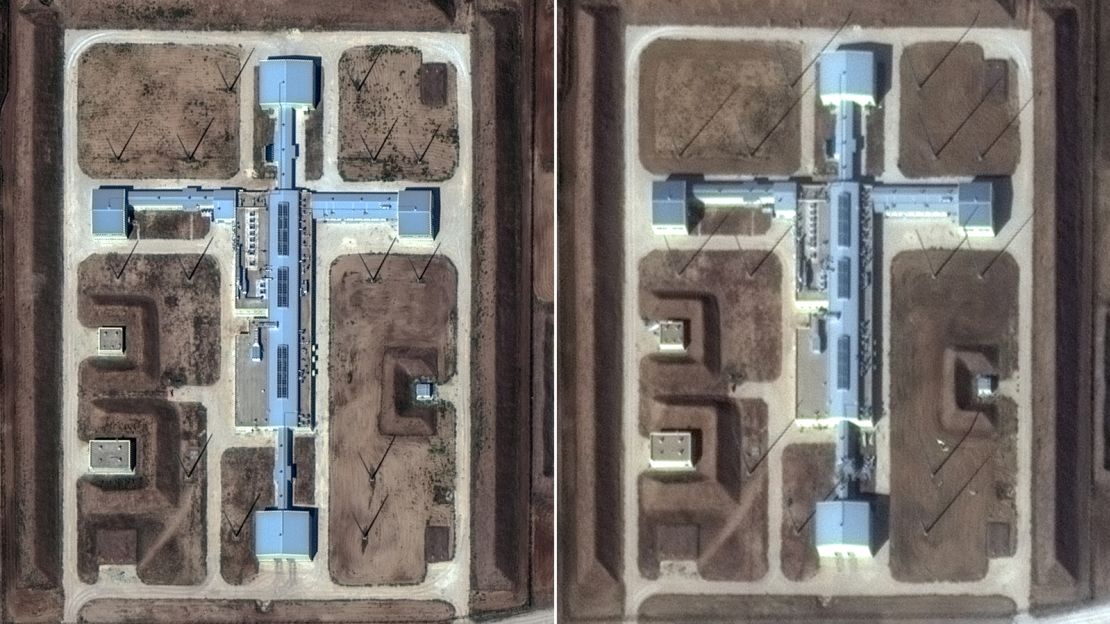
    Close-up before (left) and after (right) Maxar satellite images of the Kotluban facility show damage to a building and scattered debris in the later image, center bottom, taken in early October.
    Close-up before (left) and after (right) Maxar satellite images of the Kotluban facility show damage to a building and scattered debris in the later image, center bottom, taken in early October. 

    Maxar Technologies

    A later Maxar Technologies satellite image, also obtained by CNN, shows less debris in the vicinity – an indication that the Russian military had cleaned up the site – but the same building, heavily damaged.

    The mission to destroy Iranian-delivered missiles was a total success, the Ukrainians insist.

    As the drones were heading towards Kotluban, Serge told CNN: 'We are constantly forcing the enemy to think about what they did in February 2022. They must realize that we are getting stronger every day and we are bringing our victory and their defeat closer.'

    The post Inside a secretive Ukrainian drone unit targeting Russian territory appeared first on The Custom Reports.

    Source : https://thecustomreports.com/inside-a-secretive-ukrainian-drone-unit-targeting-russian-territory/
  • Tiananmen Square: Where China's past, present and power converge (Photos) #rwanda #RwOT

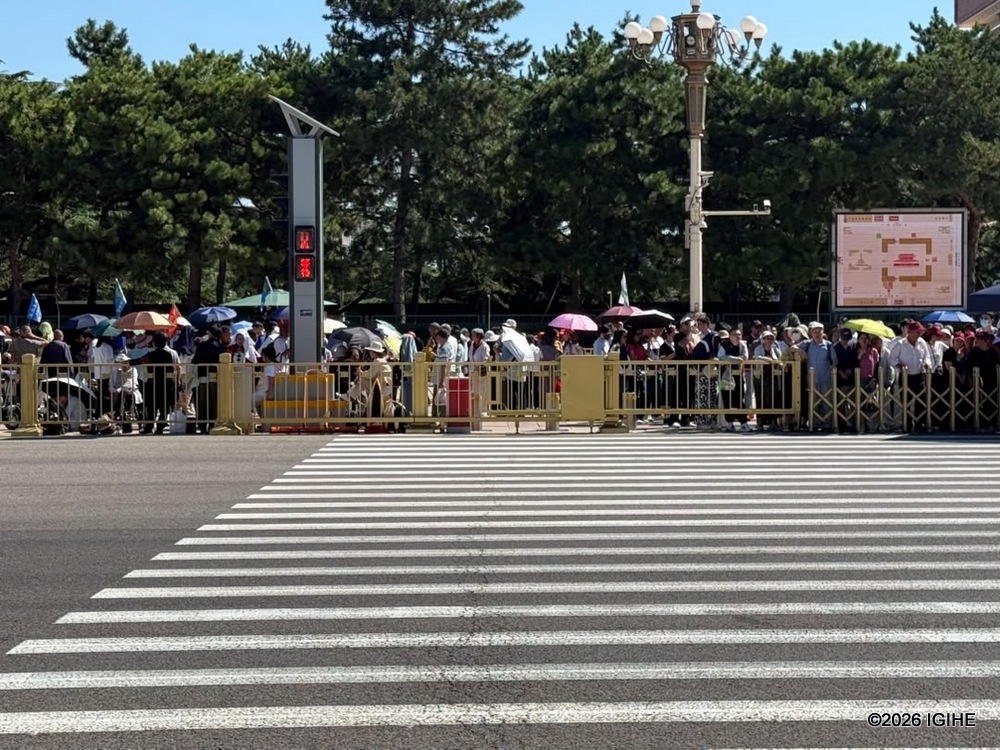
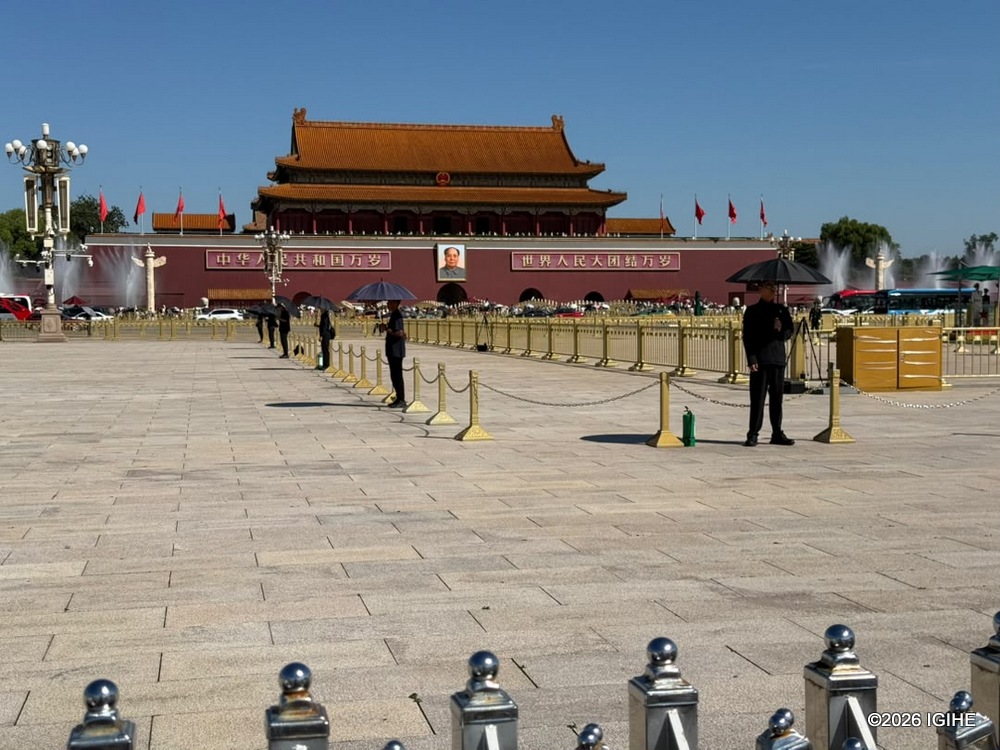
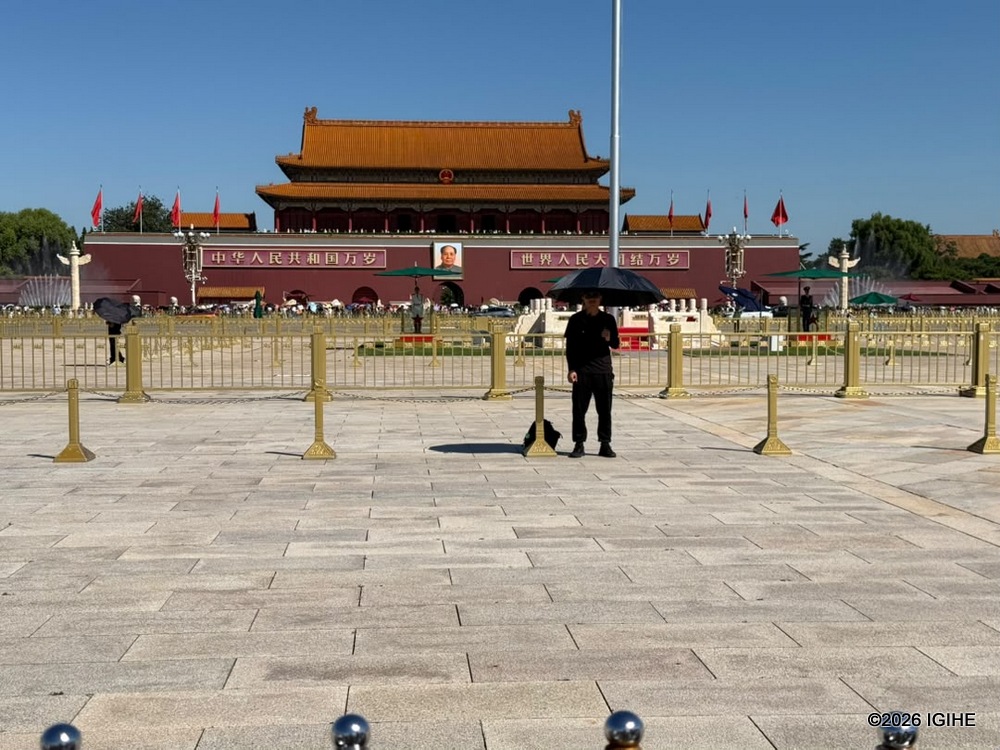
    Soldiers and uniformed guards stand around the entrances, a reminder that this is not simply a tourist attraction but one of China's most carefully protected national and ceremonial sites.

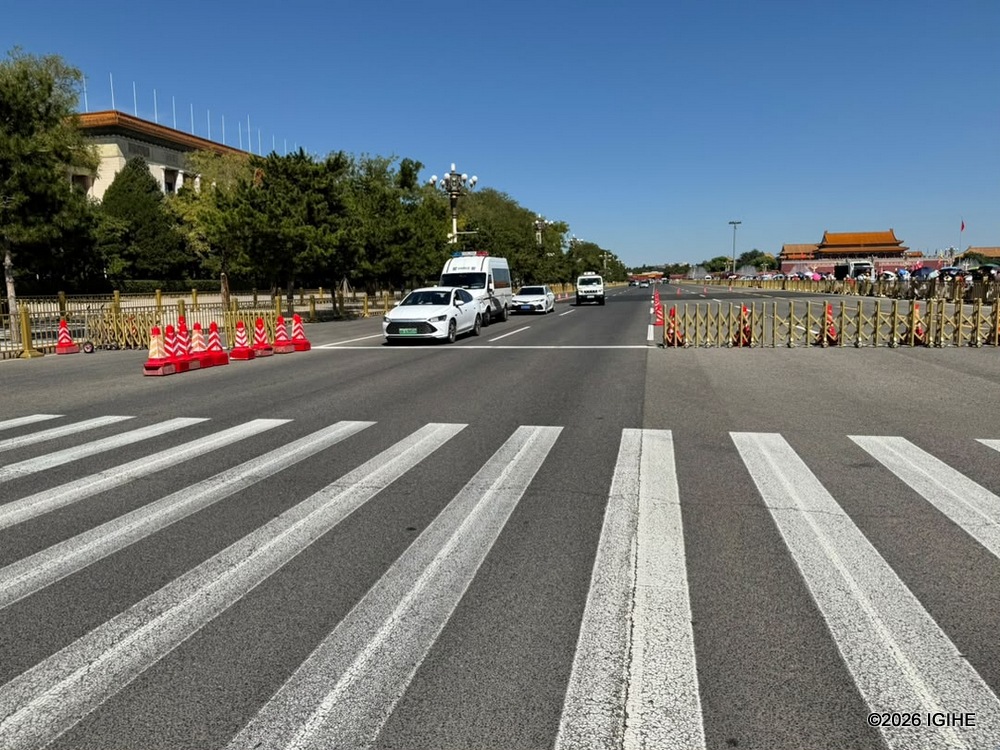
    Located in central Beijing, Tiananmen Square forms part of the city's historic north–south Central Axis. Tiananmen Gate, or the Gate of Heavenly Peace, stands to the north, with the Forbidden City directly behind it.
    Zhengyangmen, commonly known as Qianmen, marks the southern end, while the National Museum of China and the Great Hall of the People occupy the eastern and western sides respectively.

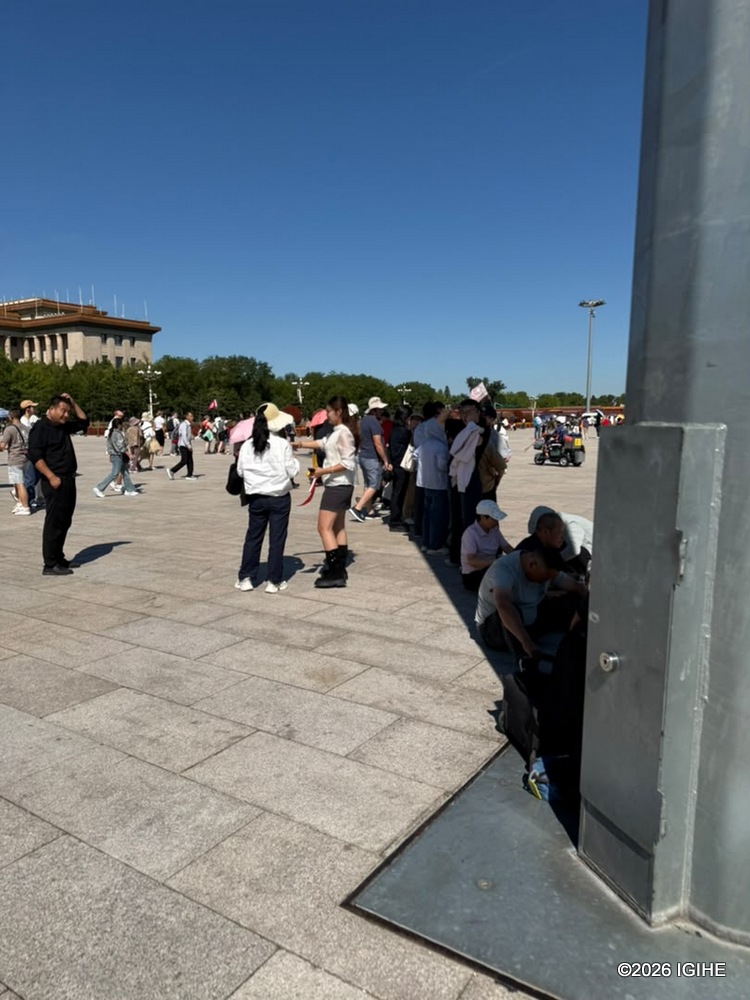
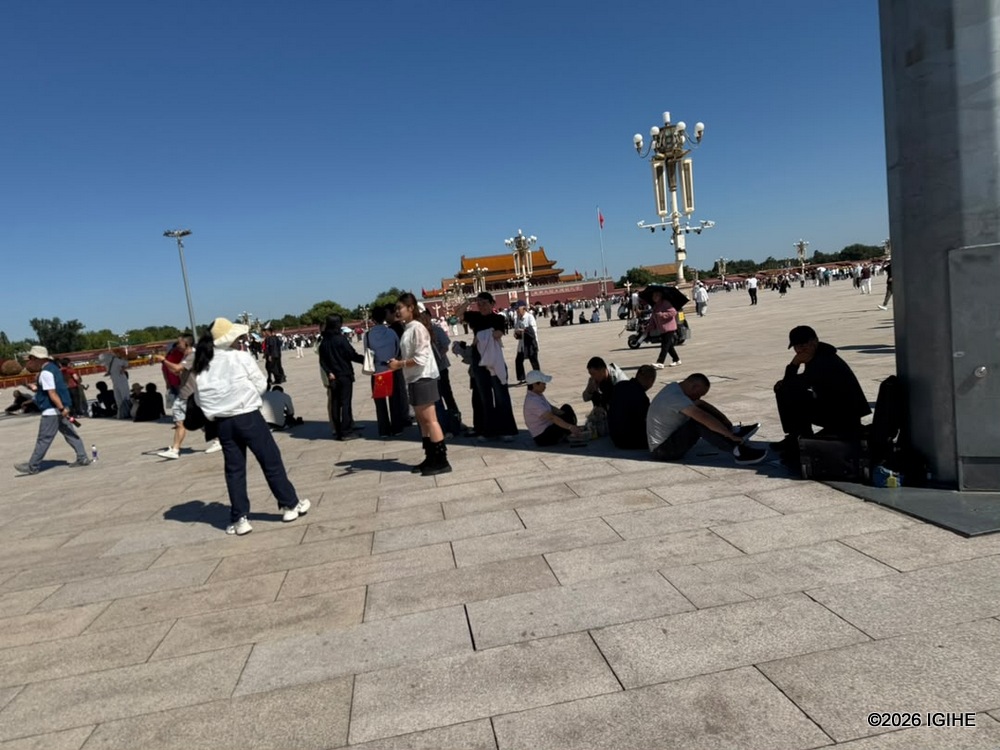
    The square measures about 880 metres from north to south and 500 metres from east to west, covering approximately 440,000 square metres. It can accommodate about one million people during a major gathering.

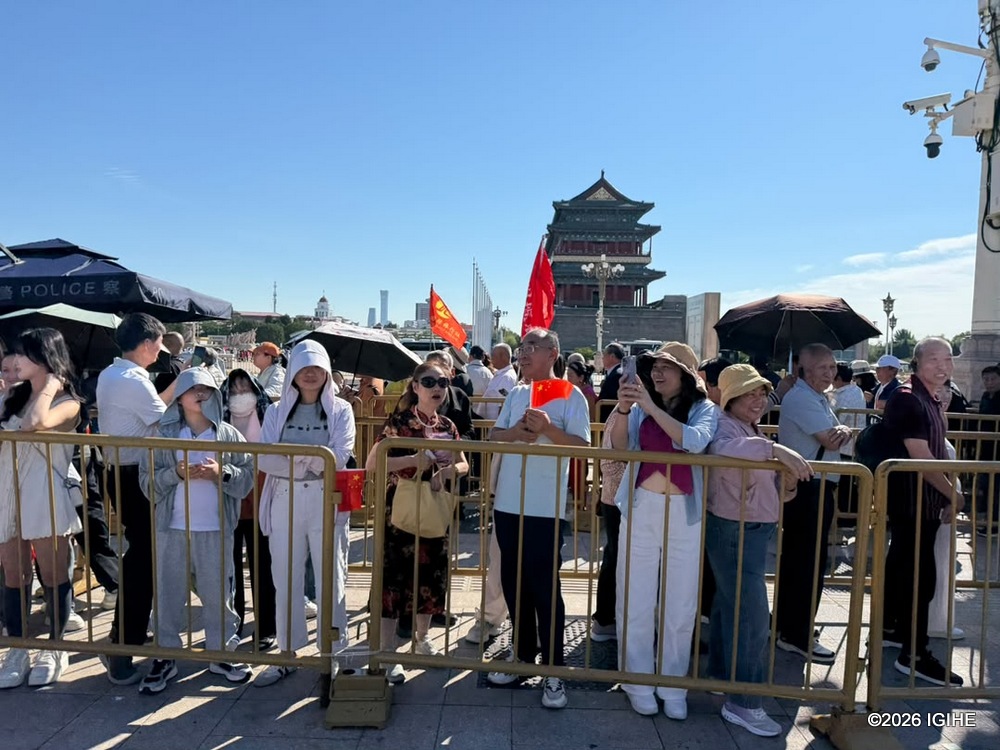
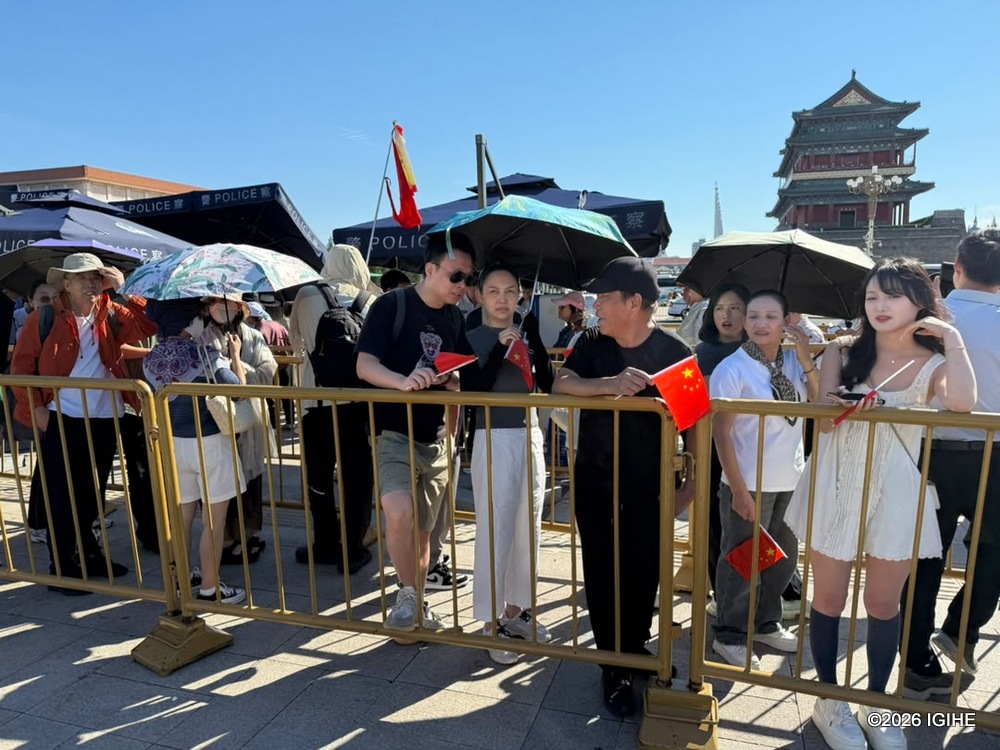
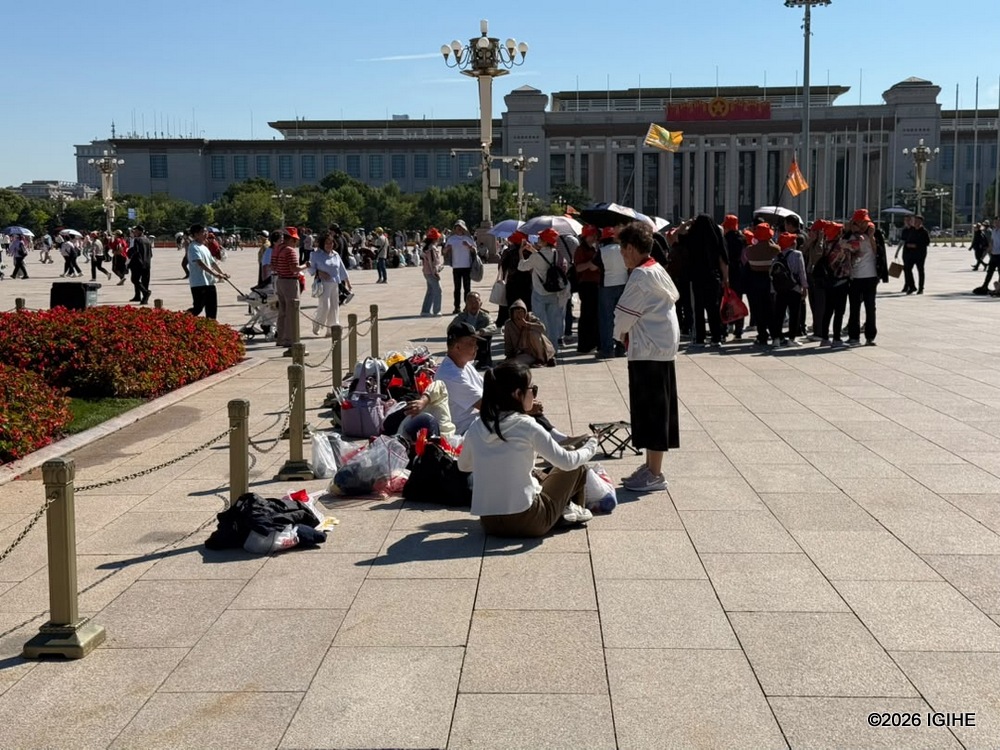
    Its scale is matched by the number of visitors. The official 2024 annual report of the Tiananmen Area Management Committee recorded more than 57 million visits by Chinese and foreign tourists during the year. The figure covers the wider Tiananmen area rather than the paved square alone. Visitors must also make a reservation before entering, according to current Beijing visitor guidance.

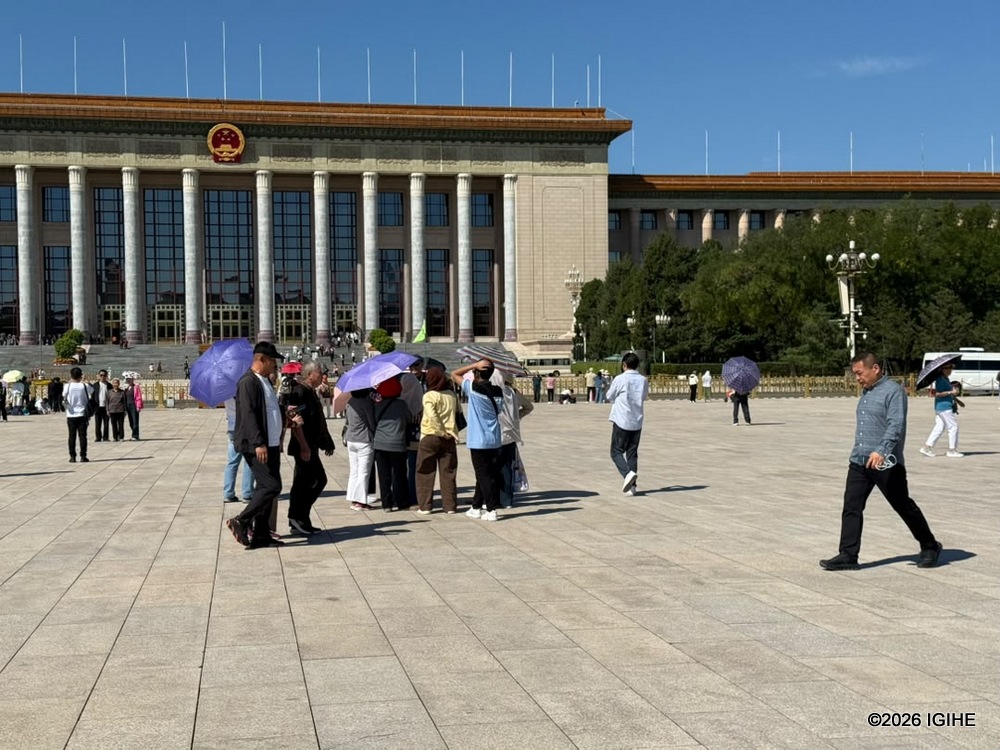
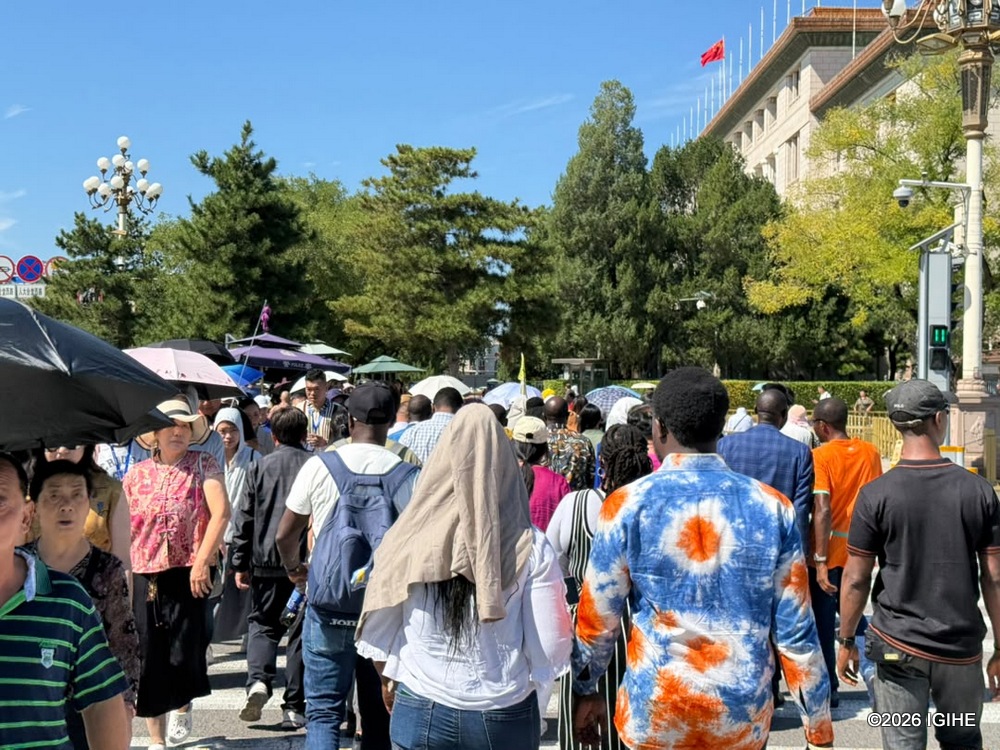
    The Great Hall of the People hosts major political, state and diplomatic events in Beijing.

    From imperial approach to public square

    The history of the site goes back centuries before the establishment of the People's Republic of China.

    Tiananmen Gate was first built in 1417 during the Ming dynasty and was originally known as Chengtianmen. It was rebuilt in 1651 during the Qing dynasty and received its present name, Tiananmen, meaning 'Gate of Heavenly Peace'.

    For centuries, it formed part of the Imperial City and served as an important entrance to the Forbidden City, where Chinese emperors lived and governed. The area was then an imperial approach surrounded by gates, offices and ceremonial buildings rather than the open public square seen today.

    Major changes came in the twentieth century. The Gate of China was demolished in 1954, while construction between 1958 and 1959 created the broad modern plaza. The Great Hall of the People and buildings that later became the National Museum of China were also constructed during this period.

    Tiananmen Gate took on a new role in modern Chinese history on October 1, 1949, when Mao Zedong announced the establishment of the People's Republic of China from its balcony before a large crowd.

    The gate has five doorways and seven bridges, reflecting its imperial history. In front of it stand marble lions and two Huabiao, or ceremonial stone columns, decorated with dragons and clouds.

    The national flagpole at the northern end continues the square's ceremonial role. Every day, the Chinese flag is raised around sunrise and lowered around sunset, attracting visitors who arrive early to watch the ceremony.

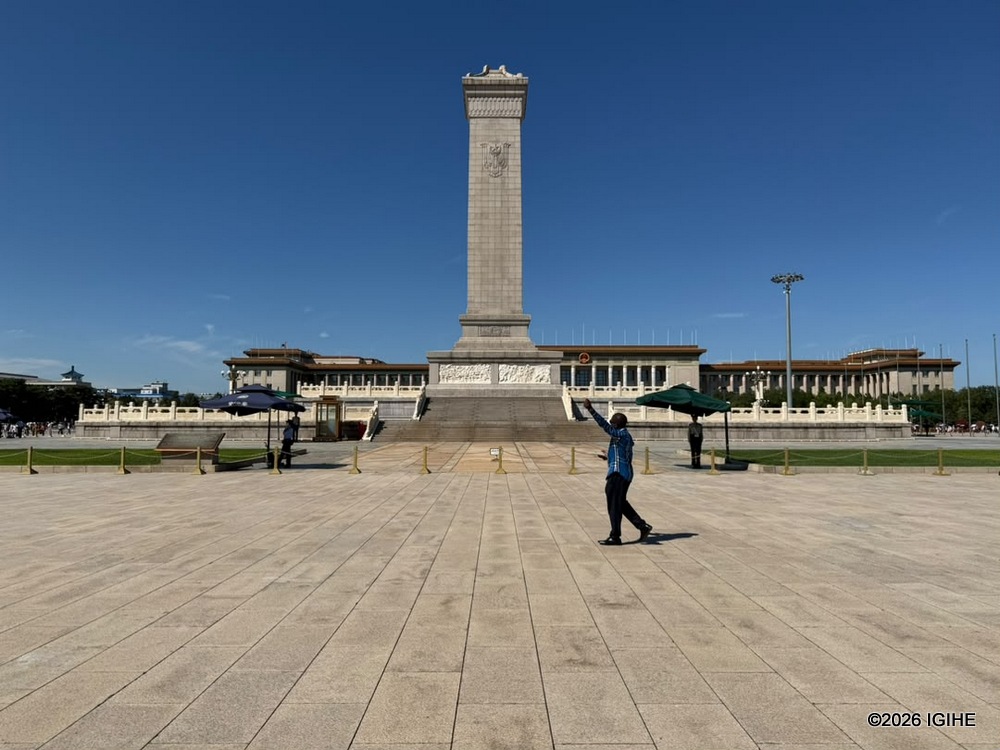
    Tiananmen Square forms part of Beijing's historic north–south Central Axis.

    The landmarks around the square

    On the western side, the Great Hall of the People hosts meetings of the National People's Congress, China's highest legislative body. It is also used for major political, state and diplomatic events and the National Congress of the Chinese Communist Party.

    The building includes a Great Auditorium with around 10,000 seats and a large banquet hall.

    On the eastern side, the National Museum of China connects the square to China's ancient civilisation and cultural heritage.

    According to the museum's official information, it has a construction area of about 200,000 square metres, more than 1.4 million objects and 48 exhibition halls. Its collections include archaeological discoveries, works of art, rare books and other objects from China's long history.

    At the centre stands the Monument to the People's Heroes, a 37.94-metre obelisk built between 1952 and 1958. Its base contains reliefs depicting important episodes in China's revolutionary history. During national ceremonies, leaders and other important guests lay flowers or wreaths there to honour the country's heroes and martyrs.

    South of the monument is the Chairman Mao Memorial Hall. Built after Mao's death in 1976 and completed in 1977, it stands on the former site of the Gate of China. Mao's preserved body is displayed inside, attracting visitors who come to pay their respects.

    Mao was a Chinese revolutionary and Communist Party leader who became the founding leader of the People's Republic of China. His portrait remains above Tiananmen Gate.

    Tiananmen has therefore witnessed imperial ceremonies, the founding of the People's Republic, national celebrations, public mourning, political protests and major state events.

    In 2024, Tiananmen Square and several surrounding historic structures became part of the UNESCO World Heritage property Beijing Central Axis: A Building Ensemble Exhibiting the Ideal Order of the Chinese Capital, recognising the area's importance to Beijing's urban development and China's history.

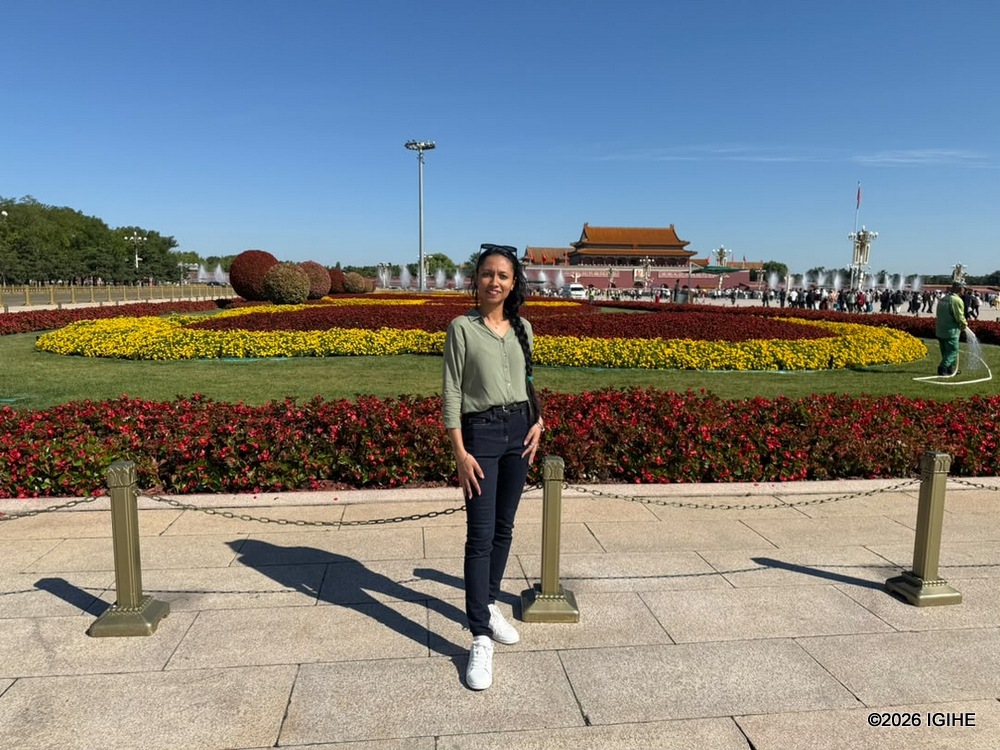
    For visitors, the square offers more than an impressive backdrop for photographs. Within one vast space, its gates, monuments and surrounding buildings provide a glimpse into centuries of Chinese history.

    The famous portrait of Mao Zedong overlooks Tiananmen Square from the front of Tiananmen Gate.
    Visitors walk across Tiananmen Square, one of Beijing's most prominent historic landmarks.

    Source : https://new.igihe.com/english/tiananmen-square-where-chinas-past-present-and-power-converge-photos/

  • Fitch reaffirms Rwanda's 'B+' credit rating with stable outlook #rwanda #RwOT

    The assessment, released on September 11, highlights continued confidence in the country's economic fundamentals and policy framework despite a challenging global and regional environment.

    Fitch expects Rwanda's economy to grow by 7.8% in 2026, down from 9.4% in 2025 but still well above the 4.5% median for countries rated 'B'. Growth is expected to be supported by continued expansion in agriculture, services and construction, including infrastructure projects such as the Bugesera airport.

    The agency expects inflation to average 11.7% in 2026, above the National Bank of Rwanda's 2%-8% target. It noted that the central bank has raised its policy rate by a cumulative 150 basis points to 8.75% since February 2026.

    Fitch forecasts Rwanda's current account deficit to widen to nearly 15% of GDP in 2026, driven by resilient domestic growth, higher imports linked to the Bugesera airport project, and increased fuel and fertilizer costs. The deficit is largely financed through foreign direct investment and official borrowing.

    The agency estimates Rwanda's net external debt will reach 63% of GDP in 2026, compared with a 48% median for 'B'-rated countries. However, it noted that 87% of Rwanda's external debt is highly concessional, helping to mitigate the risks associated with the country's external financing position.

    On public finances, Fitch expects the fiscal deficit to remain broadly stable at 4.5% of GDP in the fiscal year ending June 2027, compared with 4.4% in FY2026.

    The agency said tax reforms implemented since FY2025 helped tax receipts exceed the government's target by 0.6 percentage points of GDP in FY2026. Further gains are expected, although revenue growth could moderate in FY2027 due to the impact of the Iran war, lower grants and weaker non-tax revenues.

    Fitch projects general government debt to decline in FY2027-FY2028, averaging about 65% of GDP, after peaking at around 74% in FY2025. The decline is expected to be driven mainly by strong nominal GDP growth and, to a lesser extent, spending consolidation.

    The agency also expects Rwanda to rely more heavily on external borrowing to finance its fiscal deficit, with external financing remaining largely concessional. Multilateral and bilateral partners are projected to account for about 82% of total external financing in FY2027-FY2028.

    Fitch expects regional security risks to remain elevated, with the conflict in eastern DRC continuing to pose risks to Rwanda's external financing position. However, the agency does not anticipate a sharp escalation in the near term.

    The Ministry of Finance and Economic Planning welcomed the reaffirmation, saying it reflects continued confidence in Rwanda's economic fundamentals and policy framework.

    'The reaffirmation reflects continued progress in strengthening Rwanda's macroeconomic foundations while maintaining a focus on sustainable growth, investment, resilience and fiscal sustainability,' the ministry affirmed.

    The latest assessment comes six months after Fitch revised Rwanda's sovereign outlook to Stable from Negative while retaining the 'B+' rating. At the time, the agency cited improved access to external financing and reduced uncertainty over Rwanda's funding position.

    Fitch Ratings is an American-British credit rating agency and one of the 'Big Three' global rating agencies alongside Moody's and S&P Global Ratings.

    Source : https://new.igihe.com/english/fitch-reaffirms-rwandas-b-credit-rating-with-stable-outlook/

  • One dies, three injured in illicit alcohol brewing accident in Rwamagana #rwanda #RwOT

    The incident happened in the wee hours of Monday, September 14, 2026, in Kiryango Village, Nkungu Cell, Munyaga Sector.

    Munyaga Sector Executive Secretary Munyentwari Damascene told IGIHE that the four had gone into a forest at night to brew the illicit alcohol for sale.

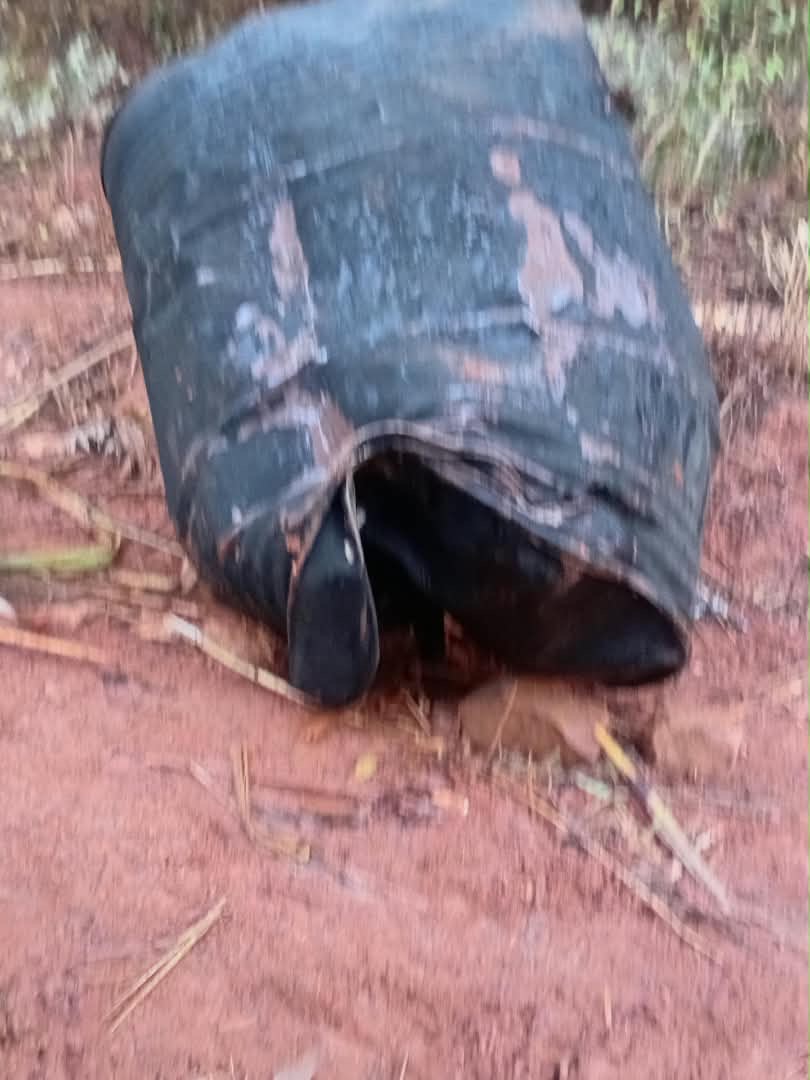
    'They went into the forest at night to brew Kanyanga. The drum then exploded. A piece of metal struck one of them, killing him instantly. The other three are being treated at Rwamagana Hospital. They suffered serious burns,' he said.

    Munyentwari warned residents against producing illicit alcohol, which is prohibited in Rwanda.

    He said producing illicit alcohol is punishable by law and urged residents to avoid activities that could lead to imprisonment and financial losses for their families.

    'We urge residents to sell and consume alcohol that is permitted by Rwandan law. They should stop producing illicit alcohol and other prohibited substances because anyone caught doing so is punished by law. In most cases, they are imprisoned. We urge them to stop and instead consume or sell legally permitted alcohol,' he said.

    The person who died was a 20-year-old man. The three others, aged 14, 16 and 22, were seriously injured and are receiving treatment at Rwamagana Hospital.

    The damaged alcohol-brewing drum at the scene of the incident in Rwamagana District.
    The incident occurred in Kiryango Village, Nkungu Cell, Munyaga Sector, Rwamagana District, in the early hours of September 14, 2026.

    Source : https://new.igihe.com/english/one-dies-three-injured-in-illicit-alcohol-brewing-accident-in-rwamagana/