Through the Swedish Energy Agency, the Kingdom of Sweden has voluntarily supported a cooperation initiative for countries willing to reach their respective mitigation targets as per the provisions of the article.
By working together and trading carbon credits, countries can achieve larger emission reductions than what they otherwise would have been able to with their own resources.
The MoU, signed in Kigali, marks a significant step in the joint efforts to address climate change and deepen the cooperation between the two countries in relation to their climate mitigation efforts.
The partnership sets the stage for both nations to collaborate on areas of mutual interest, particularly in climate change mitigation, as well as in supporting the Nationally Determined Contributions (NDCs) of each country.
Shortly after signing the cooperation pact, Dr. Valentine Uwamariya, Rwanda’s Minister of Environment, explains that this will foster joint initiatives such as technical analysis, capacity building, and the development of joint work plans.
Signing the cooperation pact on Rwanda’s behalf was Dr. Valentine Uwamariya, the Minister of Environment.
According to her, this is very important since it supports Rwanda’s already existing targets on climate change mitigation and paves way for potential legally binding agreements that can further both parties’ joint objectives.
“This partnership with the Swedish Energy Agency reinforces Rwanda’s commitment of implementing Article 6 of the Paris Agreement and advancing our Nationally Determined Contributions,' she said.
'Rwanda is eager to leverage this partnership to not only to meet our climate targets but also foster sustainable development that benefits both our environment and our people,' she added.
Through this collaboration, both Rwanda and Sweden will also engage in dialogue and organize activities and meetings with stakeholders, aiming to promote bilateral cooperation in achieving climate mitigation goals.
Martina Fors Mohlin, Chargé d´affaires Embassy of Sweden in Kigali also highlighted the significance of the agreement, commending Rwanda for its efforts.
The MoU sets the foundation for Rwanda and Sweden to develop a Bilateral Cooperation Agreement
'Rwanda has shown that it is possible to combine economic growth with ambitious climate mitigation goals. Through its initiatives for a long-term green transition, Rwanda is an inspiration for other countries,' she said.
Martina emphasized that Sweden is committed to financing high-quality greenhouse gas mitigation activities in Rwanda that provide substantial contributions to the energy transition in the country
The MoU sets the foundation for Rwanda and Sweden to develop a Bilateral Cooperation Agreement which would enable Sweden to finance emission reduction projects in Rwanda.
According to her, this will support Rwanda and Sweden’s national efforts to meet their climate targets and drive sustainable development.
The Swedish Energy Agency is the country´s lead agency on Article 6, with a mandate from the Swedish government to enter into bilateral agreements with other countries.
This partnership with the Swedish Energy Agency reinforces Rwanda’s commitment of implementing Article 6 of the Paris Agreement
In addition to the five recoveries, it was noted that no fatalities were reported on the same day. Of the 1,009 new tests conducted, one person tested positive, bringing the total number of patients currently receiving medical treatment to 21.
The Minister of Health, Dr. Sabin Nsanzimana, expressed optimism in a post on X, stating, “Today, five have recovered. They are in good health and will return home tomorrow. Let’s thank the healthcare workers who attended to them. We will defeat Marburg.”
Health officials have explained that Marburg can be contracted without showing symptoms for three to 21 days, although symptoms may sometimes appear sooner.
The initial symptoms of the disease often resemble other illnesses, particularly malaria, and include sudden high fever, severe headaches, joint pain, muscle aches, and digestive problems such as diarrhea and vomiting.
As the illness progresses, symptoms worsen, causing the body to deteriorate. Medical experts note that early treatment can significantly improve the chances of recovery.
To prevent further transmission, health authorities are urging Rwandans to maintain proper hygiene and avoid sharing personal items with individuals showing symptoms similar to Marburg.
Rwandan authorities have also disclosed that efforts to contain the outbreak are underway, with vaccine and therapeutic clinical trials set to begin in the near future.
Additionally, international partners such as the World Health Organization (WHO), the United States, and the United Kingdom have pledged their support for Rwanda’s response to the disease.
This follows the 45th Ministerial Conference of the Francophonie (CMF) held Thursday September 3, 2024 chaired by IOF Secretary General Loiuse Mushikiwabo, also attended by Foreign Affairs Minister Olivier Nduhungirehe.
Held under the theme 'Create, innovate, and do business in French,' the 19th Francophonie Summit, also called Villers-Cotterêts Summit, will have a special focus on youth employment.
The advance meeting was also attended by Foreign Affairs Minister Olivier Nduhungirehe.
During the preparatory meeting, Minister Nduhungirehe announced to his peers the anticipated reception of the 46th Ministerial Conference of the Francophonie in Kigali in 2025.
On the first day of the Summit tomorrow, the President and First Lady will attend the opening ceremony of the 19th Francophonie Summit in Villers-Cotterêts, a town 80 km north-east of Paris where French was declared the official language of France in 1539, replacing Latin.
Later in the evening, they will join other dignitaries for a dinner hosted by French President Emmanuel Macron and First Lady Brigitte Macron at the Élysée Palace.
President Kagame and First Lady are in Paris ahead of 19th Francophonie Summit
On the second day of the Summit, President Kagame will attend a closed roundtable session on 'Renewed Multilateralism' chaired by President Macron, followed by a closed door session. The Summit will conclude with the adoption of the Villers-Cotterêts Declaration.
The Preparatory meeting held on September 3, 2024 was chaired by IOF Secretary General Louise Mushikiwabo
Strettch was among over 70 startups that participated in the contest organized by the Ministry of ICT and the Rwanda Information Society Authority (RISA) under the Public Procurement for Innovation (PPI) framework, which is currently being piloted. This framework aims to enable public institutions to procure solutions from the innovation ecosystem.
The current research and innovation project is the second of four initiatives funded by the Japan International Cooperation Agency (JICA). The first project focused on health.
The first phase of the project implementation began on Thursday, October 3, 2024, with a meeting between the partners and Strettch software engineers at the Rwanda Polytechnic Campus in Kicukiro.
The meeting was attended by key officials including Ephrem Musonera, the Deputy Vice-Chancellor in Charge of Training, Institutional Development, and Research at Rwanda Polytechnic; Parfait Yongabo, the Division Manager in charge of Institutional Development, Research, and Consultancy at Rwanda Polytechnic; Immaculate Mutesi, the Programme Coordinator for ICT at JICA; Dr. Said Ngoga, Technology Innovation Division Manager at RISA; and representatives from PWC Rwanda.
PWC Rwanda serves as the Contract Manager overseeing the project on behalf of PWC Japan.
Yongabo stated that the project will create digital solutions for institutional challenges, primarily supporting students and lecturers in their mandate of teaching, learning, and research.
The platform will enable students to document their learning journeys, support the implementation of innovative projects for both students and researchers, and foster collaborations.
The platform will also increase the visibility of students to potential employers through the generation of eCVs or e-portfolios.
'The portal will be able to generate e-portfolios where employers can quickly access a summary of the competencies and skills of the students. If they are interested, they can reach out to them for employment opportunities,' Yongabo explained.
Additionally, the platform will be integrated with Artificial Intelligence assistance to increase its efficiency and save students and researchers time.
Yongabo noted that while many of the companies that expressed interest in developing the platform had good solutions, Strettch provided the best solution that responded effectively to the challenge at hand.
Sauvé Jean-Luc, the co-founder and CEO of Strettch, was ecstatic that their startup won the bid, noting that the victory came after intense preparations and sleepless nights.
'We were very happy to hear that we were among the finalists because we also had to pitch and do intensive work after pitching,' Jean-Luc explained.
'More than 70 startups applied. It was very tough. We had a tight timeline and had to work hard to make the most of every hour. We needed to understand the problem and the client’s needs while being creative, too.'
The 21-year-old made the presentation alongside Libériste Clarance, one of the five founding members of the company. Both are graduates of the Rwanda Coding Academy, an institution they credit for their skills and exposure.
“Rwanda Coding Academy trained us from the ground up as engineers and encouraged us to think outside the box. We gained knowledge across different sectors, including networking, cybersecurity, software engineering, robotics, and artificial intelligence. We learned a lot, so we feel the need to give back more than what is expected,' Jean-Luc said.
The startup founders intend to use the new funding to develop the project and scale up their operations to create even bigger impact.
Immaculate Mutesi, the Programme Coordinator for ICT at JICA, emphasized that the PPI initiative will play a pivotal role in fostering the growth of startups by removing obstacles in traditional procurement.
This will allow emerging companies to compete on equal footing with more established firms, helping them gain valuable experience and contribute to innovation.
'For young startups, tendering their solutions through normal procurement procedures is not possible, as it often requires five to ten years of experience to bid for certain tenders. But with this policy, young startups are being supported to participate regardless of the experience they may lack, so it’s a privilege for JICA to support them,' she quipped.
Strettch co-founders Libériste Clarance and Sauvé Jean-Luc presenting at Rwanda Polytechnic on Thursday, October 3, 2024.
The meeting was attended by key officials including Ephrem Musonera, the Deputy Vice-Chancellor in Charge of Training, Institutional Development, and Research at Rwanda Polytechnic; Parfait Yongabo, the Division Manager in charge of Institutional Development, Research, and Consultancy at Rwanda Polytechnic; Immaculate Mutesi, the Programme Coordinator for ICT at JICA; Dr. Said Ngoga, Technology Innovation Division Manager at RISA; and representatives from PWC Rwanda.
Dr. Said Ngoga, Technology Innovation Division Manager at RISA, makes a contribution point during the project presentation.
Representatives from PWC Rwanda engage Sauvé Jean-Luc, the co-founder and CEO of Strettch, after the presentation.
From left: Parfait Yongabo, Division Manager for Institutional Development, Research, and Consultancy at Rwanda Polytechnic; Ephrem Musonera, Deputy Vice-Chancellor in Charge of Training, Institutional Development, and Research at Rwanda Polytechnic; and Dr. Said Ngoga, Technology Innovation Division Manager at RISA.
While Israel’s defense systems, supported by the United States, managed to intercept many of the missiles, the situation still posed a significant threat to civilian life.
Speaking with IGIHE, Israel’s ambassador to Rwanda, Einat Weiss, described the situation as “surreal,” with over 10 million people forced into temporary shelters across the country.
This latest attack is seen by Israel as part of a broader strategy by Iran to destabilize the region and support militant groups such as Hamas and Hezbollah.
Unprecedented missile attack
The missile barrage came just hours after a deadly train station attack in Israel, which killed seven civilians.
Speaking with IGIHE, Ambassador Weiss recounted the events, highlighting the sheer magnitude of the missile strike.
“We had 181 missiles launched at Israel for an hour, primarily targeting Tel Aviv. The streets, the country was shut down basically,” she said.
Weiss emphasized that the Israeli government’s decision to instruct millions of civilians to take shelter was not taken lightly.
“Think about itâ”these ballistic missiles weigh around one ton each. Without our defense capabilities, particularly the Hetz missile system, which intercepted many of the missiles, we would have seen thousands of casualties. It’s no wonder the Home Front Command took immediate action.”
Despite Israel’s ability to neutralize many of the threats, Weiss noted that the silence from the international community has been “mind-boggling.”
She expressed frustration that Iran’s direct assault on civilians has not been met with global condemnation.
“If Israel had launched 181 missiles at another country, the international outcry would have been immediate. But when Iran does this, the world remains silent,” she remarked.
Israel’s defense systems, supported by the United States, managed to intercept majority of the missiles
Facing conflict on multiple fronts
In addition to the missile strikes from Iran, Israel is engaged in an ongoing battle with Hamas in Gaza and Hezbollah in Lebanon. Ambassador Weiss outlined the scope of the threat, explaining that Israel is being forced to defend itself from all sides.
“We have Hezbollah in the North, Hamas in the South, and now Iran, 2,000 kilometers to the East. This is not a normal situation.”
Israel’s military operations in Lebanon are a direct response to intelligence suggesting that Hezbollah was planning an attack similar to Hamas’s October 2023 assault on Israel, which left over 1000 civilians dead.
“We had intelligence confirming that Hezbollah was planning an attack on Galilee, using a network of tunnels like those in Gaza. We had no option but to act,” Weiss explained.
She stressed that Israel’s response is driven by the need to protect its citizens and prevent further loss of life.
“These terrorist groups are not leaving us with any option,” she said.
Amb. Weiss accused Iran of using Hezbollah, Hamas, and the Houthi militia in Yemen as tools to further its agenda.
Iran’s role in the conflict
Following the recent missile attack, Iran’s Chief of Staff, Maj Gen Mohammad Bagheri, announced on state television that Iran would target critical infrastructure across Israel if Israel chose to retaliate.
Bagheri warned that the strikes would intensify and focus on key infrastructure sites across the country.
Iran framed the attack as a response to what it described as the “violation of its sovereignty” and the death of Hamas political leader Ismail Haniyeh, who died in an explosion in Tehran in Julyâ”a blast for which Iranian officials blamed Israel, though Israeli authorities have not officially claimed responsibility.
The attack is also linked to the killing of Iranian-backed Hezbollah leader Hassan Nasralla in Israeli airstrikes on September 27, 2024. Iran’s Supreme Leader Ali Khamenei had vowed to avenge Nasrallah’s death.
However, Iran’s involvement in the conflict is seen by Israel as a clear demonstration of its strategy to use proxies to destabilize the region.
Weiss accused Iran of using Hezbollah, Hamas, and the Houthi militia in Yemen as tools to further its agenda.
She also pointed out that Iran’s aggression extends beyond Israel, posing a broader threat to international security.
Despite these threats, Israel continues to call for the enforcement of international agreements, particularly UN Resolution 1701, which demands Hezbollah’s disarmament in Lebanon.
“This is an international resolution, not an Israeli one,” Weiss stated. “Yet it is not being enforced, and Hezbollah continues to operate freely in Lebanon.”
Iran’s latest attackon Israel is also linked to the killing of Iranian-backed Hezbollah leader Hassan Nasralla in Israeli airstrikes on September 27, 2024.
Frustration with global inaction
Ambassador Weiss expressed deep frustration with the international community’s reluctance to hold Iran accountable for its actions.
She highlighted what she perceives as a double standard in how Israel’s actions are viewed compared to those of its adversaries.
As she said, Iran is being embraced by the international community despite their direct involvement in terrorism while Israel is the one facing criticism for defending itself.
Weiss noted that while Israel is doing everything it can to minimize civilian casualties, including issuing warnings before attacks, the international response remains skewed against Israel.
“We go out of our way to avoid civilian casualties, even putting our own soldiers at risk. When we retaliate and people die for collateral damage, because that’s war, then the blame instead of being on Hamas is being on Israel. Now, the expectation that we do not retaliate is insane.”
This, she argued, is contributing to a dangerous precedent, where terrorist organizations like Hamas and Hezbollah are emboldened by the lack of consequences for their actions.
“The biggest winner of this year is Iran. They continue to support terrorism with no repercussions. The international community needs to send a clear message that this behavior will not be tolerated.”
A call for global support
As Israel continues to defend itself on multiple fronts, it is calling for greater support from the international community.
Weiss emphasized that the world cannot afford to ignore Iran’s actions, as the consequences will not be limited to Israel.
“Iran is against everything that is liberal or different from them. They will go after anyone who doesn’t align with their ideology,” she warned.
Despite the challenges, Weiss remains hopeful that Israel’s resilience will see the country through this difficult period.
“Our goal is simple: to protect our people and ensure they can return to their homes safely. We want peace, but we cannot allow these terrorist groups to continue attacking us without consequence.”
Israel’s ambassador to Rwanda, Einat Weiss called on the international community to take a stand against Iran’s actions and support Israel in its fight against terrorism.
Way forward
As the conflict drags on, Ambassador Weiss made it clear that Israel will not back down.
She explained that Israel has to defend itself noting that the international community cannot expect the country to sit by while its citizens are under attack.
Weiss also expressed concern that Iran’s aggression could spill over into other regions, particularly Europe and Africa and called on the international community to take a stand against Iran’s actions.
When Leonid Volkov, a longtime partner of the late Russian opposition leader Alexei Navalny, was brutally attacked with a hammer outside his home in Lithuania in March, it initially seemed yet another case of the Kremlin hunting down its enemies abroad.
The assailant smashed open Volkov's car window and struck him repeatedly with a hammer, breaking his left arm and damaging his left leg. Western officials and opposition figures assumed the attack, which took place a few weeks after Navalny's mysterious death in prison, had been orchestrated by the Kremlin.
Then, last month, Navalny's team released an explosive investigation that cast doubt on that version of events.
In the video, Maria Pevchikh, the head of Navalny's investigation department, accused the wealthy businessman and outspoken Kremlin critic Leonid Nevzlin of hiring the men to beat up Volkov outside his home, claiming the attack was triggered by a personal dispute.
Nevzlin has denied any involvement in the attack. In a statement on X, he wrote: 'I have nothing to do with any attacks on people, in any form whatsoever,' adding that 'justice will confirm the absurdity and complete baselessness of the accusations against me'.
In their investigation, Navalny's team published screenshots they said showed conversations on the messaging app Signal between Nevzlin and an alleged associate, Anatoly Blinov, apparently discussing the attack on Volkov. Navalny's team handed their dossier of evidence to Polish authorities, where Blinov was arrested in September.
The allegations have caused shock and led to infighting among members of the exiled Russian opposition, as people come to terms with the implications of the revelations, if true.
Pevchikh, of Navalny's Anti-Corruption Foundation, told the Guardian: 'There isn't a rulebook on what you do when you find out that someone you know stabs you in the back.
'Volkov was attacked three weeks after Alexei was killed. We had barely buried him. In the lowest point of our lives, someone pushes you from behind so you fall even more and suffer even more.'
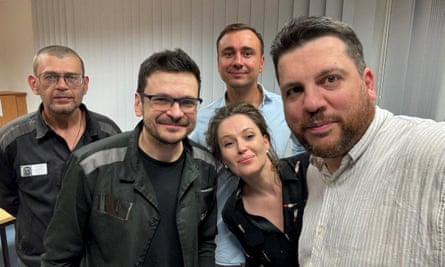
Leonid Volkov (right) with Maria Pevchikh, Ilya Yashin (front left), Ivan Zhdanov (back right) and Vadim Ostanin (back left) in August. Photograph: Leonid Volkov/Reuters
Nevzlin, a former executive and partner of the ex-oil tycoon Mikhail Khodorkovsky, gave up his Russian citizenship after the start of Moscow's full-scale invasion of Ukraine and is now based in Israel, where he owns a stake in the Haaretz newspaper.
From Israel, Nevzlin has funded several media projects that are critical of the Kremlin and voiced staunch support for Ukraine in its war with Russia. He has previously clashed with other opposition groups, including Navalny's team, over disagreements regarding the best approach to challenge Vladimir Putin, the Russian president.
Nevzlin is known for his more radical political views, including calling for the dissolution of Russia as a country and referring to the majority of Russia's population as 'slave cattle'.
The Navalny team's investigation is based partly on a cache of private Signal screenshots they have obtained, which, they say, reveal exchanges between Nevzlin and a fixer, allegedly Blinov, a Russian lawyer.
Pevchikh stated in the video investigation that the screenshots were provided by a middleman with ties to Russia's FSB security service.
The Guardian was unable to verify the authenticity of the conversations, which also featured covertly shot photos of Volkov and other members of Navalny's team living in Vilnius. 'Time to do away with this moron,' reads one of the messages, which the Navalny team claims Nevzlin wrote.
They further allege that Nevzlin, in the messages, discusses plans to abduct Volkov in a way that would leave him 'in a wheelchair' before handing him over to the FSB.
The Navalny team said in a statement it believed 'stupid senseless hatred' combined with 'political competition' may have driven the attack on Volkov.
The Polish law enforcement agency said Blinov was under investigation on three charges, 'including the charge of orchestrating the assault on Russian opposition activist Leonid V due to his political identity and activities'.
So far, they have not made any comment on the allegation that Nevzlin was behind the attack. 'Many different scenarios have to be investigated. We also know that in such cases, disinformation is often being shared,' said Stanisław Żaryn, a national security adviser to the Polish president, in an interview in Warsaw.
The arrest of Blinov came months after Polish authorities detained two men suspected of attacking Volkov, based on a European arrest warrant issued by Lithuania.
Prosecutors said they were investigating eight people in the case â” six Poles, a Belarusian and the Russian who has been charged.
The Polish prosecutor's office said it was looking at events 'that took place both in Europe (including Vilnius) and in South and North America'.
It was not immediately clear what incident authorities were referring to, though Pevchikh in the investigation also claimed Nevzlin was behind an attack on the wife of a well-known Russian economist based in Argentina who has feuded with Nevzlin on social media.
Nevzlin in turn told Sota, an opposition media outlet he sponsors, that Blinov, the fixer, was seeking to implicate him in ordering the attack on Volkov, and denied involvement in organising any attack. He said he himself filed a report to the Lithuanian police on 5 August about what he described as a provocation.
The community of Russian dissidents living abroad has long been disposed to infighting, but the accusations against Nevzlin have provoked the biggest split in the opposition movement since the start of Russia's full-scale invasion of Ukraine in February 2022.
Navalny's team has also accused Khodorkovsky, once Russia's richest man who spent 10 years in prison after falling out with Putin, of being aware of Nevzlin's alleged crimes before they became public.
Khodorkovsky has defended his former business partner Nevzlin, claiming the screenshots were probably part of a scheme orchestrated by Russian security services.
'Either it is true, and Leonid Nevzlin has gone mad, or it is an FSB provocation and a fake on which a lot of money has been spent ⦠For perfectly understandable reasons, I lean towards the second,' Khodorkovsky said.
Khodorkovsky flew into Warsaw on Monday and met Polish prosecutors to share his own information about the case. In an interview on Wednesday, Khodorkovsky said he still believed the evidence was probably faked by Russian authorities.
He also suggested the most implausible part of the allegations was not that Nevzlin could have theoretically ordered the attack, but that he would have been clumsy enough to leave a trail of evidence. 'There are things you can believe in, although it would be idiotic and hard to see why. But then there are things that it is absolutely impossible to believe,' he said.
The scandal risks further splitting Russia's already marginalised opposition, which has been scattered across European capitals since Moscow's invasion of Ukraine in 2022 and Putin's brutal crackdown on dissent. Without Navalny, regarded as a unifying figure and Putin's most formidable opponent, the opposition finds itself lacking a clear leader.
The public quarrels have been eagerly picked up by Russian state media propagandists, who have been leveraging the scandal to further discredit the opposition.
Pevchikh said: 'It is damaging to all the sides including us, and it's probably a life-changing event in terms of the Russian opposition ⦠But in these very difficult situations you just have to speak the truth, however sad and scary it is.'
Cheaper versions of the 'gamechanger' HIV prevention drug lenacapavir are to be made available in 120 low- and middle-income countries, manufacturer Gilead Sciences has announced.
However, campaigners said the deal 'abandons' many countries with a high HIV burden, particularly in Latin America, and urged transparency over exact pricing.
Lenacapavir, given as a twice-yearly injection, has shown strong results for HIV prevention. It stopped infection in a trial involving girls and women in South Africa and Uganda, and offered almost complete protection in a second trial that mainly involved men across Argentina, Brazil, Mexico, Peru, South Africa, Thailand and the US.
Gilead has faced pressure to make lenacapavir available as soon as possible and as cheaply as possible globally. Already approved as a treatment for HIV, it is sold for $42,250 a year under the name Sunleca in the US. Researchers say it could be profitably produced for just $40 (£30) a patient, a year.
The company said it had signed agreements with six manufacturers to make and sell generic lenacapavir in 120 'high-incidence, resource-limited' countries. These are mainly lower-income countries.
It said it would also bridge the gap until those manufacturers were up and running by providing Gilead-supplied product, prioritising registration in 18 countries with high HIV rates including Botswana, South Africa and Thailand.
However, Dr Mohga Kamal-Yanni, policy co-lead for the People's Medicines Alliance, criticised the decision to arrange licences directly rather than through the UN-backed Medicine Patent Pool. The agreements came with 'draconian conditions' that could make it harder for people in excluded countries to get hold of the drug, she said.
'Behind the seemingly large numbers of countries included in the licence, Gilead is largely abandoning upper middle-income countries, where new infections are highest, with nearly all of Latin America left out,' she said.
'The countries that have been excluded can use their legal rights to overcome intellectual property restrictions with a compulsory licence. However, Gilead's agreement prevents the six licensee companies from selling to those countries. Moreover, this route is fraught with difficulties and can face legal challenges from industry. But it is a country's right, and should be used if necessary.'
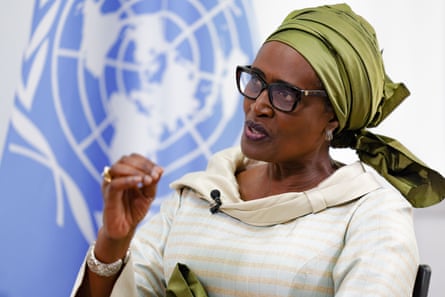
Winnie Byanyima, UNAids executive director, called for access to lenacapavir for all who would benefit. Photograph: Xinhua/Rex/Shutterstock
Winnie Byanyima, UNAids executive director, said: 'Lenacapavir, which requires only two injections per year, could be gamechanging â” if all who would benefit can access it.
'We applaud Gilead for licensing the medicine without waiting for registration, which should be the norm. We are battling a pandemic and the speed at which generic versions come to market will dictate whether this medicine can really be transformative.'
Byanyima warned that 41% of new infections were in upper middle-income countries, and excluding them from the licences 'is deeply worrying and undermines the potential of this scientific breakthrough'.
She said UNAids was also still waiting for a specific price and full transparency on Gilead's costs.
The generic manufacturers are India's Dr Reddy's Laboratories, Emcure Pharmaceuticals and Hetero Labs, as well as US-based Viatris' unit Mylan, Egypt's Eva Pharma and Pakistan-based Ferozsons Laboratories. UNAids said it would also like to see agreements in countries with high HIV rates such as South Africa.
Gilead said it will start filing for global regulatory approval for lenacapavir as a prevention regimen for HIV by the end of this year.
Daniel Chapo, running for the presidency on the ruling FRELIMO party ticket, is almost certain to win, succeeding Filipe Nyusi, who is retiring after two terms. His challengers include Ossufo Momade, the leader of Mozambique’s main opposition party and former rebel movement, Renamo, as well as Lutero (MDN) and Simango Venancio Mondlane (independent).
The 47-year-old former university professor, campaigning under the slogan “Let’s get to work,” is expected to oversee the revival of two liquefied natural gas (LNG) projects currently stalled due to insecurity in northern Cabo Delgado province.
Local analysts argue that Chapo’s development goals will heavily depend on the continued military support from the Rwandan forces, first deployed by Nyusi in 2021 to assist local troops in containing the insurgency.
“The Rwandans are undeniably competent,” Tertius Jacobs, lead Mozambique analyst at risk consultancy Focus Group, told Reuters. “Mozambique … has little to no better alternative.”
Jacobs notes that Nyusi’s introduction of Chapo to Rwandan President Paul Kagame in June signals a likely continuation of Rwandan involvement.
Rwandan forces, operating in the volatile northern province, are tasked with securing the area around the Afungi site, where TotalEnergies and ExxonMobil are planning LNG projects. TotalEnergies halted its $20 billion project when the skirmishes erupted in 2021.
Robert Besseling, CEO of consultancy Pangea-Risk, emphasized that the presence of Rwandan troops will remain crucial to the next administration’s efforts to neutralize terrorist threats, which have hindered Mozambique’s ambition to become a major gas exporter.
'They have thousands of troops there to protect the LNG sites,' Besseling remarked. Rwanda began deploying its security forces to Mozambique on July 9, 2021. Initially, the contingent included 1,000 troops from the Rwanda Defence Force and Rwanda National Police.
By late 2022, the Rwandan troop presence had increased to approximately 2,500, reflecting an expanded mandate to pursue and dislodge terrorists from their strongholds.
Rwanda’s most recent troop deployment to Mozambique was in August 2024, led by Major General Emmy Ruvusha.
Since 2021, Mozambique has also received military support from the Southern African Development Community (SADC), but SADC forces began withdrawing in April 2024 as their mandate ended. This withdrawal has left Rwanda with a greater share of responsibility in assisting local forces in addressing the ongoing security crisis.
Before the intervention of Rwandan troops in 2021, the insurgency had claimed the lives of 3,000 civilians, and more than 800,000 people had been displaced. The insecurity also brought all development projects in insurgent-controlled areas to a halt.
Rwanda’s most recent troop deployment to Mozambique was in August 2024, led by Major General Emmy Ruvusha. The troops are responsible for securing several key areas and communities in Mocimboa da Praia, Chinda, Palma, Afungi, Pundanhar, Macomia, Ancuabe, and Pemba.
The event was graced by Khalid Musa, the Chargé d’Affaires at the Sudanese Embassy in Rwanda.
Speaking at the inaugural event to welcome the new students, Dr. Rose Mukankomeje the Executive Director of the High Education Council (HEC) emphasized the importance of education and health for Rwanda’s development.
“Education and health are very key for us as a country and we thank the government’s support in expanding higher education institutions in the medical field,' she explained
'We need more such institutions, but the quality is paramount,' she added, stressing the goal of improving medical services within Rwanda to reduce reliance on foreign healthcare.
Dr. Rose Mukankomeje, the Executive Director of the High Education Council (HEC) while speaking to new students emphasized the importance of education and health for Rwanda’s development.
She said that Rwanda’s reputation for beauty, security, and cleanliness is not enough. The country is constantly striving to transform into hub for knowledge and welcoming new students like these is a good step in the right direction.
“Health goes hand in hand with wealth to produce better results in terms of development. I welcome you to feel at home here in Rwanda kindly remember to work hard. Work until it hurts and work until it heals,” she told the new students.
She encouraged them to prepare for life beyond school, emphasizing the importance of discipline and forward planning for the future.
Today, Rwanda has four medical training schools including the University of Rwanda College of Medicine, School of Medicine at the Adventist University of Central Africa (AUCA), Africa Health Sciences University based at King Faisal Hospital and UMST.
Some of the new students at UMST pose for a group photo
On her part, Dr. Suzan Homeida, the Deputy Chairperson of the University Board of Trustees, implored the students to understand that impacts of joining a university that is deeply committed to excellence in education and healthcare.
'Medicine is a noble profession that requires hard work, compassion, and a deep sense of responsibility to others. In the coming years, you will grow, learn, and develop the skills needed to make a real difference in people’s lives. We are here to guide and support you on this journey,' she said
She advised to embrace Rwanda’s rich culture and history saying it is a place that values unity, progress, and resilienceâ”qualities that should inspire the students during their time of studies. Homeida reminded the students that the path they have chosen is challenging, but also incredibly rewarding.
'The University’s dedicated teachers and staff are her to provide you with the best education possible, and to help you become the best healthcare professionals you can be. We believe in your potential to not only succeed but also to contribute to the betterment of healthcare in your communities and beyond,' she said.
Dr. Africa Gasana, the Chairperson of Rwanda Medical and Dental Council (RMDC) says that a moment to receive new medical students at UMST is a milestone.
Dr. Africa Gasana, the Chairperson of Rwanda Medical and Dental Council (RMDC) says that a moment to receive new medical students at UMST is a milestone not just for the students but the entire healthcare sector in Rwanda.
'We recognize that training and nurturing the next generation of healthcare professionals is a responsibility of immense importance as it addresses the growing need for skilled, dedicated and ethical medical practitioners in Rwanda,' he pointed out.
He tasked the new students with the unique responsibility to set a high standard for those who will follow after receiving the knowledge, skills and attitudes necessary to navigate the complexities of healthcare.
'One of the most important lessons you will learn throughout your journey is the value of interprofessional collaboration. Healthcare is a team effort that involves working closely with other professionals to provide comprehensive care for patients,' he said.
UMST was established in Sudan’s capital Khartoum in 1996 with a main campus comprising two Faculties namely, Medicine and Medical Laboratory Technology.
From 2 faculties and 60 students, it grew over the years and in 2021 it had 17 faculties and over 7000 students, and more than 27 postgraduate degrees in both medical disciplines and humanities.
UMST is well equipped with state of the art teaching equipment
Khalid Musa (L), the Chargé d’Affaires at the Sudanese Embassy in Rwanda being guided through a school tour
Daniel Chapo, running for the presidency on the ruling FRELIMO party ticket, is almost certain to win, succeeding Filipe Nyusi, who is retiring after two terms. His challengers include Ossufo Momade, the leader of Mozambique’s main opposition party and former rebel movement, Renamo, as well as Lutero (MDN) and Simango Venancio Mondlane (independent).
The 47-year-old former university professor, campaigning under the slogan “Let’s get to work,” is expected to oversee the revival of two liquefied natural gas (LNG) projects currently stalled due to insecurity in northern Cabo Delgado province.
Local analysts argue that Chapo’s development goals will heavily depend on the continued military support from the Rwandan forces, first deployed by Nyusi in 2021 to assist local troops in containing the insurgency.
“The Rwandans are undeniably competent,” Tertius Jacobs, lead Mozambique analyst at risk consultancy Focus Group, told Reuters. “Mozambique … has little to no better alternative.”
Jacobs notes that Nyusi’s introduction of Chapo to Rwandan President Paul Kagame in June signals a likely continuation of Rwandan involvement.
Rwandan forces, operating in the volatile northern province, are tasked with securing the area around the Afungi site, where TotalEnergies and ExxonMobil are planning LNG projects. TotalEnergies halted its $20 billion project when the skirmishes erupted in 2021.
Robert Besseling, CEO of consultancy Pangea-Risk, emphasized that the presence of Rwandan troops will remain crucial to the next administration’s efforts to neutralize terrorist threats, which have hindered Mozambique’s ambition to become a major gas exporter.
'They have thousands of troops there to protect the LNG sites,' Besseling remarked. Rwanda began deploying its security forces to Mozambique on July 9, 2021. Initially, the contingent included 1,000 troops from the Rwanda Defence Force and Rwanda National Police.
By late 2022, the Rwandan troop presence had increased to approximately 2,500, reflecting an expanded mandate to pursue and dislodge terrorists from their strongholds.
Rwanda’s most recent troop deployment to Mozambique was in August 2024, led by Major General Emmy Ruvusha.
Since 2021, Mozambique has also received military support from the Southern African Development Community (SADC), but SADC forces began withdrawing in April 2024 as their mandate ended. This withdrawal has left Rwanda with a greater share of responsibility in assisting local forces in addressing the ongoing security crisis.
Before the intervention of Rwandan troops in 2021, the insurgency had claimed the lives of 3,000 civilians, and more than 800,000 people had been displaced. The insecurity also brought all development projects in insurgent-controlled areas to a halt.
Rwanda’s most recent troop deployment to Mozambique was in August 2024, led by Major General Emmy Ruvusha. The troops are responsible for securing several key areas and communities in Mocimboa da Praia, Chinda, Palma, Afungi, Pundanhar, Macomia, Ancuabe, and Pemba.