This partnership aims to drive full-scale digital transformation across Corporate, SME, Agribusiness, and Retail segments.
With this collaboration, Bank of Kigali will become the first financial institution in the country to offer a fully digital, hyper-personalized experience to its customers.
Veefin will empower Bank of Kigali with its flagship suite of comprehensive SCF and Digital Lending solutions. This includes a self-on boarding module available across all channels, automated digital underwriting of loans via the Loan Origination Solution (LOS), and efficient transaction management through the Loan Management Solution (LMS), complemented by an advanced Debt Recovery System.
Leadership Insights
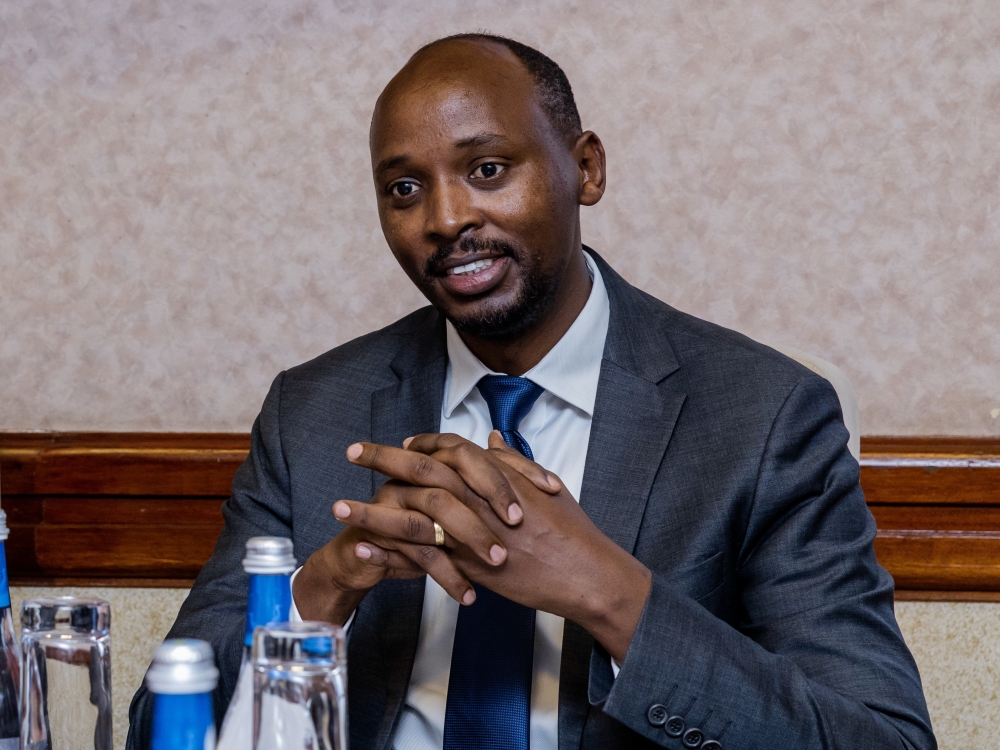
Dr. Diane Karusisi, CEO at Bank of Kigali explains that this is yet another milestone in the Bank’s digitization journey. 'The partnership with Veefin will help us boost efficiency and improve transparency in our loan processes. Our esteemed clients will be able to apply for any credit product using BK digital channels and will enjoy faster turnaround times,' she said.
Raja Debnath, Managing Director, Veefin Solutions said 'Bank of Kigali’s decision to partner Veefin’s advanced SCF and Digital Lending solutions underscores their commitment to innovation.
Africa and especially Rwanda is at the epicentre of technological adaptation and innovation, multiple banks in the region have shown significant interest in implementing Veefin’s solution, reflecting a broader trend towards adopting cutting-edge financial technologies to efficiency. Our partnership with Bank of Kigali will set new benchmarks in the continent for other lenders to follow'
About Bank of Kigali Plc
Bank of Kigali, established in 1966, is Rwanda’s leading financial institution dedicated to driving the nation’s economic growth.
Through its wide range of banking services catering to individuals, small and medium enterprises (SMEs), agribusinesses and corporate customers, the bank has played a pivotal role in fostering economic resilience, innovation and community development.
To meet the evolving customer needs, the bank embarked on a digital transformation journey and has set an ambition to become a leader in innovation and financial inclusion.
Bank of Kigali has been frequently recognized as the best bank in Rwanda by Global Finance Magazine, Euromoney and The Banker.
These accolades reflect our unwavering commitment to customer centricity and excellence in the banking sector.
With this collaboration, Bank of Kigali will become the first financial institution in the country to offer a fully digital, hyper-personalized experience to its customers.
Dr. Diane Karusisi, CEO of Bank of Kigali (left), highlighted the milestone of this partnership, aiming to boost efficiency and transparency in loan processes for their clients.
Bank of Kigali Plc have partnered with Veefin Solutions to pioneer digital lending innovation in Africa.
Raja Debnath, Managing Director, Veefin Solutions.
The prevalence of these disorders is on the rise, with the World Health Organization (WHO) indicating a 40% increase over the past 30 years globally.
Neurological disorders, which rank second in causing the highest number of deaths globally, include epilepsy, Alzheimer’s and Parkinson’s diseases, stroke, myopathies, paralysis, and many others.
WHO projects that by 2050, the prevalence of these disorders in Rwanda will have doubled.
Professional attention to these conditions in Rwanda began less than 20 years ago with the first specialized department established at Caraes Ndera in 2006 and another one at King Faisal Hospital (KFH) in April 2024.
At Caraes Ndera, approximately 70% of patients suffer from neurological disorders, resulting in long wait times for appointments up to five months.
To gain deeper insight into these disorders, their treatment, and Rwanda’s progress in training more specialists, IGIHE engaged Dr. Fidele Sebera, regarded as the pioneer of neurological treatment in Rwanda.
Dr. Sebera, a specialist in treating neurological disorders, introduced this field in Rwanda after undergoing specialized training in Senegal. He studied medicine at the former National University of Rwanda and specialized in neurology in Senegal. For over a decade, Dr. Sebera was the sole specialist in neurological treatment in Rwanda.
'At that time, I started discussions with the Brothers of Charity here in Ndera, who connected me with doctors from Ghent University in Belgium and the medical company Union Chimique Belge (UCB),' he recalls.
Collaborating with them, he arranged for Rwandan doctors to train in Senegal, where he had studied, to increase the number of specialists. Today, there are five such trained doctors.
Considering the growing concerns caused by these disorders, Dr. Sebera planned to sustainably increase the number of specialists.
In partnership with experts from Ghent and UCB, he developed a curriculum for neurology, now taught at the University of Rwanda.
'Currently, we have 11 students. The first cohort is in their second year, with six in their first year and five in their second year. We plan to admit another seven to ten students in the upcoming academic year (September 2024),' he noted.
There is hope that admitting students annually will provide a sufficient human resource to treat these disorders properly and ultimately neurology studies will deepen roots in Rwanda.
In support of his initiatives, the Government extended a scholarship to Dr. Sebera to study at Ghent University, where he earned a Ph.D. in 2023.
Previously, he had received various medical training, including in brain cancer and the general functioning of the brain, from France and Belgium.
'These services are now available in Rwanda. I initiated them after establishing the neurology department at Ndera,' he says.
Dr. Sebera chose this field because, upon completing general medicine, he noticed a lack of specialized doctors in neurology despite the prevalence of such conditions globally.
His passion was partly driven by observations during internships at various hospitals, where he saw many Rwandans with these disorders being inadequately treated.
'Among my peers, none were interested in specializing in this field because they feared it. That’s when I decided to encourage Rwandans to pursue this field,' he explains.
Neurological disorders are often overlooked and confused with mental illnesses like madness, but Dr. Sebera explains that there is a difference.
He says that neurological disorders have specific causes, such as brain tumors, which can be detected through medical examinations.
'For instance, epilepsy can be diagnosed using radio imaging to identify the cause, unlike other mental illnesses which has no proven cause.
18 years down the road, Dr Sebera admits that patients can now receive proper diagnosis and treatment, with quantifiable improvements in their conditions.
Though the journey is still far from over due to the limited number of doctors, there is a beacon of hope since these disorders are now recognized and people know where to seek treatment.
Factors contributing to these disorders include hormonal imbalance, brain tumors, strokes, and poor eating habits. Epilepsy, in particular, can be treated successfully if properly diagnosis is made in time, contrary to common myths that it’s as a result of witchcraft or demonic possession.
Dr. Sebera cautions on the abuse of illicit drugs, which significantly impact neurological health, preventing accidents as much as possible, and maintaining overall body health.
These are some of the latest machines brought to Rwanda, enabling doctors to examine patients’ brain issues more effectively.
Dr. Sebera, a specialist in treating neurological disorders, introduced this field in Rwanda after undergoing specialized training in Senegal.
The neurological department was introduced at King Faisal Hospital (KFH) in April 2024.
At Caraes Ndera, approximately 70% of patients suffer from neurological disorders, resulting in long wait times for appointments up to five months.
In an unexpected turn of events, Facebook, once a social media giant, has now become a platform for adult content.
This transformation raises numerous questions about the future of social media and the implications for users and the broader online community. Over the past few years, Facebook has experienced a significant decline in user engagement and a loss of public trust due to various controversies, including data breaches and the spread of misinformation.
In an attempt to revitalize the platform and attract a new user base, Facebook’s executives made the bold decision to pivot into the lucrative adult content industry.
The transition has been marked by the relaxation of Facebook’s content moderation policies, allowing explicit images and videos to be shared on the platform.
While this change has drawn criticism from some quarters, it has also attracted a surge of new users seeking an alternative to traditional adult websites.
Facebook’s entry into the adult content market has disrupted the industry, with established platforms struggling to compete with the social media giant’s vast resources and user base.
As a result, many smaller adult websites have been forced to close their doors, consolidating the market and potentially leading to a decline in content diversity.
Despite the controversy surrounding Facebook’s new direction, the platform’s transformation highlights the ever-evolving nature of social media and the internet as a whole.
As technology continues to advance, it is likely that we will see further shifts in the online landscape, with traditional social media platforms giving way to new forms of digital interaction.
In conclusion, Facebook’s metamorphosis into a porn website raises important questions about the role of social media in our lives and the future of online communication.
While the platform’s new focus may be divisive, it undoubtedly marks a new era in the world of adult content and serves as a stark reminder of the ever-changing nature of the internet.
The delegations last convened in Angola in March 2024, where they reached several resolutions, including the cessation of hostilities between the DRC’s armed forces and the M23 rebel group, which has been central to these conflicts, in order to restore security in the North Kivu province.
A statement signed by the foreign ministers of both countries at the time, called for mutual trust and the sharing of intelligence information to prevent any security threats to Rwanda and the DRC.
The DRC delegation agreed to present a plan to dismantle the FDLR rebel group in a subsequent meeting that was scheduled for April 2024.
It was agreed that if the DRC follows through on its commitment to dismantle the FDLR, the Rwandan government would also take measures to ensure Rwanda’s security.
However, shortly after these talks, Christophe Lutundula, the DRC’s Minister of Foreign Affairs, told reporters in Kinshasa that he and his government officials were unaware of the FDLR’s exact location, casting doubt on their willingness to fulfill their commitment.
The FDLR, which Lutundula claimed could not be located, is reportedly collaborating with the DRC’s armed forces in the fight against the M23, as corroborated by a UN Group of Experts report containing evidence and testimonies from Congolese soldiers.
The planned talks for April 2024 did not take place. However, both parties continued to communicate with the mediator, Angola, regarding the implementation of resolutions made since the first Luanda summit in 2022.
Although not part of the Luanda talks, in early July 2024, Rwanda’s Minister of Foreign Affairs and Cooperation, Amb. Olivier Nduhungirehe, and State Secretary for East African Community Gen (Rtd) James Kabarebe met with DRC’s Deputy Minister of Foreign Affairs, Gracia Yamba Kazadi, in Zanzibar, Tanzania.
Amb. Nduhungirehe explained that during their meeting, held on the sidelines of an East African Community retreat, both parties agreed that resuming the Luanda talks promptly was essential to finding a lasting solution to the conflicts between both countries.
In March 2024, it was anticipated that the April talks would prepare for a meeting between Rwandan President Paul Kagame and DRC President Félix Tshisekedi, facilitated by Angola. Both presidents had agreed to meet face-to-face.
Angola has beene a mediator since tensions between both countries erupted in 2022.
Delegations from Rwanda and DRC last convened in Angola in March 2024.
Since the launch of kidney transplant services in Rwanda last year, all 32 recorded cases requiring such surgeries have been successfully handled within the country, Dr. Sabin Nsanzimana, the Minister of Health, said
Introduced in May last year, the services are provided at King Faisal Hospital (KFH). The program began with three living donor kidney transplants in the same month, marking a significant milestone in the government's efforts to reduce expensive medical referrals abroad.
Prior to the introduction of these services, the government had referred close to 70 patients to other countries for kidney transplants at a cost of over Rwf 800 million.
Â
Minister of Health Dr Sabin Nsanzimana during the interview.Courtesy
A June 2023 article published by Rwandan doctors in the Rwanda Public Health Bulletin highlighted that while kidney transplants done abroad have provided Rwandan patients with survival opportunities, they are associated with significant financial implications.
These include travel costs, accommodation, medical procedures, and post-operative care, in addition to the usual expenses associated with transplants.
The cost of a kidney transplant in India, one of the cheapest treatment destinations, can range from $7,400 to $14,000 and depends on several factors including a patient's age, health, blood type compatibility, concomitant ailments, and hospital room preference. This does not take into account additional costs such as transportation.
The cost for transplants is higher when the procedure is carried out in nations like the US, UK, and Germany.
'This can place a financial burden on patients and their families. Other challenges include language and cultural barriers in a foreign country, as well as legal and ethical issues since the regulations and ethical practices surrounding organ transplantation vary across countries,' the article noted.
It further highlighted that patients who undergo kidney transplants abroad may face challenges in receiving follow-up care and ongoing management of their condition upon returning to their home country.
'Coordinating medical records, accessing necessary medications, and finding healthcare providers knowledgeable about the patient's specific transplant can be significant hurdles.
Lack of continuity of care is a major challenge faced by patients who get kidney transplants abroad due to the lack of skilled transplant specialists and infrastructure,' it stated.
Nsanzimana anticipates that with the ongoing enhancement of health services, the need for renal transplant transfers abroad will decrease. He also expects the referral of patients to other countries for various conditions to diminish, while more people from across the continent and beyond will come to Rwanda for treatment.
In March 2023, the parliament passed a law regulating the use of the human body, organs, tissues, cells, and products of the human body for therapeutic, educational, or scientific purposes, paving the way for lifesaving medical procedures, including kidney transplants.
The government, through the Ministry of Health, continues to upgrade KFH's infrastructure and equipment to enhance its capacity to perform kidney transplant procedures and various highly specialized medical services.
Nicolás Maduro's claim of victory in Venezuela's presidential election has brought the South American country to a hazardous standoff, with his thwarted opponents accusing him of rigging the election to remain in power, and many leaders in the region and beyond questioning the veracity and transparency of the vote.
Sunday's results, which followed an election described by independent observers as the most arbitrary in recent years â” even by the standards of the authoritarian regime founded by Maduro's mentor and predecessor, Hugo Chávez â” appeared to have dashed opposition hopes of ending a quarter of a century of chavista rule and economic turmoil.
After a six-hour delay in releasing the results prompted international concern, the government-controlled electoral authority claimed Maduro had won with 51.21% of votes compared with 44.2% for his rival, the former diplomat Edmundo González Urrutia.
The council said that with about 80% of votes counted, Maduro had secured more than 5m compared with González's 4.4m. Authorities delayed releasing the results from each of Venezuela's 30,000 polling stations, saying only that they would be released in the 'coming hours'.
On Monday morning, amid reports of the first post-election protests breaking out in and around Caracas, the electoral authority officially confirmed Maduro as the victor. 'I assume the mandate of the people to be their president and lead our country towards peace and prosperity,' Maduro told an audience of allies, calling the result 'irreversible'.
Critics blame Maduro, 61, for leading Venezuela into a crippling economic and social crisis, and turning the country into an increasingly repressive state where political opponents are routinely jailed and tortured.
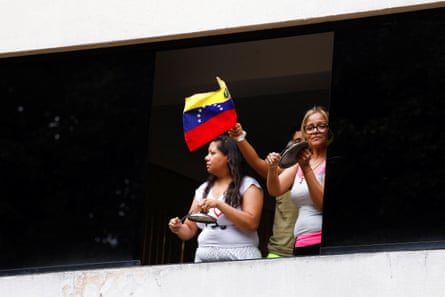
People bang on pot lids, after Venezuela awoke to political uncertainty after both president Nicolás Maduro and his opposition rival Edmundo González claimed victory in the presidential election. Photograph: Leonardo Fernández Viloria/Reuters
Addressing supporters in the capital, Caracas, Maduro dedicated his victory to Chávez, who anointed him as his successor shortly before his death in 2013. 'Long live Chávez. Chávez is alive!' Maduro shouted.
He added: 'I am Nicolás Maduro Moros â” the re-elected president of the Bolivarian Republic of Venezuela ⦠and I will defend our democracy, our law and our people.'
But the opposition camp was quick to dispute the results.
'The Venezuelans and the entire world know what happened,' González said in his first remarks.
The opposition leader, María Corina Machado â” who had thrown her weight behind González's campaign after being banned from running â” rejected the result, claiming the opposition had won in every single state.
'We won, and everybody knows it,' she said. 'We haven't just defeated them politically and morally, today we defeated them with votes,' Machado told journalists, claiming González should be considered the country's president-elect.
Edison Research, which conducts high-profile election polling in the US and other countries, published an exit poll showing González had won 65% of the vote, while Maduro won 31%.
'The official results are silly,' said Edison's executive vice-president, Rob Farbman, adding it stood by the results of its survey. Edison's exit poll was conducted nationwide with preliminary data from 6,846 voters interviewed at 100 polling locations. Local firm Meganalisis predicted a 65% vote for Gonzalez and just under 14% for Maduro.
The Carter Center, which sent a team of electoral observers for the vote, called on the electoral authority to immediately publish the complete results by polling station.
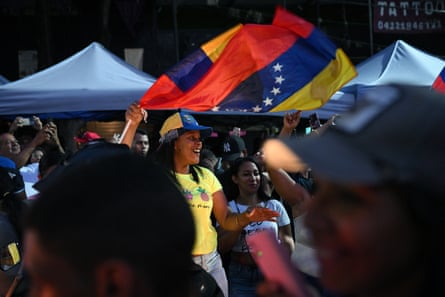
A supporter of Edmundo González Urrutia and Maria Corina Machado attends a rally demanding the closure of polling stations during the presidential election in Caracas on Sunday. Photograph: Federico Parra/AFP/Getty Images
Although Maduro's allies in countries such as Cuba, Bolivia and Honduras congratulated him on his victory, key players including the US, Spain and the EU expressed deep reservations about the election and its results.
Meanwhile, Paraguay, Argentina, Costa Rica, Ecuador, Guatemala, Panama, Peru, the Dominican Republic and Uruguay said they would request an emergency meeting of the Organization of America States to discuss the election.
The US secretary of state, Antony Blinken, said Washington had 'serious concerns that the result announced does not reflect the will or the votes of the Venezuelan people'.
He said the international community was watching the vote 'very closely' and would react accordingly.
'It's critical that every vote be counted fairly and transparently, that election officials immediately share information with the opposition and independent observers without delay, and that the electoral authorities publish the detailed tabulation of votes,' said Blinken.
Spain's foreign minister, José Manuel Albares, also called on the electoral authority to release voting information in the interests of 'respecting the democratic will' of the Venezuelan people.
'The people of Venezuela yesterday voted democratically and in very large numbers,' Albares told Spain's Cadena Ser radio on Monday morning. 'We want total transparency, and that's why we're asking for the results to be published, polling station by polling station. We don't have a candidate â” we just want a guarantee of transparency. The publication of polling station information is key so that the results can be verified.'
Josep Borrell, the EU's most senior diplomat, said the will of the Venezuelan people had to be respected, adding: 'Ensuring full transparency in the electoral process, including detailed counting of votes and access to voting records at polling stations, is vital.'
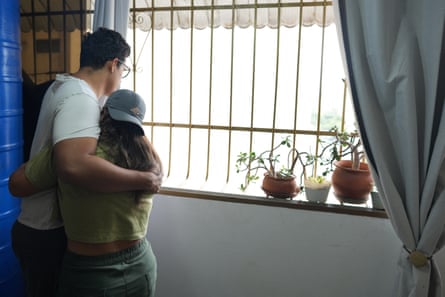
Engineer Nejcareth Paz, 32, hugs her boyfriend amid the unrest. Photograph: Alexandre Meneghini/Reuters
Many Latin American leaders, including Chile's leftist president, Gabriel Boric, were far blunter in their assessment of Sunday's vote.
'Maduro's regime must understand that the results are hard to believe,' Boric wrote on X. 'The international community and, above all, the Venezuelan people â” including the millions of Venezuelans in exile â” demand total transparency.' Chile, he added, 'will not recognise any result that is not verifiable'.
Panama's president José Raúl Mulino said his country was putting relations with Venezuela 'on hold' and would withdraw diplomatic staff from Caracas until a full review of the result is conducted.
Others were more cautious. Mexico's leftwing president Andrés Manuel López Obrador said he would only recognize a winner only after results were reported fully. 'We're going to wait until they finishing counting the votes,' López Obrador told reporters.
Brazil â” whose president, Luiz Inácio Lula da Silva, said recently he had been 'frightened' by Maduro's warnings of a 'bloodbath' if he lost the vote â” hailed a 'peaceful' election day in Venezuela but said it was keeping a close eye on the vote count.
Celso Amorim, a former foreign minister who is now Lula's chief diplomatic adviser, said the Brazilian government would only comment on the results after reviewing the records.
Amorim, who observed Sunday's vote, said that while he was still familiarising himself with what happened, 'the main issue is transparency'.
'The [Brazilian] government continues to monitor the situation until we have the necessary data to make an informed decision [on whether or not to recognise the results], as with any election,' he said in an interview with the Brazilian newspaper O Globo.
'It must be transparent. I'm not necessarily questioning what is being said, but the government was supposed to provide the records from which this number is derived, and that has not yet happened.'
González's campaign had generated a rare wave of optimism among millions of disillusioned citizens after a decade during which the economy of the country with the world's largest oil reserves contracted by 80% and nearly 8 million people â” almost a third of Venezuela's population â” fled abroad.
The number of property developers and architecture firms registered in the country over the last decade has grown significantly as property entrepreneurs seek to capitalize on this promising sector.
Johnson Bigwi is the founder of Futuristic Design Group (FDG) Africa, a local company which offers engineering services with a special focus on urban development. He told IGIHE in a recent interview that the sector has experienced exponential growth over the last decade, particularly in the architectural design of buildings emerging in Kigali and other parts of the country.
Futuristic Design Group (FDG) Africa offices in Gikondo, Kigali.
A graduate of Jomo Kenyatta University of Agriculture and Technology (JKUAT) in Nairobi, Bigwi ventured into real estate in 2014. At the time, he observed that most buildings shared a similar aesthetic design and this presented him with an opportunity.
'This gave us the chance to offer alternative, well-orchestrated designs and we have since grown to offer other services, including surveying and construction, to cater for the growing demands on the market,' Bigwi said.
Kigali-based architecture Johnson Bigwi. He ventured into real estate market in 2014
Despite the setbacks brought about by the Covid-19 pandemic, Rwanda’s economic is on a steady trajectory. This has led to a rising middle class with increased disposable income, creating a fertile ground for diverse real estate investments.
Boris Muhirwa, a project manager for DND Developers in Kigali, concurs that the demand for luxury apartments is on the rise.
Boris Muhirwa (l) is a project manager for DND Developers in Kigali.
A civil engineer with close to 15 years of experience, Muhirwa is currently overseeing the refurbishment of the Royal Golf View Apartment Hotel in Kigali’s upscale Kacyiru neighborhood. The 10-storey structure will encompass residential apartments, retail spaces, and a hotel upon completion.
He revealed that while the project is only a month old and has a two-year timeline, several clients have already placed bookings.
The 10-storey structure will encompass residential apartments, retail spaces, and a hotel upon completion.
'Previously, people were hesitant to pay upfront for something they had no input be it with design or execution. However, the industry has evolved, and clients now have more confidence in developers, allowing for installment payment plans,' Muhirwa said.
Beyond the traditional residential and commercial infrastructure, the Rwandan real estate market is experiencing robust growth fueled by a number of factors such as increased accessibility to financing through local financial institutions.
Government policies
Prince Hoffman Banamwana, a real estate marketer and founder of Quick Homes Rwanda, believes that investor-friendly policies and unmatched security have been instrumental in attracting foreign investment, thereby stimulating growth in the sector.
'The government policies have ensured one thing beyond reasonable doubtâ” safety,' says Banamwana, a social sensation renowned for his vibrant YouTube channel where he showcases houses for potential clients to buy.
According to him, once people feel safe, they are bound to stay or even engage in productive activities in a given area.
Government advertising initiatives such as Visit Rwanda have also opened up Rwanda’s tourism sector, promoting the hotel and hospitality industry.
'The government is doing us a great service by advertising the country through Visit Rwanda campaigns, such as the partnership with Arsenal and other teams, which attract people to visit. Once here, they often fall in love with the country and want to stay,' he added.
Banamwana observed that infrastructure development makes Rwanda an attractive destination for real estate investors. Investments in transportation, energy, and telecommunications are improving the business environment and supporting real estate development.
Beyond the current improvements, there is widespread consensus that there are substantial investment opportunities for real estate developers, particularly in affordable housing and high-rise buildings.
“The current market is unaffordable. It’s expensive across the board. Anyone investing in affordable housing here would tap into a significant market that could be supported by government initiatives,” Banamwana stated.
By and large, there’s a growing need to explore high-rise buildings due to limitations of available land, the demand for modern and amenity-rich living spaces, and the desire for efficient and sustainable urban development.
The real estate market in Rwanda is rapidly evolving as demand for residential and commercial housing continues to grow.
The outbreak of mpox in Rwanda comes barely two weeks after 25 cases of the viral infection were confirmed in Goma town, the Eastern Province Capital of the Democratic Republic of Congo (DRC).
The Government of Rwanda has since assured the general population that it is well-prepared to handle the outbreak. But what exactly is mpox?
According to the World Health Organization (WHO), the viral illness is caused by a virus known as the monkey pox virus.
This virus was first identified in Denmark in 1958 during a research study involving monkeys. The first known human case was of a young child who was diagnosed in 1970 in the DRC.
The infection is transmitted to humans through physical contact with contaminated materials, or with infected animals or other human beings.
Medics say that the mpox virus enters the body through inhalation of respiratory droplets, pores of the skin, and mucous membranes mainly found in the mouth, throat, eyes, genitals, or the rectum.
It also spreads easily within households through sexual intercourse amongst couples, with individuals having multiple partners being at increased risk.
Common symptoms include a rash or sores that can last several weeks, accompanied by fever, headache, body aches, fatigue, and swollen lymph nodes.
Preventive measures include avoiding close contact with individuals who have the virus. Vaccination is also effective in protecting those at high risk.
At the national level, the Ministry of Health says it will rely on advanced response systems and protocols to detect and contain the spread of the infection.
'Rwanda is well-prepared to handle a potential mpox outbreak, leveraging our experience and systems developed during previous health challenges like COVID-19,' Dr Edson Rwagasore, the Division Manager of Public Health Surveillance and Emergency Preparedness and Response at Rwanda Biomedical Center (RBC), told local media.
'We can now quickly test and confirm infections using advanced methods, including genomic sequencing, which is crucial for effective outbreak management,' he said.
Rwagasore says it is important to remain vigilant despite the measures instilling confidence in the country’s ability to manage potential health challenges, including mpox.
The infection is transmitted to humans through physical contact with contaminated materials, or with infected animals or other human beings.
IGIHE has learned that the experienced banker has been confirmed for the position and will begin her new role in August 2024. She will be based at NCBA Group’s headquarters in Nairobi, Kenya.
NCBA Group operates as an investment company with a presence in Kenya, Rwanda, Uganda, and Tanzania.
Higiro’s appointment is part of NCBA Group’s strategy to streamline operations across all its banks, benefiting both employees and customers. This approach allows employees to move between branches or to the headquarters, based on their skills and expertise.
Since 2018, under Higiro’s leadership, NCBA Bank Rwanda has experienced significant growth in assets and client loans. When she took over, the bank was grappling with a loss of Rwf2.5 billion but within three years, she transformed the bank into a new phase of profitability.
Statistics indicate that from 2019 to 2023, NCBA Bank Rwanda’s assets increased from Rwf35 billion to Rwf205 billion. Loans to clients rose from Rwf19 billion in 2019 to Rwf103 billion in 2023, while client deposits grew from Rwf21 billion to Rwf140 billion over the same period.
In March 2023, NCBA Group’s Chief Financial Officer, David Abwoga, noted that their fastest-growing bank is in Rwanda, with assets increasing by 56%.
Higiro played a crucial role in this growth by focusing on technological advancement and establishing effective operational frameworks that enhanced employee productivity. Her leadership also emphasized employee satisfaction, including providing maternal and partenal leave and creating a supportive work environment for mothers.
NCBA was the first bank to introduce a daycare and a mother’s room for breastfeeding, allowing mothers to work comfortably.
Similarly, fathers were granted 14 days of paternity leave, instead of the seven days mandated by law, which many employees say improved their ability to care for their families and increased workplace productivity.
She also launched the ‘Man Enough’ program, encouraging male employees to advocate for gender equality, making NCBA Bank Rwanda Plc the first to implement this initiative.
Recognizing the importance of mental health for productivity, Higiro initiated a program to support employees’ mental well-being, offering free services and access to psychological counsellors as needed.
In March 2023, NCBA Bank was awarded by the Government of Rwanda for its efforts in promoting gender equality and inclusivity among its employees.
In July 2023, Higiro introduced the need for mental health support programs for women in all workplaces to address issues such as gender-based violence and job loss due to pregnancy.
Higiro founded the Women In Finance Rwanda (WIFR) organization and serves as its CEO. The first WIFR agreement was signed in 2023 with the Chartered Institute for Securities & Investment (CISI) in the UK, providing scholarships to over 50 women.
WIFR also signed a partnership agreement with the Uganda Institute of Banking and Financial Services (UIBFS) in June 2024, aimed at training women in the financial services sector in Rwanda.
Higiro noted that this agreement would benefit over 13,000 women by providing essential knowledge.
In 2021, Higiro was among the top three finalists for the Angaza Award, recognizing women for impactful and skilled leadership in banking and financial services.
With extensive experience in banking operations, Higiro previously served as Chief Operating Officer at AB Bank Rwanda and Head of Planning and Marketing at I&M Bank. From 2007 to 2011, she served as Head of Banking Services for small and medium enterprises at Guaranty Trust.
Higiro holds a Master’s degree in Business Leadership from the University of Liverpool in the UK, a Bachelor’s degree from North-West University in South Africa, and a diploma in Business and Communication from Ryerson University in Canada.
Lina Higiro will begin her new role in August 2024. She will be based at NCBA Group’s headquarters in Nairobi, Kenya.
A war of words has broken out between Israel and Turkey after President Recep Tayyip Erdogan threatened his country could intervene militarily in Israel's war on Gaza.
Turkish and Israeli officials unleashed barbs at one another on Sunday and Monday after Erdogan said in a speech on Sunday that 'there is no reason' that Turkey could not act, noting military interventions made in the past in other countries.
While crude rhetoric between the two countries has been regular amid the war in Gaza, the threats and insults come as fears of a wider escalation rise once again.
Shortly after Erdogan's speech, Israeli Foreign Minister Israel Katz said in a post on X that the Turkish president was 'following in the footsteps' of former Iraqi dictator Saddam Hussein by threatening to attack Israel.
'Just let him remember what happened there and how it ended,' he wrote in reference to the Iraqi president's infamous 2003 capture by United States forces while hiding in a hole in the ground near a farmhouse in Tikrit. Hussein was later executed.
In retaliation, Turkey â” not for the first time â” compared Israeli Prime Minister Benjamin Netanyahu to Adolf Hitler.
'Just as genocidal Hitler ended, so will genocidal Netanyahu,' said the Turkish Ministry of Foreign Affairs.
'Just as the genocidal Nazis were held accountable, so will those who try to destroy the Palestinians,' the post continued. 'Humanity will stand by the Palestinians. You will not be able to destroy the Palestinians.'
'Humanity's conscience'
Erdogan, who has consistently issued strong rhetoric during Israel's 10-month war in Gaza, made the suggestion that Turkey could intervene militarily in a speech to his ruling Justice and Development (AK) Party on Sunday.
'We need to be very strong so that Israel cannot do these ridiculous things to Palestine. Just as we entered Karabakh, just as we entered Libya, we can do something similar to them,' he said.
Turkey, which backs the Tripoli-based government of Libyan Prime Minister Abdul Hamid Dbeibah, in 2020 sent soldiers to the fractured North African country to support its United Nations-backed administration.
In the breakaway region of Nagorno-Karabakh, over which Ankara ally Azerbaijan has fought for decades against Armenia, Turkey has denied engaging in any direct military operations.
But it has pledged support for Azerbaijan with 'all means', which has included military training and modernisation, along with the provision of advanced combat drones and other military equipment.
In a post on X on Monday, Turkish Foreign Minister Hakan Fidan boasted that Erdogan 'has become the voice of humanity's conscience'.
'International Zionist circles, especially Israel, who want to suppress this righteous voice, are in great alarm,' he wrote. 'History ended the same way for all genociders and their supporters.'
Turkey restricted some exports to Israel in April â” six months into the war on Gaza â” and said it halted trade with Israel altogether in early May.
Israel said it would scrap the country's free trade agreement with Turkey in retaliation, with Israeli Finance Minister Bezalel Smotrich signalling the move is reversible when Erdogan is replaced by a leader who is 'sane and not a hater of Israel'.