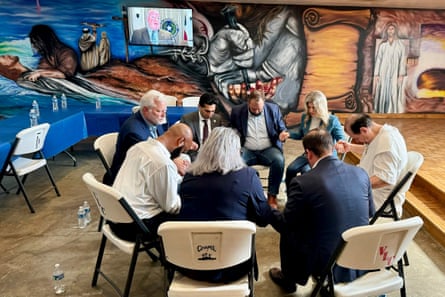
President Tshisekedi, on December 11, 2024, addressed both chambers of the Congolese Parliament, accusing Rwanda of repopulating North Kivu by replacing Congolese citizens with foreign nationals.
In an interview with DW, Minister Nduhungirehe expressed surprise at President Tshisekedi’s remarks, calling them dangerous and fueling xenophobia against Congolese Tutsi communities in Eastern DRC.
He questioned the logic behind the claim that Rwandans would leave their peaceful country to settle in North Kivu, a region where security is severely compromised by ongoing armed conflicts and violence from over 200 militia groups, including the FDLR and Wazalendo.
'It doesn’t make any sense to claim that Rwandan citizens would leave a country in peace for a war zone, where civilians are facing daily violence and ethnic persecution by a hundred local militias, including the Wazalendo, and by the FDLR genocidaires, supported by Kinshasa,' he noted.
Minister Nduhungirehe also deemed Tshisekedi’s statements irresponsible, especially on the eve of the Luanda talks scheduled for December 15.
These talks, aimed at addressing the security crisis in eastern DRC and the region, will be led by Angola’s President, who is also serving as the African Union (AU)-appointed mediator.
Both Tshisekedi and Rwanda’s President Paul Kagame are expected to participate in the discussions, with Angola emphasizing the potential for a lasting peace agreement.
Amb. Nduhungirehe clarified that the primary focus of the talks will be to ensure the DRC government is committed to engaging in direct negotiations with the M23, which represents the marginalized Congolese Tutsi community.
According to United Nations reports, over 1.45 million internally displaced persons have returned to North Kivu.
Rwanda has consistently rejected accusations from the DRC that it supports the M23 rebel group, calling such claims unfounded.
Instead, Rwanda has accused the DRC government of collaborating with the FDLR in the ongoing conflict in North Kivu, a group which poses a threat to Rwanda’s security.
Minister Nduhungirehe has rejected Tshisekedi’s claims of repopulating eastern DRC with Rwandans.
President Tshisekedi, on December 11, 2024, addressed both chambers of the Congolese Parliament, accusing Rwanda of repopulating North Kivu by replacing Congolese citizens with foreign nationals.
On a monthly basis, the general PPI rose 0.4 percent between May and June 2026.
The report, which tracks prices received by domestic producers across mining, manufacturing, and utilities, showed divergent trends between goods sold locally and those destined for export. The local PPI increased 20.6 percent year-on-year and 0.8 percent month-on-month, while the export PPI rose 29.2 percent annually but fell 3.3 percent from May to June.
Mining leads the surge
Mining and quarrying prices jumped 76.5 percent year-on-year and 2.9 percent month-on-month, making it the single largest driver of the overall increase despite accounting for only a small share of the general index by weight. In the export index, where mining carries a much larger weighting, the sector's growth was the dominant factor behind the annual gain.
A split picture for manufacturers
Manufacturing prices told two different stories depending on the market. For goods sold locally, manufacturing prices rose 19.3 percent year-on-year and 0.9 percent month-on-month, with beverages up 31.9 percent and food products up 20.3 percent over the year. Textiles were the exception, falling 7.2 percent annually.
For exporters, manufacturing prices moved in the opposite direction, falling 12.3 percent year-on-year and 9.8 percent month-on-month, with export food products down 15.2 percent annually.
Electricity, gas, steam and air conditioning supply prices rose 34.8 percent year-on-year, though they were unchanged on a monthly basis. Water supply and sewerage prices were flat both annually and monthly.
Why it matters
The Producer Price Index tracks the prices businesses receive for their goods before they reach consumers. Higher producer prices can eventually lead to higher prices for shoppers if companies pass on the extra costs.
The PPI is compiled using a monthly chained Laspeyres-type formula, with prices collected at the factory gate around the midpoint of each month. Weights are based on the value of output reported in the 2024 National Accounts.
Producer prices in Rwanda climbed 22.3 percent in June 2026 compared to the same month last year, driven largely by a sharp surge in mining prices, according to the latest Producer Price Index (PPI) report released by the National Institute of Statistics of Rwanda (NISR).
Yahya Sinwar, the Hamas leader who masterminded the 7 October attack on Israel that triggered the war in Gaza, has been killed by Israeli forces, Israel's foreign minister has said, ending a year-long hunt.
Katz confirmed reports on Thursday in a statement sent to counterparts around the world. The Israel Defense Forces (IDF) said almost immediately after Katz's statement was reported by Israeli media that Sinwar had been 'eliminated'.
His death represents a major boost to the Israeli military and the Israeli prime minister, Benjamin Netanyahu, after a string of high-profile assassinations of prominent leaders of its enemies in recent months.
The IDF said on Thursday afternoon it was checking whether Sinwar was one of three militants killed during a patrol in an unidentified area of Gaza, but that their identities could not yet be confirmed. By Thursday evening, it confirmed he had been 'eliminated', reportedly in Tel Sultan, a neighbourhood of Gaza's southernmost town, Rafah, on Wednesday.
The bodies were found by troops and taken to Israel for DNA and dental record testing.
Israel's Kan Radio reported that the Hamas leader had been killed 'by chance', and not as a result of intelligence gathering. The station also said the bodies were found with cash and fake IDs.
Graphic photos and video from the scene, broadcast on Israeli media, showed what appeared to be Sinwar's body, wearing fatigues, with a severe head injury, lying on a pile of rubble on the floor of a destroyed building.
Israel's Channel 12 reported that an infantry battalion, operating with a tank unit, had identified a group of men running into a building. The forces opened fire using tank shells, and the bodies were buried under the rubble.
It is not yet clear what impact Sinwar's killing would have on Israel's campaign in Gaza. Most analysts believe that Israel is now intent on a military occupation of the Strip for the foreseeable future.
It has long been believed that Sinwar had surrounded himself with Israeli hostages to lessen the likelihood of being killed. However, in a statement, the prime minister's office said that no hostages were believed to have been present.
Without citing a source, Israel's Channel 12 reported that Sinwar had been hiding with the six hostages whose bodies were recovered by the IDF in August after they were killed by their captors as Israeli troops approached.
Israel has spared no resources in its year-long hunt for Sinwar, engaging a taskforce of intelligence officers, special operation units, military engineers and surveillance experts under the umbrella of the Israeli Security Agency. Yet, in the end, he appears to have been killed by regular troops on patrol.
Sinwar considered himself an expert on Israel's military and politics. He spoke perfect Hebrew, learned during more than 20 years in Israeli prisons, and was the driving force behind Hamas's strategy of the past few years: to lull Israel into thinking the group had been deterred from fighting, before launching the surprise attack in which 1,200 people were killed and another 250 taken hostage.
Various western and Israeli intelligence assessments over the past year have suggested that Sinwar has long shunned electronic communication, relying on a network of couriers to communicate with the outside world from Hamas's vast network of tunnels beneath the Gaza Strip.
Those reports also said Sinwar had become 'fatalistic' after 12 months of intense warfare in which 42,000 Palestinians have been killed, believing he would die, but still hoping to ensnare Israel in a regional battle with Iran and allied groups around the Middle East, such as Lebanon's Hezbollah. It is unknown whether he thought or knew that the 7 October attack would trigger such a massive Israeli response.
Sinwar, 61, was born in the Khan Younis refugee camp in southern Gaza and grew up in poverty before studying at the Islamic University of Gaza, where he received a bachelor's degree in Arabic Studies.
Among his childhood friends were Mohammed Deif, Hamas's military chief, whom Israel claimed to have killed in an airstrike three months ago, and Mohammed Dahlan, an influential member of the secular Fatah party now living in exile in the UAE.
Sinwar joined Hamas at an early age, soon after the group's founding, spending much of his youth in and out of Israeli prison. He rose through the ranks as an infamous enforcer, in charge of finding and killing suspected Palestinian collaborators with Israel, and was instrumental in building the group's military capabilities.
In 1989, he was sentenced to four life sentences for the abduction and killing of two Israeli soldiers and four Palestinians he suspected of collaboration. He served 22 years, becoming a respected prison leader, and was treated for brain cancer in 2008.
Sinwar was released in the 2011 prisoner exchange in which Israeli soldier Gilad Shalit was returned for 1,000 Palestinians. He married on his return to Gaza and had three children.
The former prisoner was elected by other Hamas members in a secret ballot as Hamas's chief in Gaza in 2017, surviving several Israeli assassination attempts: famously, after the 2021 war between Hamas and Israel, he posed for photographs, grinning, on an armchair amid the ruins of his house. Unlike some senior Hamas leaders, he has never wavered from a belief that armed struggle is the only way to force the creation of a Palestinian state.
Israel said it came close to capturing or killing Sinwar in January, when it found DNA evidence of his presence in a bunker beneath Khan Younis, including clothing and more than 1m shekels (more than £200,000) in wads of banknotes. He was estimated to have left a few days before Israeli forces raided the bunker.
Israeli officials have suggested before that Sinwar has been killed, particularly after long stretches in which the leader went incommunicado. Last week, he reportedly made contact with Hamas members in Qatar after another period of silence.
In a statement, Israel's Hostage Families Forum said: 'The Forum commends the security forces for eliminating Sinwar, who masterminded the greatest massacre our country has ever faced, responsible for the murder of thousands and the abduction of hundreds.
'However, we express deep concern for the fate of the 101 men, women, elderly and children still held captive by Hamas. We call on the Israeli government, world leaders, and mediating countries to leverage the military achievement into a diplomatic one.'
The prosecutor's office of the international criminal court in The Hague announced it was seeking arrest warrants for Sinwar, Deif and Haniyeh in May. All three men are now believed to have been killed.
For months, frustrated American officials looking to end the war in Gaza have mused quietly about the one scenario they believed could loosen deadlocked ceasefire talks: the death of Hamas leader Yahya Sinwar, believed to be hiding deep underneath Gaza in the group's network of tunnels.
Whether that is what transpires over the coming days remains an open question.
Despite all the unknowns, the moment was viewed inside the White House and across President Joe Biden's administration as a momentous one.
Sinwar's killing has the potential to transform a conflict that long ago became a drag on Biden's political fortunes â” and by extension Vice President Kamala Harris's campaign.
Even with Sinwar's death, there is virtually no expectation the wider Middle East conflict will be resolved before Election Day on November 5, particularly as Israel prepares to retaliate against Iran's ballistic missile attack from earlier this month. For many voters, negative views of the conflict have hardened after a year of fighting. Yet any development that could allow for a lowering of the regional temperatures would be welcome, both inside the White House and at Harris' campaign headquarters.
In the end, after a year-long, multi-agency manhunt involving the latest technology, Israel's best special forces and American assistance, Yahya Sinwar appears to have been killed by regular soldiers who had stumbled into him and had no idea whom they had killed.
According to the initial reports, they were not there on an assassination operation and had no prior intelligence that they could be in the vicinity of the elusive Hamas leader, architect of the 7 October attacks, the man Israel most wanted to kill. It was only after they took a closer look at his face and found identity documents on him that the troops realised they had got Sinwar.
Along the way, Israel Defense Forces (IDF) have smashed much of Gaza and are estimated to have killed more than 42,000 Palestinians, driving two million from their homes, a humanitarian disaster Sinwar set in motion with the sheer brutality of the initial surprise assault a year ago, killing 1,200 Israelis and taking 250 hostage.
Sinwar's last reported sighting had been just a few days after the 7 October attack, when he appeared out of the subterranean gloom in a Gaza tunnel when a group of hostages were been held.
In fluent Hebrew, perfected over more than 22 years in an Israeli prison, Sinwar reassured them that they were safe and would soon be exchanged for Palestinian prisoners. One of the hostages, Yocheved Lifshitz, an 85-year-old veteran peace campaigner from the Nir Oz kibbutz, had no time for his show of concern for their welfare and challenged the Hamas leader to his face.
'I asked him how he wasn't ashamed to do something like this to people who had supported peace all these years?' Lifshitz told the Davar newspaper after her release following 16 days in captivity. 'He didn't answer. He was quiet.'
A video recorded on Hamas security cameras at about the same time, on 10 October, and found by the Israeli military some months later, shows Sinwar following his wife and three children through a narrow tunnel and disappearing into the murk.
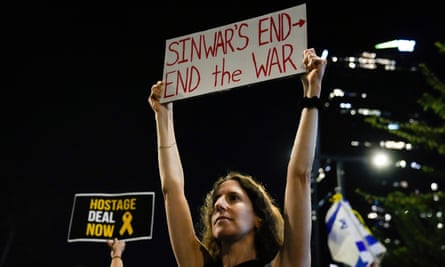
Protesters in Tel Aviv on Thursday call for a ceasefire deal and the immediate release of hostages held by Hamas. Photograph: Ariel Schalit/AP
The ferocious manhunt that ensued involved a mix of advanced technology and brute force, as his pursuers have shown themselves prepared to go to any lengths, including causing extremely high civilian casualties, to kill the Hamas leader and destroy the tight circle around him.
The hunters were a taskforce of intelligence officers, special operation units from the IDF, military engineers and surveillance experts under the umbrella of the Israeli Security Agency, more widely known by its Hebrew initials, or by the acronyms Shabak or Shin Bet.
Personally and institutionally, this team was seeking redemption for the security failures that allowed the 7 October assault to happen. But despite their motivation, they faced more than a year of frustration.
'If you'd told me when the war began he would still be alive [a year later], I would have found it amazing,' said Michael Milshtein, a former head of the Palestinian affairs section in Israeli Military Intelligence (Aman). 'But remember, Sinwar prepared for a decade for this offensive and IDF intelligence was very surprised by the size and length of the tunnels under Gaza and how sophisticated they were.'
Some in the Israeli defence establishment believed that Sinwar would be surrounded by hostages as human shields, though others maintained that would slow him down and make his entourage a bigger target. Certainly the risk of killing hostages did not stop the IDF dropping 2,000lb bombs on suspected Hamas leadership targets. In the end, the Israelis reported finding no sign of hostages in the vicinity of Sinwar when he was killed, who seems to have been in the company of just two other men.
There was no shortage of expertise among Sinwar's pursuers. Targeted killings have been a core tactic of Israel's military since the founding of the state. Since the second world war, Israel has assassinated more people than any other country in the western world.
Yahalom, a special section within the Combat Engineering Corps, has more experience in tunnel warfare than any of its counterparts in western armies, and has access to state-of-the-art US-made ground-penetrating radar. The clandestine signals intelligence unit 8200 is a global leader in electronic warfare and has been eavesdropping on Hamas communications for decades.
The Shin Bet lost many of its sources in Gaza after Israel pulled out of the territory in 2005, but worked hard to rebuild its network of informants after Israel launched its ground invasion last October, recruiting from among the desperate flows of Palestinians fleeing the onslaught.
Despite the capabilities of this formidable taskforce, it came close to catching Sinwar just once before Thursday's fatal encounter, in a bunker beneath his home town of Khan Younis in late January. The fugitive warlord had left behind clothing and more than 1m shekels (over £200,000) in wads of banknotes. This was seen by some as a sign of panic, though the Hamas leader was ultimately estimated to have left a few days before Israeli forces raided the bunker.
The assumption made by Sinwar's trackers was that he had abandoned using electronic communication, well aware of the skills and technology possessed by his hunters. It was not only Hebrew that Sinwar studied in Israeli jail but also the habits and culture of his enemy.
'He really understands the basic instincts and the deepest feelings of Israeli society,' said Milshtein, now at the Moshe Dayan Center for Middle Eastern and African Studies at Tel Aviv University. 'I'm quite sure every move he makes is based on his understanding of Israel.'
Throughout his year in hiding, Sinwar continued to communicate with the outside world, albeit with apparent difficulty. The long, fruitless negotiations over a ceasefire in Cairo and Doha were frequently paused while messages were sent to and from the subterranean commander. The dominant theory was that Sinwar uses couriers to remain in command, drawn from a small and shrinking coterie of aides he trusts, starting with his brother Mohammed, a senior military commander in Gaza.
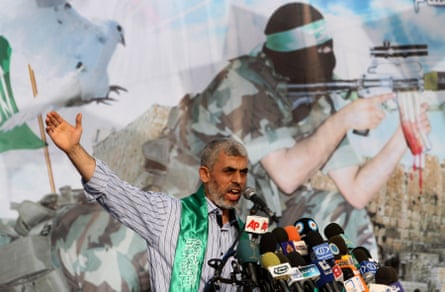
Yahya Sinwar addresses a rally in Khan Younis, Gaza, in 2011. Photograph: Hatem Moussa/AP
The team hunting Sinwar hoped that his need for contact with couriers, to issue orders and control the hostage negotiations, would ultimately prove his undoing, just as a courier led American trackers over several years to Osama bin Laden's hideout in Abbottabad, Pakistan.
It is believed that it was a courier who led the Israeli hunters to their biggest scalp of the war before Sinwar. At 10.30am on 13 July, Mohammed Deif, Hamas's veteran commander who had topped Israel's most wanted list since 1995, emerged from a hiding place near a camp for displaced people at al-Mawasi to take in some air with a close lieutenant, Rafa'a Salameh. Within an instant, both men were killed by bombs dropped by Israeli jet fighters – at least, according to IDF accounts – along with scores of Palestinians. Hamas insists that Deif is still alive but he has not been seen since.
Many in the Israeli security establishment rued what they saw as a missed historic opportunity in September 2003 when they had planes ready to bomb a house where the entire Hamas leadership was holding a meeting. After furious argument in the military chain of command, the air force used a precision missile fired into the presumed meeting room rather than flattening the whole building with a hail of bombs, out of concern for civilian casualties. They picked the wrong room and the Hamas leaders survived.
By July this year, the likelihood of killing large numbers of civilians was no longer an obstacle. In targeting Deif, the air force used 2,000lb bombs, the very weapons the Biden administration had stopped sending in May because of their indiscriminate destructive force. Israel reportedly dropped eight of them on 13 July. Ninety Palestinians in the vicinity were killed and nearly 300 injured.
Yossi Melman, a co-author of Spies Against Armageddon and author of other books on Israeli intelligence, said Deif may have made a mistake that Sinwar had avoided.
'Deif was maybe more arrogant or maybe he told himself they tried to kill me so many times, and I lost an eye and an arm but I still survived, so maybe God is with me,' Melman said. 'The Shabak and the army were waiting just for this opportunity. All these targeted killings are about waiting for the one minor mistake by the other side.'
There was some talk over the negotiating tables in Cairo and Doha of the past year of cutting a deal in which Sinwar went into exile, and some suggested that he could have crossed the border, hiding in a tunnel on the Egyptian side of the town Rafah. Such theories underestimated the ideological zeal of a man who rose through Hamas ranks as the executioner of suspected informers.
Milshtein, whose job in the Aman military intelligence service was to study Sinwar and other Hamas leaders, predicted months before his eventual death: 'It is in his basic DNA to stay in Gaza and to fight until death. He will prefer to die in his bunker.'
In that case, Sinwar got his wish. His death was perhaps preordained by the sheer determination of both sides. He would never leave or surrender, and if the hi-tech intelligence-led hunt for him failed, Israel preferred to flatten Gaza until he was finally killed.
Whether his death will stop the war is another question.
Ram Ben-Barak, a former deputy director of the Mossad, had predicted that after Sinwar's fall 'someone else will come'.
'It is an ideological war, not a war about Sinwar,' Ben-Barak said.
Milshtein said: 'After almost 50 years of assassinations, we understand this is a basic part of the game. Sometimes it is necessary to assassinate a very prominent leader. But when you start to think it will be a gamechanger and that an ideological organisation will collapse because you kill one of its leaders, that is a total mistake.
Israeli media revealed Thursday that the Israeli army killed Yahya Sinwar, the political leader of Hamas, 'by chance' and during 'routine sweeps,' without relying on intelligence information.
Reports indicated that Sinwar, Israel's top target, was killed during a field confrontation, where he was dressed in full military uniform, contradicting previous Israeli claims that he had been hiding among Israeli prisoners in tunnels for months in tunnels in the Gaza Strip.
Earlier Thursday, the army said, in cooperation with the Shin Bet security agency, it carried out dozens of operations in recent months, which restricted Sinwar's movements and eventually led to his death.
It added that a unit from the 828 Brigade spotted and killed three Hamas members during a clash in southern Gaza. After completing DNA tests, it was confirmed that Sinwar was among the dead.
The army said Sinwar was killed Wednesday, but his body was only discovered after the area was searched Thursday.
Although the military did not specify the location of Sinwar's death, Israeli media reports suggested the operation took place in the southern city of Rafah.
'Killed in routine sweeps'
The Yedioth Ahronoth newspaper reported that a force from the army's Bislach unit was conducting a routine sweep in Rafah, where they suspected that figures were inside a building later found to be booby-trapped.
The report said the unit fired artillery rounds and heavy gunfire at the building, killing three Hamas members without knowing that Sinwar was among them.
After a while, the soldiers began to sweep the building. Two grenades were thrown â”one exploded, the other did not, according to the report.
'The troops pulled back and sent a drone, which detected an injured figure, face covered, sitting in a room and attempting to knock the drone out of the air with a stick.'
When soldiers approached the bodies of the Palestinian fighters, they noticed that one of them bore a strong resemblance to Sinwar, according to the newspaper.
The Haaretz newspaper echoed Yedioth Ahronoth's report, stating that Sinwar's death was 'by chance.'
'There was no intelligence indicating Sinwar's presence; what happened was by chance,' it said.
Â
Sinwar's belongings
Israel's Channel 12 shared a photo of Sinwar's belongings found after his death, which included prayer beads, two small prayer books, a passport, bullet, small flashlight, mint candy, nail clipper and cash.
There were no Israeli hostages with Sinwar, the channel reported, contradicting claims from Israeli security agencies.
Israeli media aired videos showing Sinwar after his death, dressed in full military uniform.
'Ready for combat'
Israel's official public broadcaster claimed that Sinwar's death followed increased military pressure on Hamas leaders in southern Gaza in recent weeks
The broadcaster alleged that the intensified pressure forced Sinwar to frequently move between locations in southern Gaza, leading him to be ready for a direct confrontation with Israeli forces.
It noted that Sinwar's constant movement explained his readiness for combat, as he was armed and wearing military gear.
Sinwar reportedly engaged Israeli forces from inside a building rigged with explosives, indicating he was ready for a direct confrontation, which contradicted previous intelligence claims that he had surrounded himself with Israeli hostages.
As of 1930 GMT, Hamas had not confirmed or denied the Israeli military's claims regarding Sinwar's death.
Israel's announcement of Sinwar's killing comes more than two months after he was selected as the leader of Hamas' political bureau.
On Aug. 6, Hamas announced that Sinwar was chosen to succeed Ismail Haniyeh as its political chief after Haniyeh was assassinated in Tehran on July 31, in an attack attributed to Tel Aviv, though Israel has not officially acknowledged responsibility.
Israel views Sinwar as the mastermind behind the Al-Aqsa Flood operation, carried out by Palestinian factions, including Hamas and Islamic Jihad, against Israeli settlements and military bases near Gaza on Oct. 7, 2023.
The attack caused significant human and military losses for Tel Aviv and tarnished the international reputation of its security and intelligence agencies.
As a result, Israel declared that eliminating Sinwar was a top priority in its current war on Gaza.
Earlier, Israel's Channel 12 revealed that Shin Bet had formed a special unit to assassinate Sinwar.
Israel has continued a brutal offensive on Gaza following a cross-border attack by the Palestinian resistance group, Hamas, last October, despite a UN Security Council resolution calling for an immediate cease-fire.
More than 42,400 people have since been killed, mostly women and children, and over 99,100 injured, according to local health authorities.
The Israeli onslaught has displaced almost the entire population of Gaza amid an ongoing blockade that has led to severe shortages of food, clean water and medicine.
Israel faces a genocide case at the International Court of Justice for its actions in Gaza.
The Texas supreme court has blocked the execution of a man on death row in a late-night ruling on the day of the scheduled lethal injection.
Robert Roberson, 57, was convicted of killing his two-year-old daughter more than two decades ago, but his supporters across the US and the lead detective on the case have insisted he is innocent and that the case rested on junk science.
A committee of more than 80 Texas lawmakers, including at least 30 Republicans, had asked the parole board and governor to stop the execution and had subpoenaed Roberson to testify next week in a last-ditch effort. A judge in Travis county, Texas, blocked the execution late on Thursday afternoon, less than two hours before it was scheduled to take place at the Texas state penitentiary in Huntsville, so Roberson could testify.
The Texas court of criminal appeals overturned that ruling late on Thursday evening, but the lawmakers appealed, and the state supreme court sided with them, issuing an injunction at about 10pm.
Roberson spent hours in a cell by the prison's death chamber as during his case appeal and his execution seemed imminent.
'He was shocked, to say the least,' said the Texas department of criminal justice spokesperson Amanda Hernandez, who spoke with Roberson after the court stayed his execution. 'He praised God and he thanked his supporters. And that's pretty much what he had to say.'
She said Roberson would be returned to the Polunsky unit, about 45 miles (72km) to the east, where the state's male death row is located.
Gretchen Sween, Roberson's lawyer, said he was celebrating the fact that he 'lives to fight another day'.
'The vast team fighting for Robert Roberson â” people all across Texas, the country, and the world â” are elated tonight that a contingent of brave, bipartisan Texas lawmakers chose to dig deep into the facts of Robert's case that no court had yet considered and recognized that his life was worth fighting for,' Sween said in a statement.
The Texas representatives Joe Moody and Jeff Leach, who orchestrated Roberson's subpoena and have championed his cause, praised the court's decision in a written statement. 'We look forward to welcoming Robert to the Texas capitol, and along with 31 million Texans, finally giving him â” and the truth â” a chance to be heard,' they wrote.
The case has drawn national outrage as Roberson's lawyers have insisted that no crime occurred and that medical records show his daughter died of pneumonia that progressed to sepsis.
Roberson brought his daughter Nikki Curtis to hospital in Palestine, Texas, on 31 January 2002. He told doctors that she was ill with fever and had fallen from a bed.
Curtis was 'not breathing and had a blue color to her skin', court documents cited by Time said, and was rushed to another hospital in Dallas, Texas. She was pronounced dead and doctors suspected abuse, finding that her injuries were in keeping with symptoms of shaken baby syndrome.
The syndrome is a condition in which a baby or small child is shaken repeatedly, resulting in their brain hitting the inside of their skull. Medics noted that Roberson was unemotional, further stoking abuse suspicions, and on 1 February 2002, authorities charged Roberson with capital murder.
The American Association of Pediatrics said in 2020 that shaken baby syndrome had been 'misinterpreted' by legal and health authorities. A neurosurgeon who helped create the hypothesis has said his work was distorted and that cases have been misdiagnosed. US civilian and military courts have exonerated at least 30 people in shaken baby syndrome cases since 1992, CNN reported.
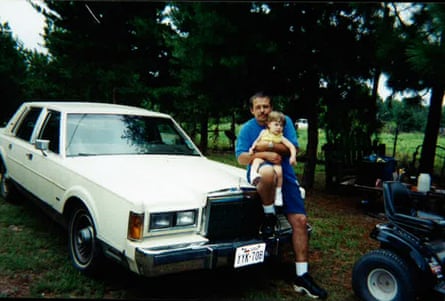
Robert Roberson with his daughter. Photograph: Courtesy of Gretchen Sween
Roberson's attorneys contend that his case is among the wrongful convictions. They cite medical experts who say Curtis's death stemmed from severe viral and bacterial pneumonia.
They say her dire medical condition worsened when she was given medication that is now considered improper for children. They contend that hospital staff's immediate shaken baby syndrome determination â” which they based on brain swelling and bleeding as well as bruises â” amounted to misdiagnosis.
Roberson's emotionless comportment was not a sign of culpability but rather due to his autism which was not diagnosed until 2018, his supporters also said. He insisted on his innocence in an interview with CNN.
'It wasn't a crime committed,' Roberson said. 'I was falsely, wrongly convicted of a crime â” they said it was a crime, but it wasn't no crime and stuff because I had a sick little girl, you know?'
Roberson received custody of Curtis two months before her death. He did not know about the girl until she was born, CNN said.
Curtis's maternal grandparents had had custody, but they ultimately agreed that he should have custody. Roberson said that he picked up Curtis from her grandparents' house and brought her home.
Roberson said he turned on a movie and that they both fell asleep in the same bed. But Roberson said he woke after hearing Curtis's cries and saw her on the ground.
There was blood on the girl's lips and a bruise below her chin, which Roberson cleaned up. Roberson said that he stayed awake for several hours to make sure the toddler was all right and fell asleep again. In the morning, she was not responsive, CNN quoted him as explaining.
'I carried her to the hospital and stuff, you know,' Roberson told the network. 'I didn't have nothing to hide.'
Texas lawmakers meet Robert Roberson at a prison in Livingston, Texas. Photograph: AP
Roberson's supporters include the Innocence Project, autism advocacy organizations and the celebrated legal novelist John Grisham, CNN notes.
Brian Wharton, the lead detective who testified against Roberson, has said he now believes the prosecution had been based on a fallacy. Last year, he told the Guardian: 'There was no crime scene, no forensic evidence. It was just three words: shaken baby syndrome. Without them, he would be a free man today.'
Roberson's lawyers had petitioned for his sentence to be commuted to a lesser punishment or that he be given a postponement to allow more time for litigating appeals.
But the Texas pardons and parole board on Tuesday failed to recommend that the Republican governor, Greg Abbott, grant clemency, Roberson's lawyers said in a statement. Abbott rarely grants clemency petitions. The US supreme court has rejected Roberson's appeals for a delay, though Justice Sonia Sotomayor has urged the governor to grant a 30-day delay.
In an interview last year, Roberson told the Guardian: 'I hope and pray that God gives them the knowledge for the people to make a righteous decision. I know I didn't do it. I'm not guilty. So I'm at peace with the Lord.'
The global football governing body issued the statement on Friday after the Union of European Football Associations (UEFA), the Asian Football Confederation (AFC) and CONCACAF rejected plans that could allow private investors to acquire a minority stake in a new commercial venture known as FIFA Forward Enterprise (FFE).
The backlash has intensified into one of the biggest governance disputes in recent FIFA history, with confederations representing 143 of FIFA's 211 member associations now opposing the proposal.
UEFA, which represents 55 national associations, warned that none of its member nations would take part in FIFA competitions if the proposal proceeds.
In a strongly worded statement, European football's governing body said the World Cup 'cannot be treated as an investment product' and accused FIFA of developing the proposal without meaningful consultation.
'No UEFA national teams will participate in any FIFA competition for so long as these proposals remain alive, unless this proposal has been abandoned in its entirety,' UEFA said.
CONCACAF, which represents 41 member associations across North America, Central America and the Caribbean, also rejected the proposal, while the AFC, representing 47 associations, called for an urgent review of FIFA's governance and decision-making processes.
The AFC said proposals of such global significance should be developed through 'transparent governance, timely consultation, informed deliberation and genuine participation.'
FIFA, however, insisted the proposal has been misunderstood and denied suggestions that it was seeking to sell ownership of football's flagship tournaments.
'We have heard the feedback provided by the respective confederations in relation to the proposed establishment of FIFA Forward Enterprise and would like to address the issues that have surfaced,' FIFA said.
The organisation maintained that FFE is intended to give member associations greater opportunities to benefit from football's commercial growth.
'FFE has been proposed solely to ensure that all FIFA Member Associations have the opportunity to take meaningful ownership of the commercial opportunity of football in their respective countries,' the statement said.
'Nobody is selling football. This is not something FIFA would ever entertain.'
Despite the widespread criticism, FIFA said it would proceed with a consultation process, arguing that all member associations should have the opportunity to examine the proposal before making a decision.
The controversy deepened further after Carlos Cordeiro, a senior adviser to FIFA president Gianni Infantino and a former president of the United States Soccer Federation, resigned in protest.
'As a senior advisor to the FIFA president, a former banker, and a lifelong football fan, I cannot stand by while FIFA considers selling a stake in the World Cup,' Cordeiro said.
'I oppose it unequivocally. It is a bad deal for FIFA's Member Associations, a bad deal for football, and a bad deal for the long-term future of the game.'
The proposed commercial venture has reportedly attracted interest from an investor group led by Thrive Eternal, founded by Joshua Kushner, with plans to acquire a minority stake should the project receive approval.
Critics argue that bringing private investors into FIFA competitions would fundamentally change the governance of world football by placing commercial returns ahead of sporting interests. They also fear investor pressure could encourage FIFA to stage larger and more frequent international tournaments, placing additional strain on domestic leagues and players.
With Europe's governing body threatening to boycott FIFA competitions and support for the proposal weakening across multiple confederations, the governing body's plans now face their most significant challenge since they were first revealed.
For now, FIFA insists the consultation process will continue, but the growing resistance suggests any attempt to reshape the commercial future of the World Cup is likely to face a difficult path.
FIFA has defended its controversial proposal to create a commercial entity linked to the FIFA World Cup, insisting that 'nobody is selling football' despite mounting opposition from some of the sport's most powerful governing bodies.
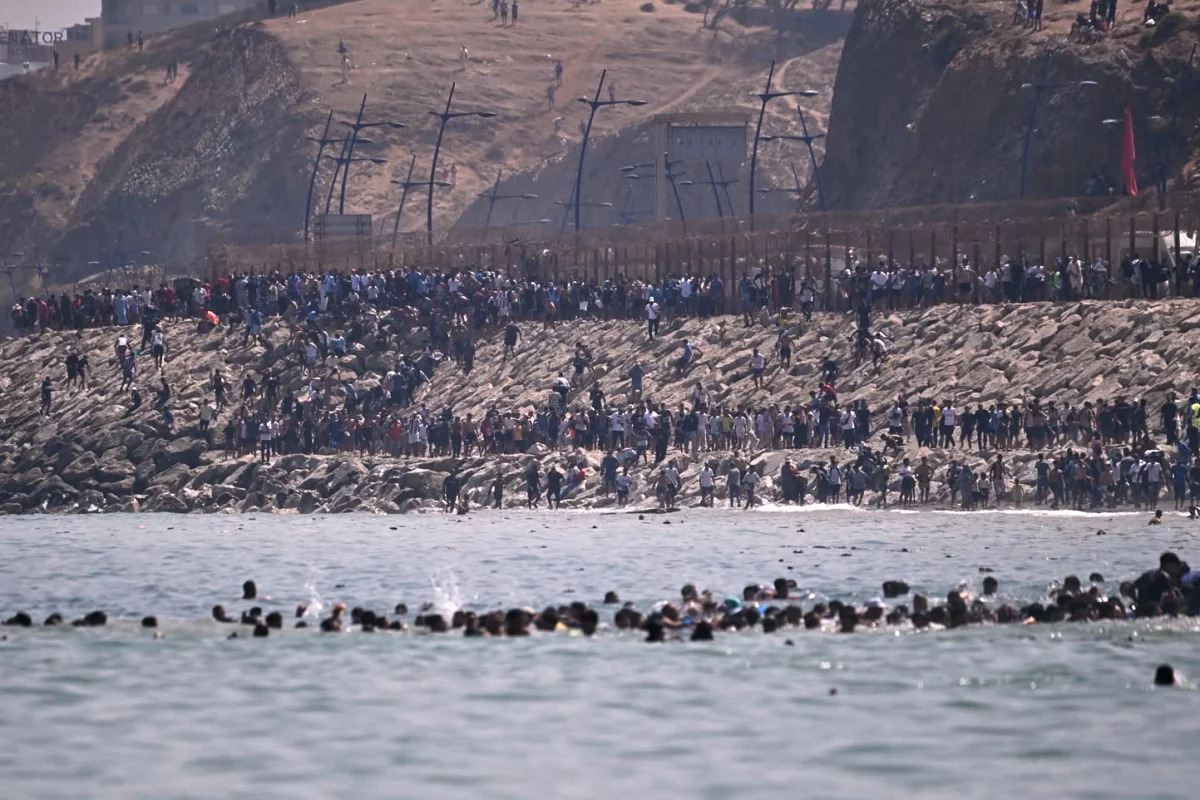
Spanish Prime Minister Pedro Sanchez described the incident as 'a violation of Spain's territorial integrity.'
Most of the victims drowned while attempting to swim around the El Tarajal border breakwater separating Morocco and Ceuta, according to the Spanish authorities.
Sanchez traveled to Ceuta on Friday together with Spanish Interior Minister Fernando Grande-Marlaska to inspect the situation. During the visit, he announced new measures to strengthen border security, including the installation of floating barriers near the El Tarajal breakwater to prevent further sea crossings.
He also pledged to accelerate the identification and return of irregular migrants, thanked Morocco for its cooperation in border management and repatriation, and vowed to intensify efforts against human trafficking networks.
Migrants try to cross from Morocco into the Spanish enclave of Ceuta, Friday, July 31, 2026.
The Spanish government has reinforced security in Ceuta by deploying additional National Police officers, Civil Guard personnel and military units, while emergency reception facilities remain under heavy pressure.
The Spanish authorities estimate that around 50,000 migrants have entered Ceuta over the past two days, making it one of the largest irregular migration crises ever recorded on the enclave's border.
Migrants cross from Morocco into the Spanish enclave of Ceuta, Thursday, July 30, 2026.
For HarakaPlus, a transit-tech startup born in Rwanda, that everyday experience sparked a bigger question about how technology can help people move through cities with greater confidence.
Founded by Millicent Kariuki, CEO and co-founder, alongside Bilen Gebremariam and Germain Rwibutso, HarakaPlus uses real-time bus tracking and passenger-demand data to help commuters plan journeys while giving transport operators insights to improve efficiency.
Since launching its minimum viable product in 2025, the platform has been accessed by nearly 2,000 users, with close to 500 people using it repeatedly each day.
The company's journey from a local idea to being selected among the innovators shortlisted for the Royal Academy of Engineering's Africa Prize for Engineering Innovation in 2026 offers lessons for entrepreneurs seeking to turn practical challenges into solutions with wider potential.
HarakaPlus was co-founded by Millicent Ruguru Kariuki (pictured), Chief Executive Officer, alongside Bilen Gebremariam, Chief Operating Officer, and Germain Rwibutso, Chief Technology Officer.
Building on Kigali's mobility progress
HarakaPlus emerged in a city that has already invested heavily in improving public transport and advancing its smart city ambitions.
The founders were not seeking to replace existing systems, but to complement them by using data to strengthen the connection between commuters, operators and the services they rely on.
'HarakaPlus was born from a problem that all three of us co-founders have experienced personally. Although we come from different backgrounds and grew up in three different African cities, we all shared one common experience: spending too much time waiting for public transport without knowing when it would arrive,' Kariuki told IGIHE.
'When we moved to Kigali, we saw many of the same challenges. While Rwanda has made tremendous investments in modernising public transport and building one of Africa's leading smart cities, there was still an information gap between commuters and transport operators,' she added.
The gap was not necessarily about the availability of transport, but about access to information. Passengers wanted to know when buses would arrive, while operators needed better insights into passenger demand and route performance.
'We discovered that this wasn't simply a transport problem; it was a time problem. Every unnecessary minute spent waiting is time taken away from work, school, family or running a business,' she said.
That understanding shaped HarakaPlus' mission of using data to make public transport more predictable.
The startup uses real-time bus tracking and passenger-demand data to help commuters plan journeys while giving transport operators insights to improve efficiency.
From an idea to the Africa Prize stage
The platform allows commuters to track buses in real time and estimate arrival times, while transport operators receive data that can support better planning and service delivery.
The approach earned HarakaPlus a place among 16 innovators shortlisted for the Africa Prize for Engineering Innovation, making it the only startup from
Rwanda in the 2026 cohort
The shortlist features innovators working on solutions across sectors including healthcare, renewable energy, agriculture, education and mobility.
For Kariuki, the programme came at a critical stage as HarakaPlus worked to grow from a promising idea into a sustainable company.
'We applied to the Africa Prize because we recognised that building a transformative mobility company requires much more than funding. We were looking for world-class mentorship, investor readiness support, engineering expertise and access to a network of people who have successfully scaled impactful businesses,' Kariuki explained.
Through the eight-month programme, HarakaPlus has received training, mentorship and exposure to experts across Africa and the United Kingdom.
A major highlight was learning from transport systems abroad, including the UK, where the team observed how technology, operators and public institutions collaborate to improve mobility.
Since launching its minimum viable product in 2025, the platform has been accessed by nearly 2,000 users, with close to 500 people using it repeatedly each day.
A journey still underway
Although HarakaPlus has already reached the shortlist stage, the Africa Prize journey is not over.
The company remains in contention for the final stage, where the overall winner will receive £50,000, while three finalists will each receive £10,000 and another innovator will receive £5,000 under the One-to-Watch category.
Kariuki said winning the top prize would help accelerate HarakaPlus' growth by supporting product development, expanding the engineering team, strengthening partnerships with transport operators and supporting expansion into other East African markets.
However, she stressed that the programme's value extends beyond the competition itself.
'Beyond the formal programme, becoming part of a community of innovators solving real challenges across Africa has been incredibly inspiring,' she remarked.
Opening doors for Rwanda's innovators
The Africa Prize is now accepting applications for its 2027 edition, inviting engineers and innovators across sub-Saharan Africa to submit solutions with the potential to create social or environmental impact.
Applicants must be developing scalable solutions with a clear path towards commercialisation. Software-based innovations must demonstrate a functional minimum viable product and user traction, while hardware solutions require working prototypes.
For Kariuki, innovators should not wait until they believe their ideas are fully developed before seeking opportunities to grow.
'You don't need to have everything figured out before applying. The Africa Prize exists to help innovators grow,' she said.
Applications for the 2027 Africa Prize for Engineering Innovation opened on July 13 and will close on September 8, 2026.
'The Africa Prize community continues to grow and each year we're seeing increased engagement from innovators across the continent, reflecting the depth and diversity of engineering talent in sub-Saharan Africa. This year, we're focused on building new connections in regions where awareness of the Prize is still growing, to broaden our reach and support even more innovations with the potential to scale and make a lasting difference,' Meredith Ettridge, Associate Director, International, at the Royal Academy of Engineering.
The Africa Prize programme, now in its 13th cycle, has supported more than 180 businesses from 24 countries.
Interested applicants can find more information and submit their applications at africaprize.raeng.org.uk.